
How to Heat Acid and Alkali Liquids Using Electromagnetic Induction Heating
Table Of Contents
How to Heat Acid and Alkali Liquids Using Electromagnetic Induction Heating
- Introduction
- Challenges of Heating Acid and Alkali Liquids
- What Is Electromagnetic Induction Heating
- Working Principle of Induction Heating for Chemical Liquids
- Induction Heating System Design for Acid and Alkali Pipelines
- Typical Heating Solutions for Corrosive Liquids
- Double-Layer Pipeline Heating
- Induction Heating of Chemical Reactors
- Induction Heated Circulation Pipelines
- Advantages of Induction Heating Compared to Traditional Methods
- Industrial Applications
- Engineering Design Considerations
- Safety and Maintenance
- Frequently Asked Questions (FAQ)
Q1. Can induction heating be used for strong acids?
Q2. What materials are suitable for induction-heated pipelines?
Q3. Is induction heating more energy-efficient than steam heating?
Q4. Can induction heating control temperature precisely?
Q5. Is induction heating safe for chemical plants?
1. Introduction
Acid and alkali liquids are widely used in industries such as chemical processing, metallurgy, electroplating, pharmaceuticals, and wastewater treatment. In many processes, these corrosive liquids must be heated to maintain reaction temperature, improve fluidity, or accelerate chemical reactions.
Traditional heating methods such as steam heating, electric heating rods, and thermal oil systems often face problems including corrosion, scaling, heat loss, and safety risks. Electromagnetic induction heating provides a modern alternative that can efficiently and safely heat corrosive liquids without direct contact with the heating element.
2. Challenges of Heating Acid and Alkali Liquids
Heating corrosive liquids presents several technical challenges:
| Challenge | Description |
| Strong corrosion | Acids and alkalis can rapidly corrode metal components |
| Leakage risk | Damaged heating elements may cause chemical leakage |
| Uneven heating | Traditional heaters may create hot spots |
| High maintenance | Frequent replacement of heating elements |
| Safety concerns | Direct-contact heating increases accident risk |
To overcome these issues, many industries are adopting indirect induction heating systems.
3. What Is Electromagnetic Induction Heating
Electromagnetic induction heating is a process that generates heat in conductive materials through electromagnetic fields.
When high-frequency alternating current passes through an induction coil, it creates an alternating magnetic field. This magnetic field induces eddy currents inside conductive materials such as steel, graphite, or metal reactor walls.
These induced currents generate heat due to electrical resistance within the material.
Key characteristics of induction heating include:
- Non-contact heating
- Rapid heating speed
- High energy efficiency (up to 90%)
- Accurate temperature control
- Clean and environmentally friendly
4. Working Principle of Induction Heating for Chemical Liquids
The heating process typically occurs in the following steps:
- The induction power supply converts grid electricity into high-frequency alternating current.
- The high-frequency current flows through an induction coil or flexible heating cable.
- The coil generates a high-frequency alternating magnetic field.
- The magnetic field penetrates the outer pipe or reactor wall.
- Eddy currents are induced in the conductive material.
- Electrical resistance converts these currents into heat.
- The heat transfers through the pipe wall to the acid or alkali liquid inside.


This process allows the liquid to be heated indirectly and safely.
5. Induction Heating System Design for Acid and Alkali Pipelines
A typical induction heating system for corrosive liquids consists of the following components:
| Component | Function |
| Induction power supply | Generates high-frequency AC power |
| Induction coil or flexible heating cable | Produces electromagnetic field |
| Heating pipe or reactor wall | Converts electromagnetic energy to heat |
| Corrosion-resistant liner (PTFE) | Protects against chemical corrosion |
| Temperature sensors | Monitor system temperature |
| Control system | Automatically regulates heating power |
| Thermal insulation | Reduces heat loss |
The induction coil or flexible heating cable is typically installed outside the pipe or reactor.
6. Typical Heating Solutions for Corrosive Liquids
Several structural designs are used to heat acid and alkali solutions safely.
1. Double-Layer Pipeline Heating
Structure:
- Outer layer: conductive pipe (steel or graphite)
- Inner layer: PTFE or corrosion-resistant lining
The outer layer absorbs induction heat and transfers it to the liquid.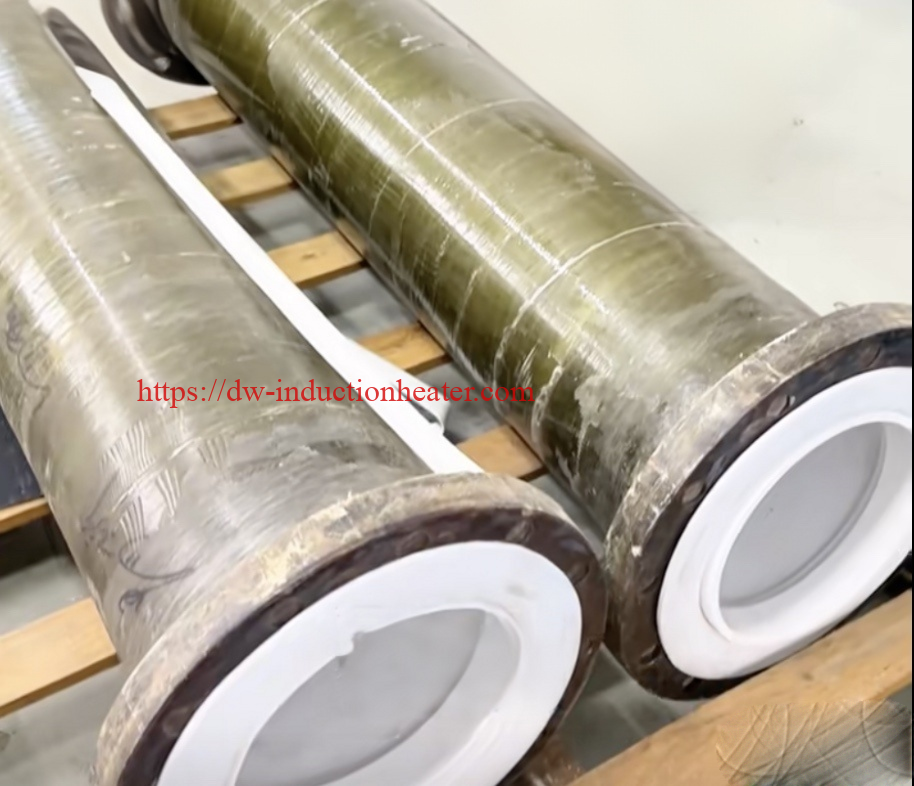
2. Induction Heating of Chemical Reactors
For reactors:
- Insulation blanket wraps around the reactor surface.
- Flexible induction heating cables are wound around the insulation layer.
- The reactor wall generates heat through electromagnetic induction.


3. Induction Heated Circulation Pipelines
In continuous processes, induction heating can be applied to:
- chemical circulation pipelines
- transfer pipes
- heat tracing systems
This maintains stable temperature during fluid transport.
7. Advantages of Induction Heating Compared to Traditional Methods
| Parameter | Induction Heating | Steam Heating | Electric Resistance |
| Heating speed | Very fast | Moderate | Slow |
| Energy efficiency | High | Medium | Medium |
| Contact with liquid | No | Indirect | Direct |
| Maintenance cost | Low | High | Medium |
| Temperature control | Precise | Limited | Moderate |
| Environmental impact | Clean | Steam emissions | Moderate |
Induction heating is particularly advantageous for corrosive chemical processes.
8. Industrial Applications
Induction heating for acid and alkali liquids is widely used in:
- Chemical processing plants
- Steel pickling lines
- Electroplating factories
- Lithium battery material production
- Pharmaceutical manufacturing
- Wastewater treatment facilities
- Petrochemical refineries
Typical heated liquids include:
- sulfuric acid
- hydrochloric acid
- phosphoric acid
- sodium hydroxide solutions
- chemical reaction mixtures
9. Engineering Design Considerations
When designing an induction heating system for corrosive liquids, engineers should consider:
| Design Factor | Recommendation |
| Pipe material | Use corrosion-resistant liners |
| Heating frequency | Select according to pipe thickness |
| Thermal insulation | Reduce heat loss |
| Temperature control | Use PID control system |
| Safety protection | Include leak detection sensors |
Proper system design ensures stable and safe operation.
10. Safety and Maintenance
Induction heating systems are generally safe but still require proper maintenance.
Important safety practices include:
- Regular inspection of insulation materials
- Monitoring temperature sensors
- Checking electrical connections
- Ensuring proper grounding
- Installing emergency shutdown systems
Routine maintenance greatly extends system service life.
11. Frequently Asked Questions (FAQ)
Q1. Can induction heating be used for strong acids?
Yes. Induction heating does not directly contact the liquid, so strong acids such as sulfuric acid and hydrochloric acid can be safely heated using corrosion-resistant pipeline structures.
Q2. What materials are suitable for induction-heated pipelines?
Common materials include:
- carbon steel
- stainless steel
- graphite pipes
The inner layer is usually lined with PTFE or other corrosion-resistant materials.
Q3. Is induction heating more energy-efficient than steam heating?
Yes. Induction heating typically achieves 85–95% energy efficiency, which is significantly higher than traditional steam heating systems.
Q4. Can induction heating control temperature precisely?
Yes. Modern induction systems use digital control systems and temperature sensors that allow precise temperature regulation.
Q5. Is induction heating safe for chemical plants?
Yes. Because it is a non-contact heating method, induction heating reduces leakage risks and improves operational safety in corrosive chemical environments.
12. Conclusion
Electromagnetic induction heating provides an efficient, safe, and environmentally friendly solution for induction heating acid and alkali liquids in modern industrial processes. By using induction coils or flexible heating cables to generate heat in conductive pipes or reactor walls, this technology eliminates direct contact between heating elements and corrosive fluids.
With advantages such as high efficiency, precise temperature control, and low maintenance costs, induction heating is becoming an increasingly popular choice for chemical industries that require reliable heating solutions for corrosive liquids.
As industrial demand for energy-efficient and corrosion-resistant technologies continues to grow, electromagnetic induction heating will play a critical role in future chemical process heating systems.