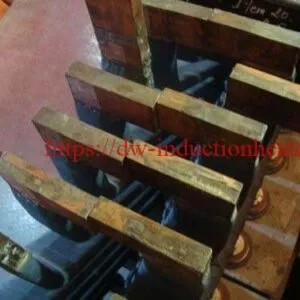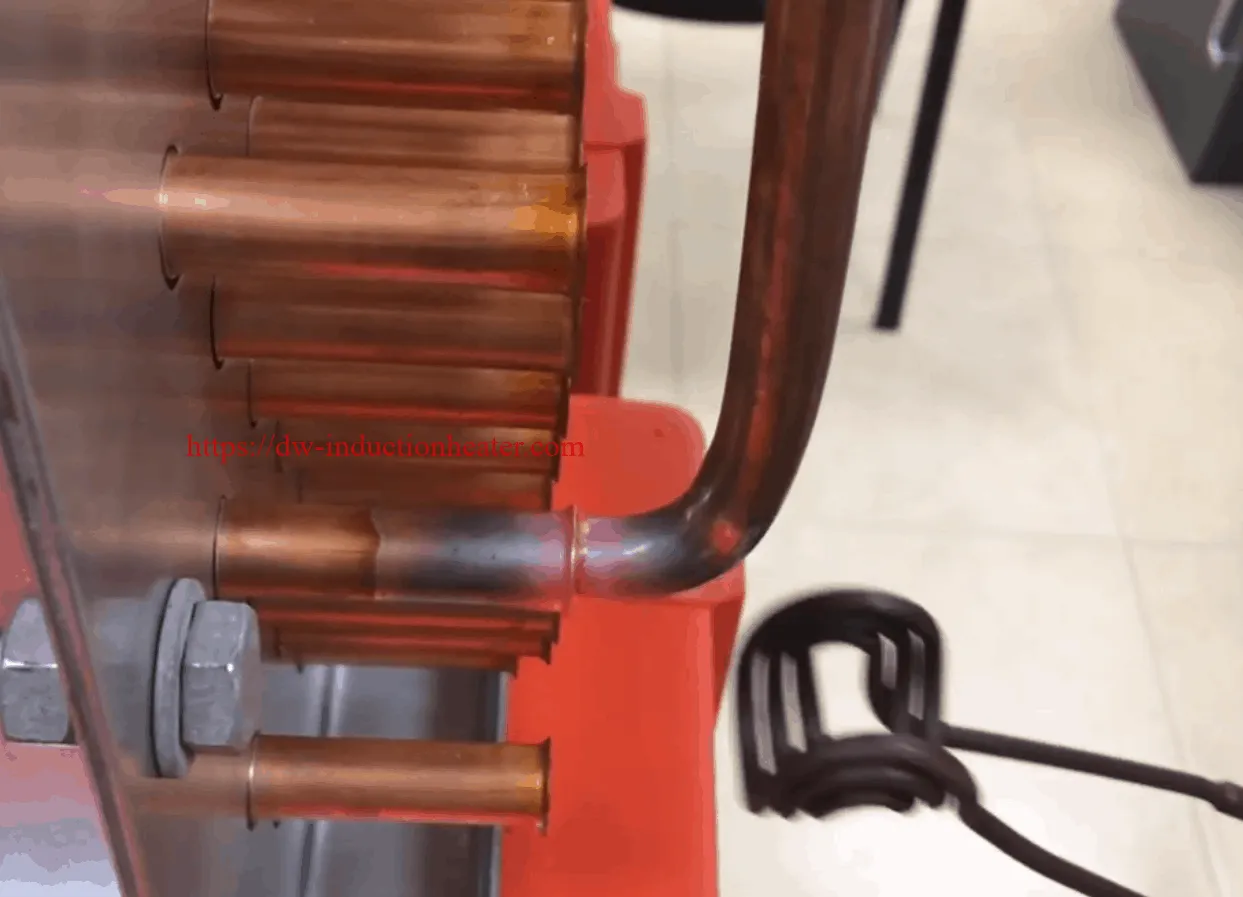
Induction Brazing Heat Exchanger Copper Tubes
Induction Brazing Heat Exchanger Copper Tubes | 5 Sec Joint
What Is Induction Brazing for Heat Exchanger Copper Tubes?
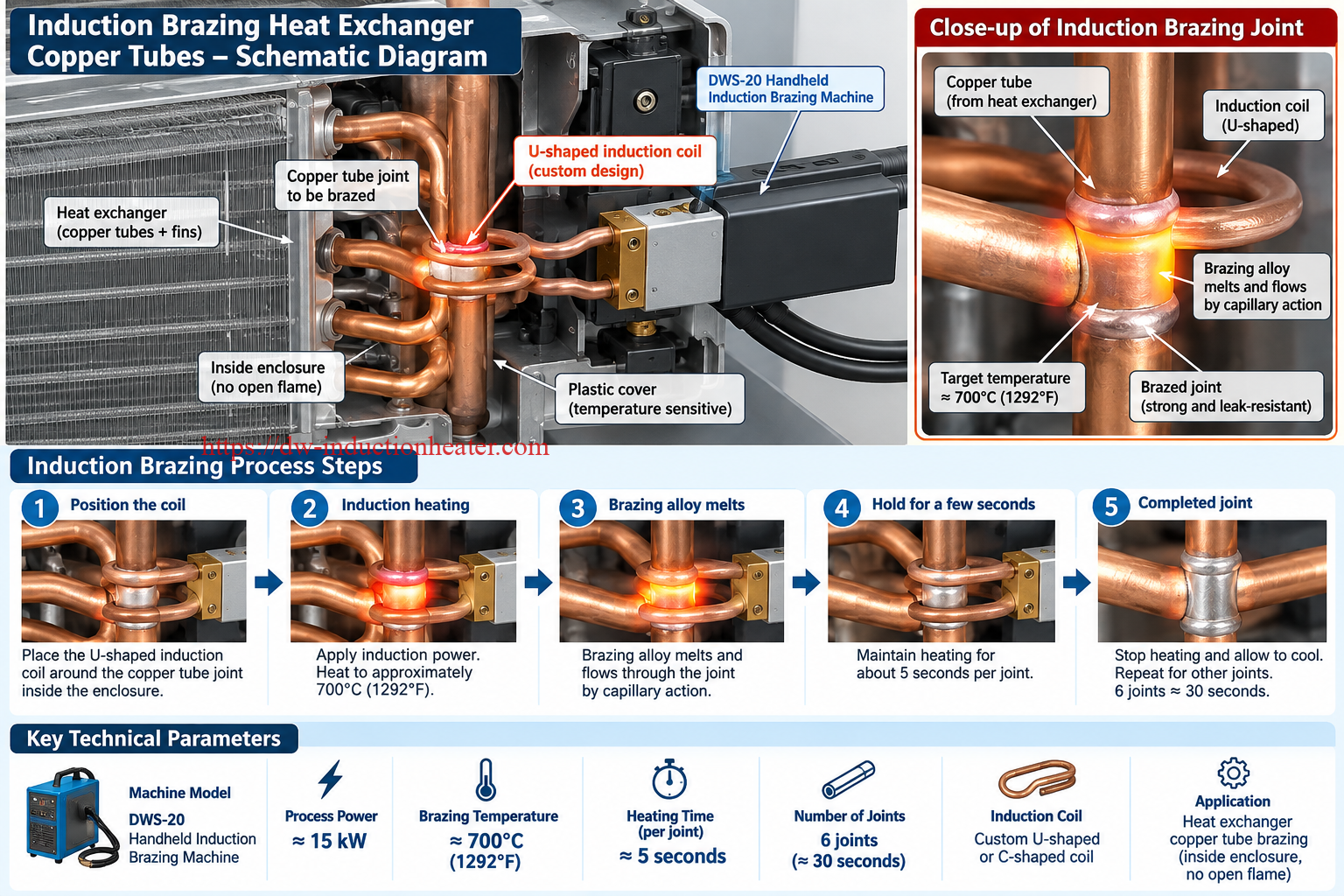
Induction brazing heat exchanger copper tubes is a fast, localized and flame-free process that uses electromagnetic energy to heat the copper joint until the brazing alloy melts and flows by capillary action.
Objective
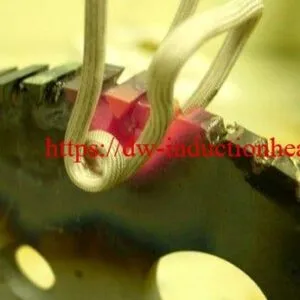
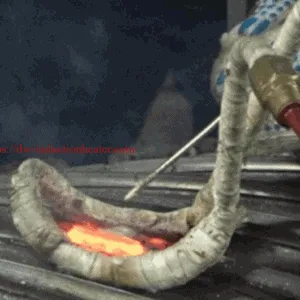
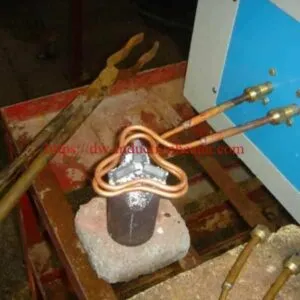
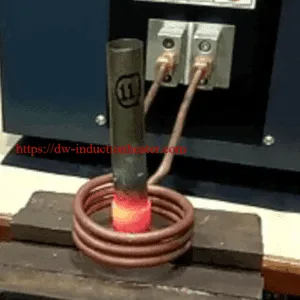
Induction brazing copper pipe of heating exchanger assembly using stationary C coil or U shape induction heating system.
Target speed for assembling all 6 joints was 30 seconds, or approximately 5 seconds per joint.
The requirement was to braze all of the joints inside the housing without affecting the plastic covers.
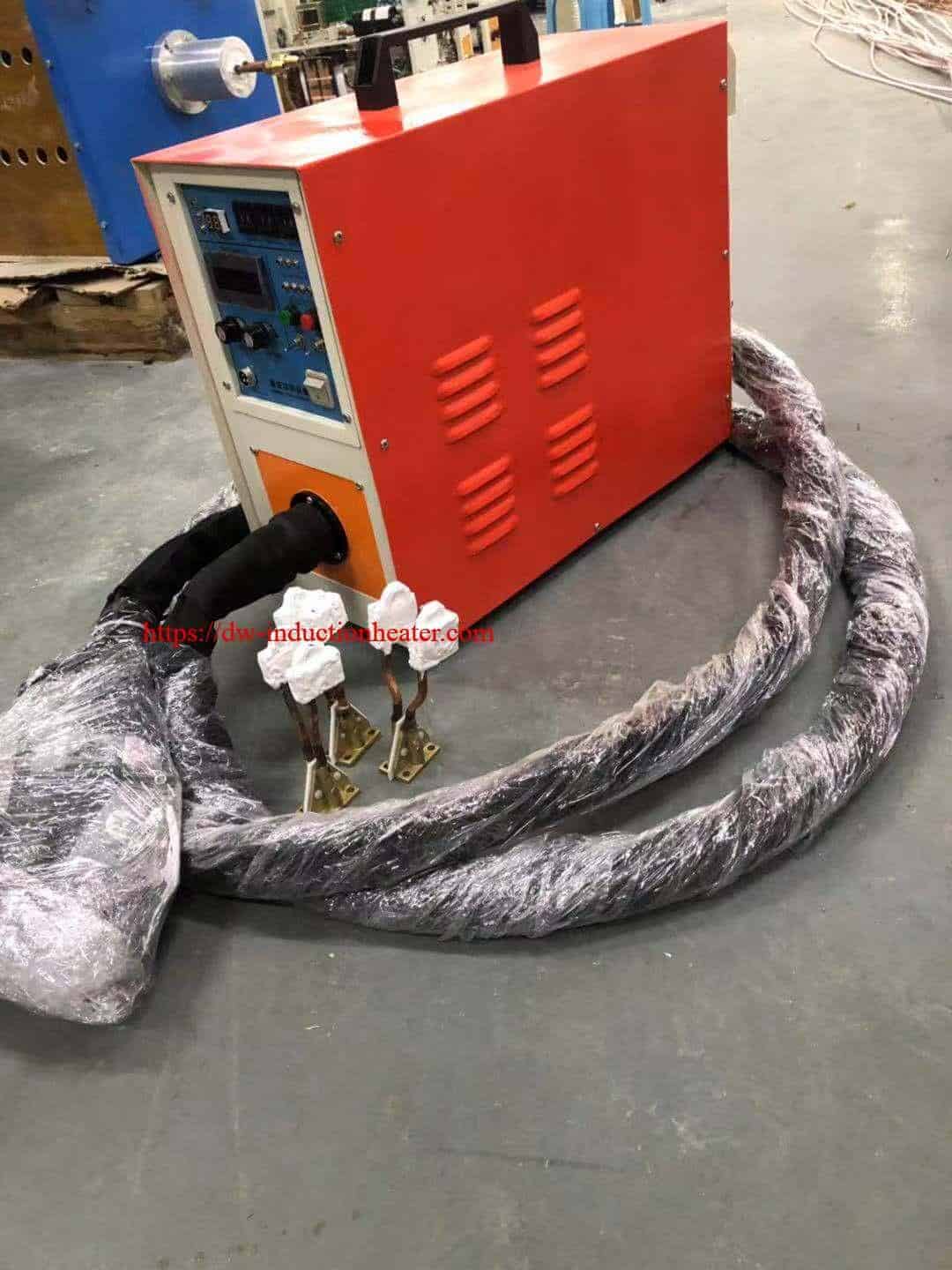
Equipment
DWS-20 handheld induction brazing machine
Materials
• Copper tubing
• Brazing flux
Key Parameters
Temperature: Approximately 1292°F (700°C)
Power: 15 kW
Time: 5 sec per joint
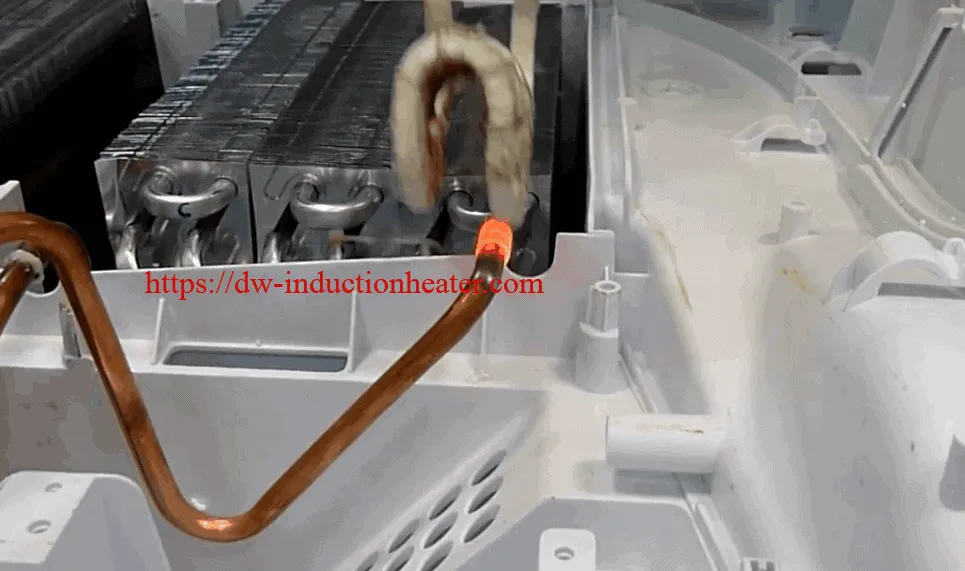
Process:
U shape custom coil is suitable for induction brazing of custom samples.
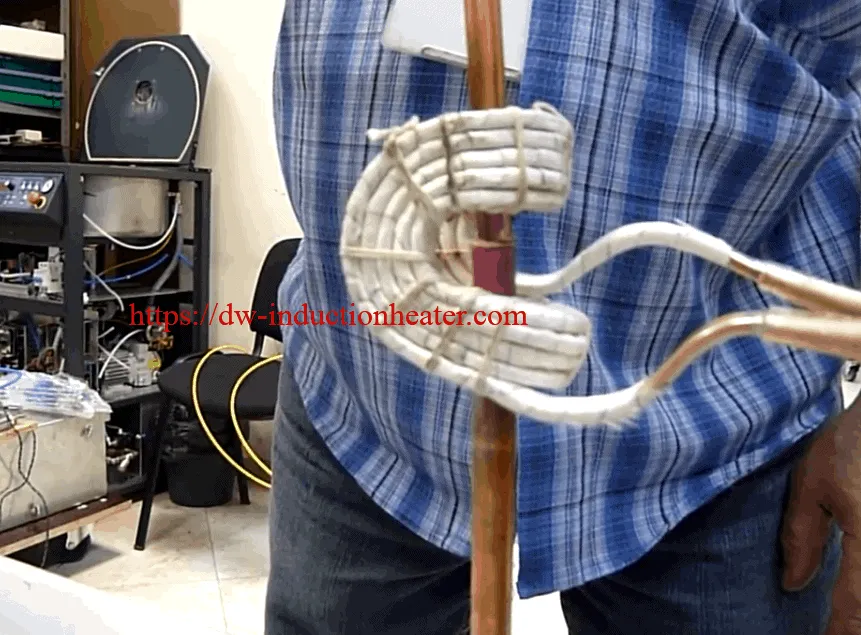
Results/Benefits:
Prior to induction brazing copper pipe, the customer was using flame brazing and had to braze the joints outside of the enclosure.

With the induction brazing, they were able to achieve the following benefits:
- Braze inside the enclosure
- Improve productivity of the brazing operation
- Precise control of the time and temperature
- Safe heating with no open flames
- Higher energy efficiency


Why Use Induction Heating for Heat Exchanger Brazing?
Copper conducts heat very quickly, so controlling the heat-affected area is important during brazing. Conventional torch brazing can heat a larger area than necessary and may create problems when plastic covers, seals or other heat-sensitive components are close to the joint.
Induction heating concentrates energy around the copper connection itself. The custom coil creates an electromagnetic field around the joint, rapidly bringing it to brazing temperature while limiting unnecessary heating of surrounding components.
In the original application, the customer had previously used flame brazing and had to braze the joints outside the enclosure. Switching to induction heating made it possible to braze the joints inside the housing while improving productivity, temperature control, safety and energy efficiency. Heating Exchanger Brazing
FAQs
1. Can heat exchanger copper tubes be brazed with induction heating?
Yes. Copper tubing in heat exchangers can be brazed effectively using induction heating. A properly designed induction coil concentrates heat around the tube joint until the brazing filler metal melts and flows through the joint.
This process is especially suitable for HVAC, refrigeration, condenser and evaporator manufacturing.
2. How fast can induction brazing join heat exchanger copper tubes?
Heating time depends on tube diameter, wall thickness, brazing alloy, induction power and coil design.
In this HLQ application, each copper-tube joint reached brazing condition in approximately 5 seconds, with a target of about 30 seconds for six joints.
3. What temperature is required for induction brazing heat exchanger tubes?
The required temperature depends mainly on the brazing alloy.
For this application, the target temperature was approximately 700°C (1292°F).
The exact production temperature should always be matched to the filler metal, flux, tube material and joint design.
4. What size induction brazing machine is suitable for heat exchangers?
The required power depends on tube diameter, wall thickness, heated mass, number of joints and required cycle time.
For this application, a DWS-20 handheld induction brazing machine operating at approximately 15 kW was used successfully.
5. What type of induction coil is used for heat exchanger brazing?
Custom U-shaped or C-shaped induction coils are commonly used when joints are located inside a housing or in areas with limited access.
The original application used a custom U-shaped coil designed around the heat exchanger joint geometry.
6. Is induction brazing better than torch brazing for heat exchangers?
For repetitive industrial production, induction brazing offers important advantages:
- Faster heating
- No open flame
- Localized heat
- Repeatable cycle times
- Better temperature control
- Less operator dependence
- Easier automation
- Reduced heat exposure to plastic components
In the original case, induction heating allowed brazing to be performed inside the enclosure, which had not been practical with the previous flame process.
7. Can induction brazing be used near plastic components?
Yes, provided the coil and heating cycle are properly engineered.
Because induction heating focuses energy in the conductive metal joint instead of applying an external flame, nearby plastic parts can be exposed to significantly less heat.
Protecting plastic covers was one of the main requirements of this application.
8. Can heat exchanger induction brazing be automated?
Yes. Heat exchanger induction brazing can be integrated into manual, semi-automatic or fully automatic production lines.
Automation may include PLC-controlled heating, automatic coil positioning, robotic loading, fixture systems, temperature monitoring, automatic filler-metal feeding and sequential multi-joint brazing.