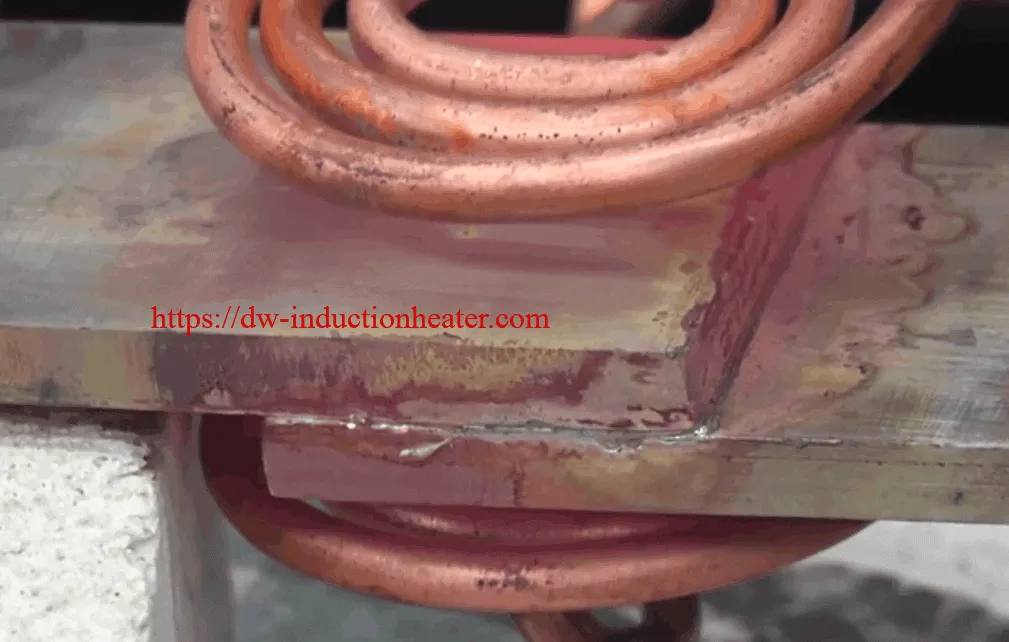
brazing copper plates overlay joints
Induction brazing copper plates and copper-to-brass lap joints
Quick Answer: How Does Induction Brazing Join Copper Plates and Brass Plates?
Induction brazing copper plates uses a concentrated electromagnetic field to rapidly heat an overlapping or lap-joint area until the brazing filler metal melts and flows between the mating surfaces by capillary action.
Objective
The objective of the application test is to braze copper and brass plates overlay joints with induction to replace torch operation. Overylay joints may be brass to brass or copper to copper.
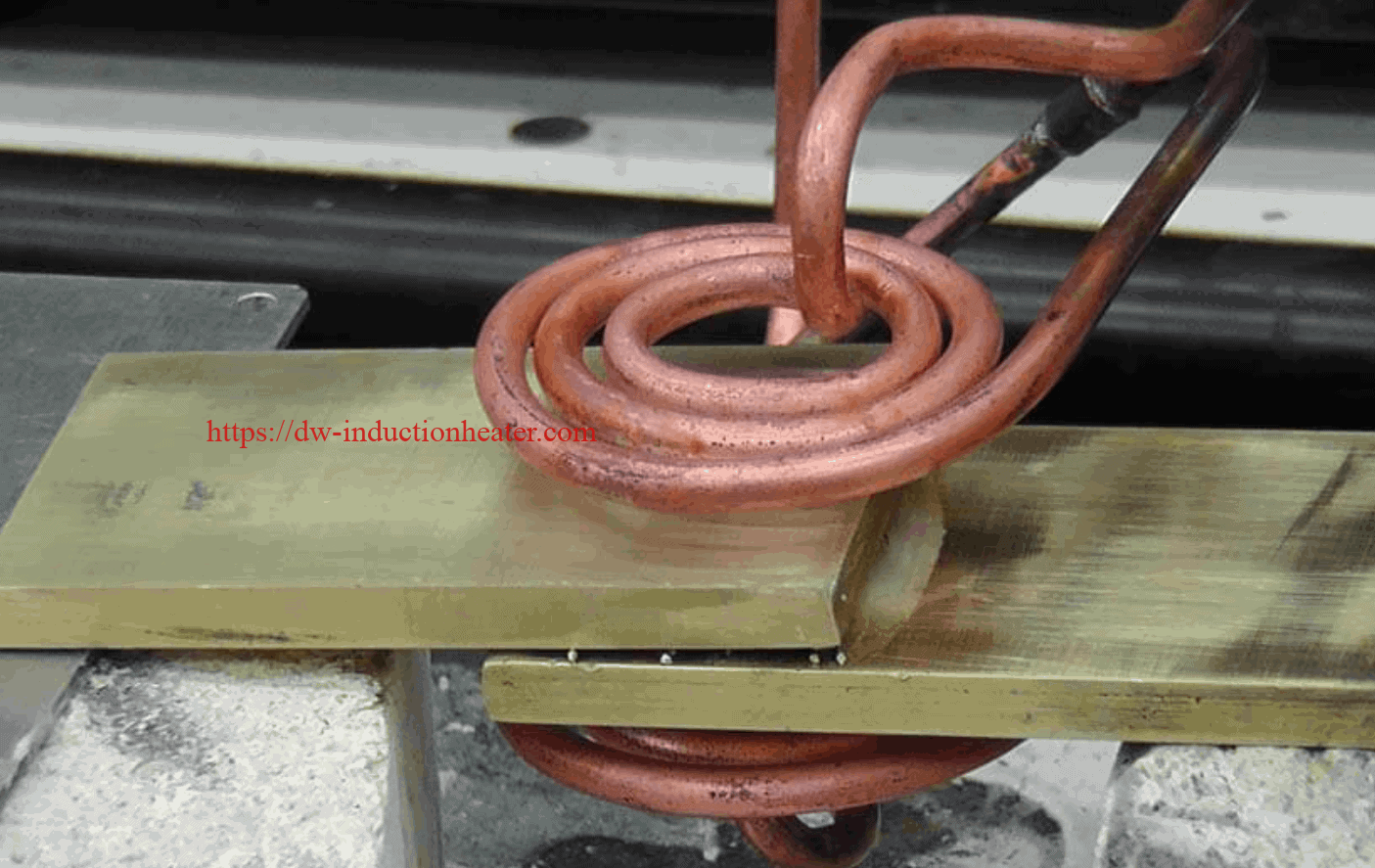
The current torch process results in excessive contaminants on the assembly and requires extensive rework after the brazing operation.
Equipment
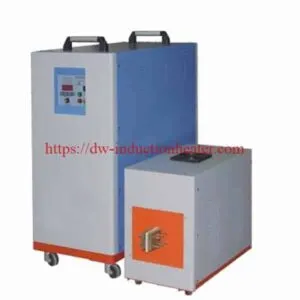
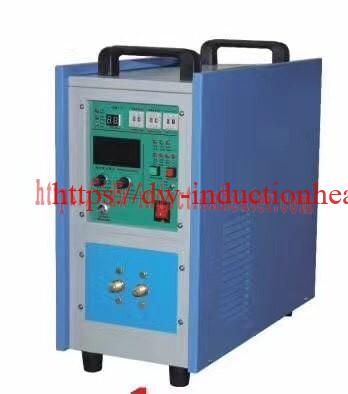
DW-HF-25kw induction heating machine
Materials
• Copper and brass coupon plates
• Braze alloy – EZ Flo 45
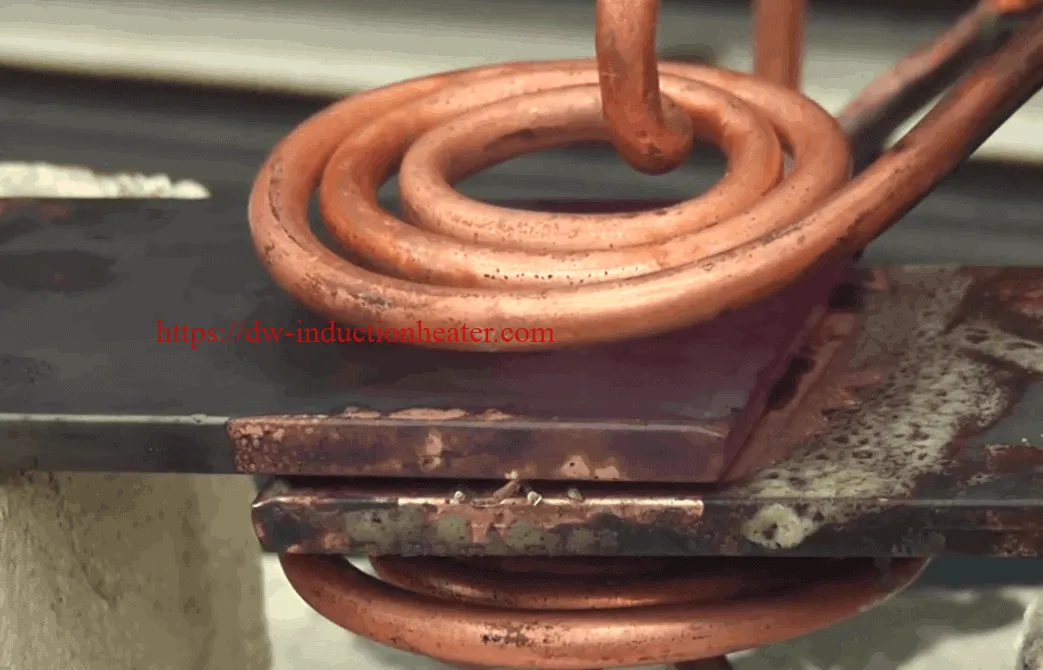
Key Parameters – Copper plates
Power: 15 kW
Heat to Temp: Approximately 1350° F (732° C)
Time: Average time – 2 minutes
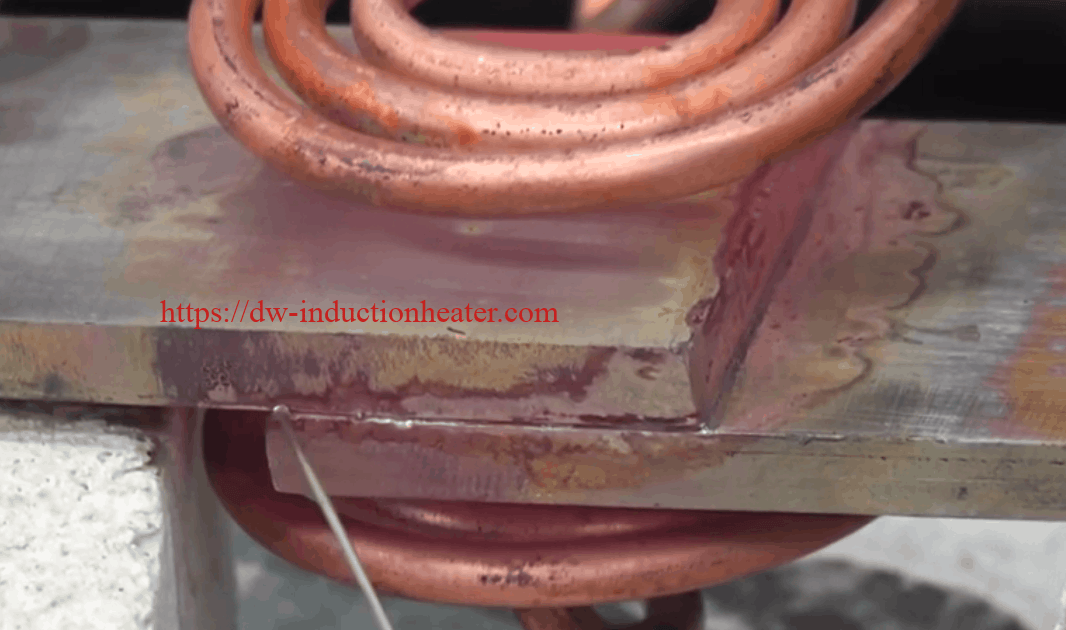
Process and Results:
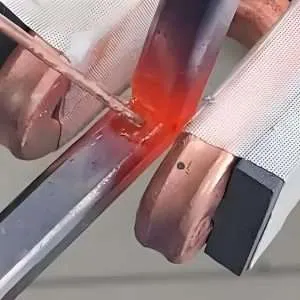
- EZ Flo 45 braze wire was cut into 2” (50.8mm) lengths and placed in the interface area.
- The assemblies were set up (see photos) and heated with induction heating for an average time of 2 minutes to flow the alloy and achieve the braze.
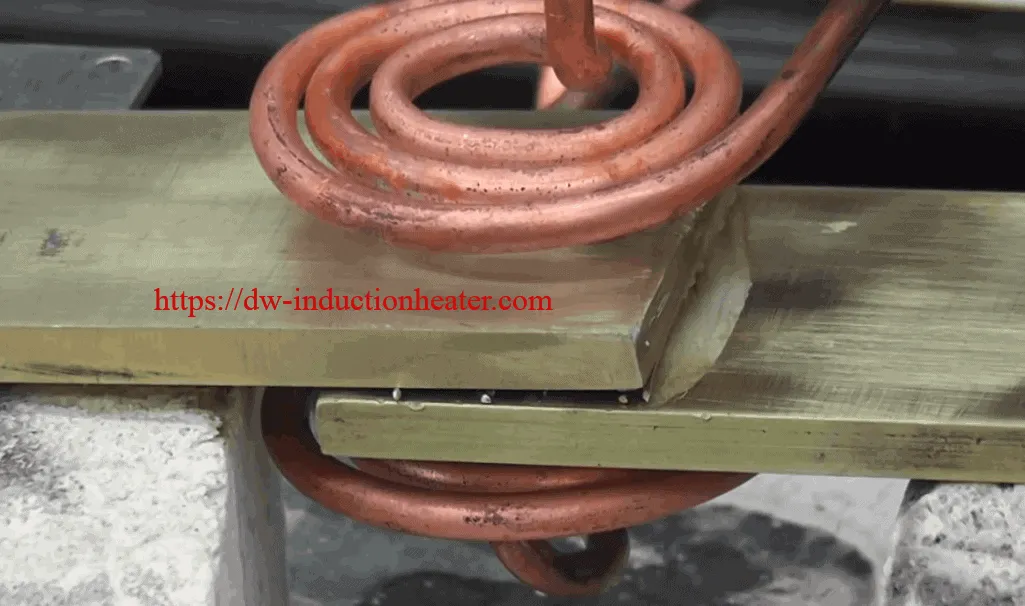
Key Parameters –Copper Brass coupon plates
Power: 15 kW
Heat to temp: Approximately 1350° F (732° C)
Time: Average time – 2 minutes
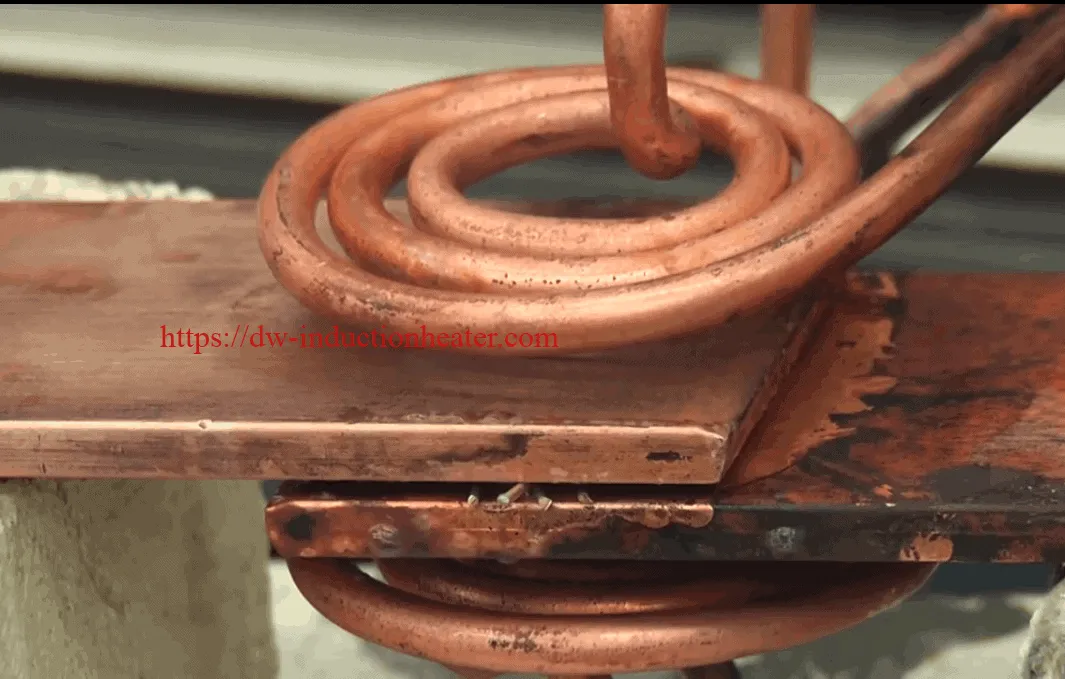
Process and Results:
- EZ Flo 45 braze wire was cut into 2” (50.8mm) lengths and placed in the interface area.
- The assemblies were set up (see photos) and heated for an average time of 2 minutes to flow the alloy and achieve the induction brazing.

Why Use Induction Heating for Copper Plate Lap Joints?
Copper has very high thermal conductivity, which means heat rapidly spreads away from the brazing area. Conventional torch brazing can therefore require extensive heating of the surrounding assembly and may create oxidation, contamination and additional cleanup.
Induction heating solves this problem by concentrating electromagnetic energy directly around the joint area.
When the copper or copper-brass plate assembly reaches the correct brazing temperature, the filler alloy melts and flows through the overlapping interface by capillary action. Once power is switched off, the joint cools and the filler alloy solidifies to form a strong metallurgical bond.
The process is particularly useful where manufacturers require repeatable brazing quality, limited thermal distortion, reduced oxidation and easier integration into automated production.
FAQs About Induction Brazing Copper Plates
1. Can copper plates be brazed using induction heating?
Yes. Copper plates can be brazed effectively using induction heating, including copper-to-copper and copper-to-brass assemblies.
The induction coil concentrates heat around the overlap or lap-joint area until the filler alloy melts and flows between the mating surfaces.
2. What temperature is required to induction braze copper plates?
The required temperature depends on the brazing filler alloy.
For this application, the copper and copper-brass plate joints were heated to approximately 1350°F (732°C) using EZ Flo 45 brazing alloy.
The exact production temperature should always be matched to the selected filler metal, flux, base materials and required joint properties.
3. How long does induction brazing a copper plate joint take?
Heating time depends on plate thickness, overlap area, joint mass, induction power and coil design.
In this test, the average induction heating time was approximately 2 minutes at about 15 kW applied process power.
A production coil designed specifically for the actual component geometry may improve cycle time and heating uniformity.
4. What size induction brazing machine is suitable for copper plates?
The required induction power depends on the total heated mass, plate thickness, overlap area, target temperature and required production rate.
For this application, an HLQ DW-HF-25kW induction heating machine was used, while approximately 15 kW of process power was applied during the brazing test.
Larger copper plates or shorter cycle-time requirements may require higher installed power.
5. Can induction brazing join copper plate to brass plate?
Yes. Induction brazing can join copper to brass when a compatible brazing alloy, suitable joint clearance and properly designed induction coil are used.
Because copper and brass have different electrical and thermal characteristics, the coil should be designed to balance heating between both components.
6. What is the best joint design for induction brazing copper plates?
A lap or overlay joint is often suitable because it provides a relatively large joining surface and allows molten filler metal to flow through the interface by capillary action.
Joint clearance, overlap length, surface cleanliness and filler-metal placement all influence brazing quality.
For repeat manufacturing, these dimensions should be kept consistent from part to part.
7. Is induction brazing better than torch brazing for copper plates?
For repetitive industrial production, induction brazing can provide several advantages over torch brazing.
It offers localized heating, repeatable cycle times, programmable power control, reduced operator dependence and less heating of surrounding areas.
It can also reduce oxidation and post-brazing cleanup, particularly where the existing torch process creates contamination on the finished assembly.
8. Can copper plate induction brazing be automated?
Yes. Copper plate induction brazing can be integrated into semi-automatic or fully automatic production systems.
Automation may include PLC-controlled heating cycles, pneumatic fixtures, automatic filler-metal placement, temperature monitoring, robotic loading and multi-station indexing.
This is especially useful for high-volume production of electrical busbars, terminals, conductive plates and copper-brass assemblies.