Induction Bonding
Induction Bonding Plastic, Rubber and Metal
Quick Answer
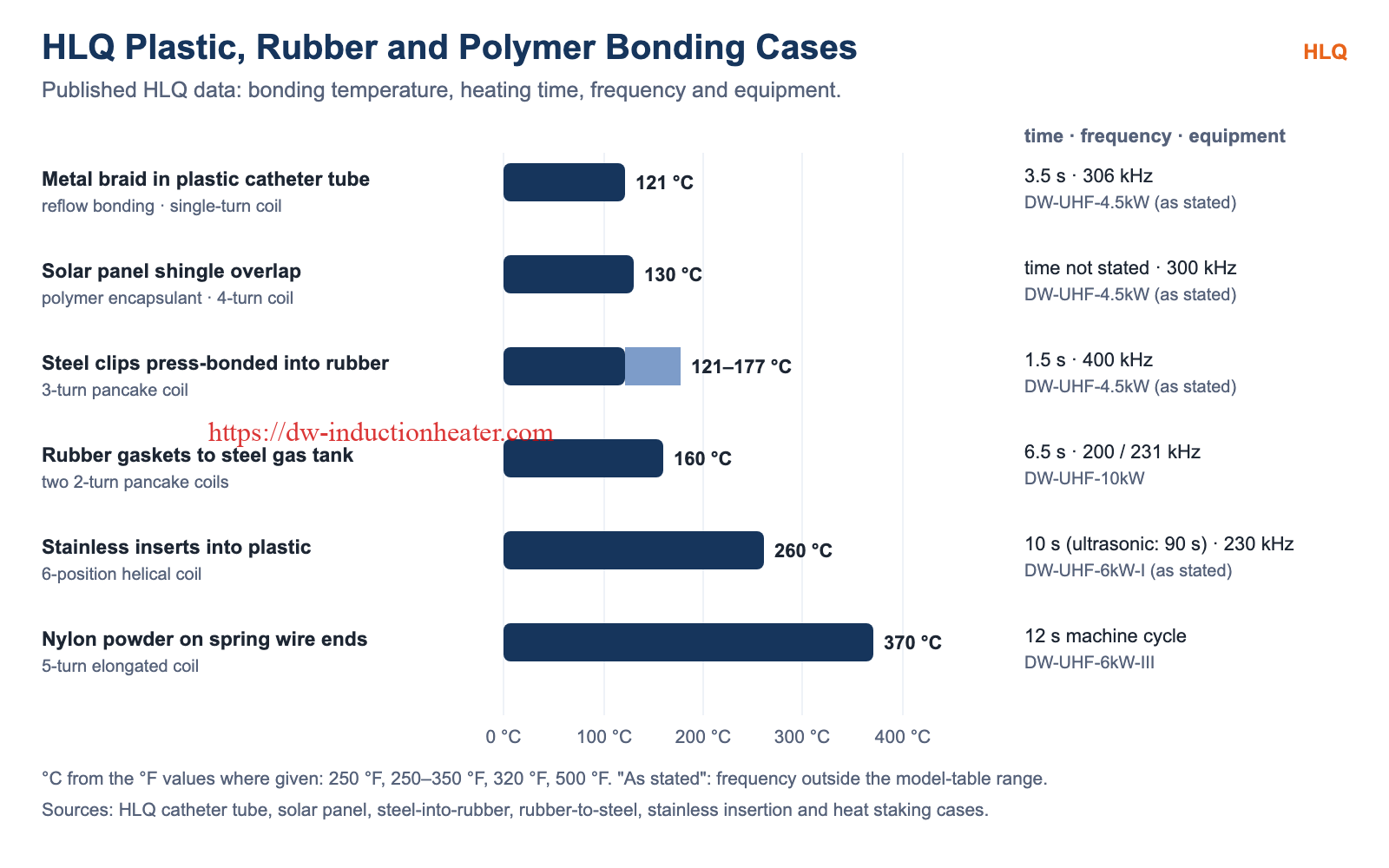
Induction bonding uses induction heating to cure bonding adhesives and to join plastics, rubber and polymers to metal. The coil heats only the metal part (an insert, braid, clip or substrate), and the plastic, rubber or adhesive in contact with it reflows, melts or bonds. HLQ cases show how fast this is. Stainless steel inserts were heated to 500 °F (260 °C) in 10 seconds for pressing into plastic; ultrasonic heating had taken 90 seconds. Rubber gaskets were bonded to a steel gas tank at 320 °F (160 °C) in 6.5 seconds, and a catheter tube’s metal braid reached 250 °F (121 °C) in 3.5 seconds. All of these used DW-UHF induction heating systems.
Table of Contents
- What is Induction Bonding of Plastic?
- Key Applications
- Suitable Materials
- Working Principle
- Technical Specifications
- Recommended Model Selection
- Process Workflow
- Common Problems and Solutions
- Engineering Selection Guide
- Advantages and Limitations
- Why Choose HLQ?
- 10 Core FAQs
What is Induction Bonding of Plastic?
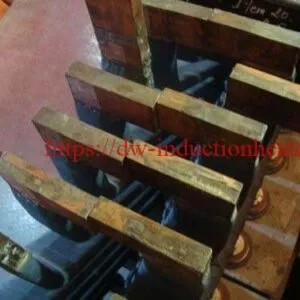
Induction bonding uses induction heating to cure bonding adhesives and to join non-metallic materials to metal. Induction is widely used to cure adhesives and sealants on car components such as doors, hoods, fenders, rearview mirrors and magnets. It also cures the adhesives in composite-to-metal and carbon fiber-to-carbon fiber joints. There are two main types of automotive bonding: spot bonding, which heats small segments of the materials to be joined, and full-ring bonding, which heats complete joints.
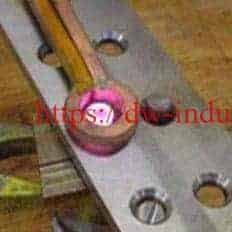
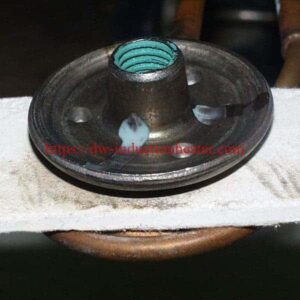
When plastic is bonded to metal, the plastic is not heated by the coil. The metal is heated and passes the heat to the plastic at the contact surface. In induction heat staking, the metal is heated above the plastic reflow point. It is either pressed into the plastic before heating or heated first, so the plastic reflows as the part is pressed in.
Key Applications
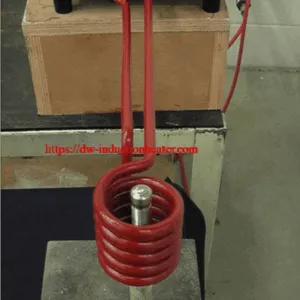
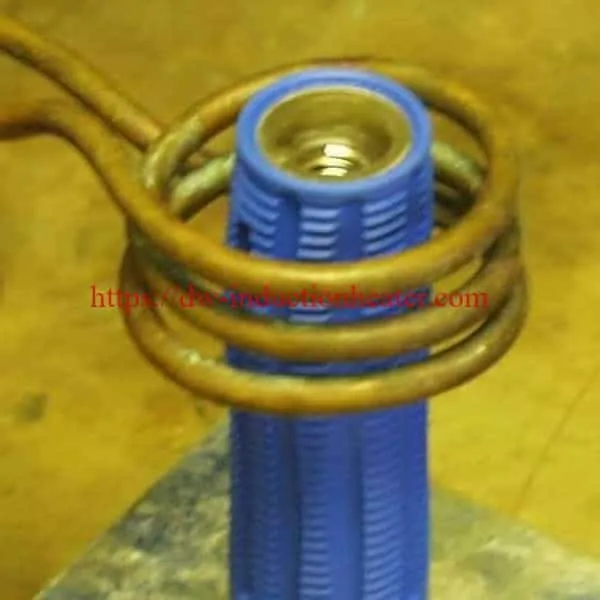
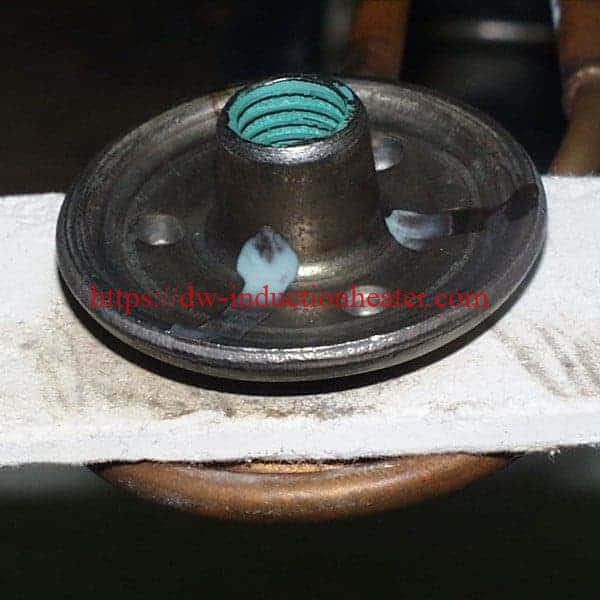
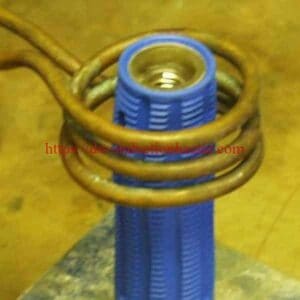
- Metal-to-plastic insertion: see induction heating stainless steel insertion for the automotive industry.
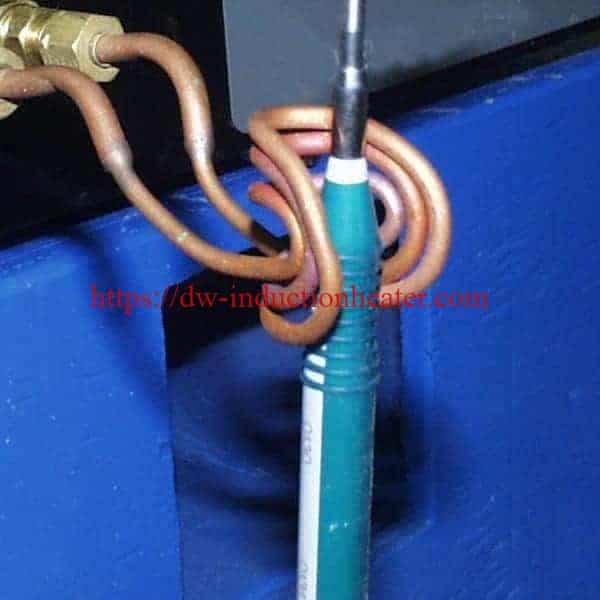
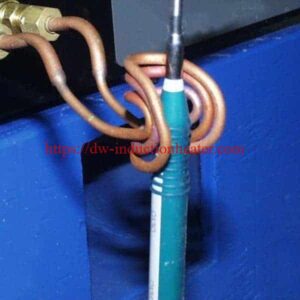
- Plastic reflow bonding of medical tubing: see induction heating plastic catheter tube.
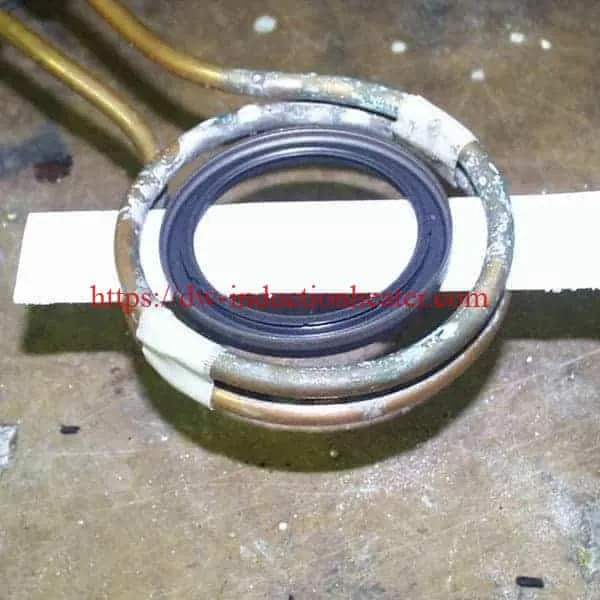
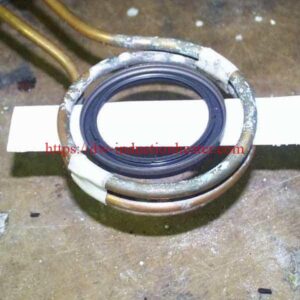
- Rubber gaskets on steel assemblies: see induction bonding rubber to steel.
- Metal clips press-bonded into rubber seals: see bonding steel into rubber with induction.
- Polymer encapsulant bonding of solar panel shingles: see induction bonding solar panel.
- Automotive and white goods: steel and aluminum sheet metal, composites and carbon fiber, brake shoes and magnets, and guides, rails, shelves and panels.
| HLQ case | Temperature | Time | Frequency | Equipment |
|---|---|---|---|---|
| Metal braid in plastic catheter tube (reflow bonding) | 250 °F (121 °C) | 3.5 s | 306 kHz (as stated) | DW-UHF-4.5kW |
| Solar panel shingle overlap (polymer encapsulant) | 130 °C | – | 300 kHz (as stated) | DW-UHF-4.5kW |
| Steel clips press-bonded into rubber seals | 250–350 °F (121–177 °C) | 1.5 s | 400 kHz (as stated) | DW-UHF-4.5kW |
| Rubber gaskets to steel gas tank | 320 °F (160 °C) | 6.5 s | 200 / 231 kHz | DW-UHF-10kW |
| Stainless steel inserts into plastic | 500 °F (260 °C) | 10 s | 230 kHz (as stated) | DW-UHF-6kW-I |
| Nylon powder on spring wire ends | 370 °C | 12 s machine cycle | – | DW-UHF-6kW-III |
Suitable Materials
| Metal part (heated) | Non-metal (bonded) | HLQ source |
|---|---|---|
| Stainless steel inserts, 3/8″ (9.5 mm) long, 1/4″ (6.4 mm) OD, 0.1875″ (4.8 mm) ID | Plastic part | Stainless steel insertion case |
| Metal braid in 0.05″ (1.27 mm) catheter tube | Plastic catheter tube | Catheter tube case |
| Steel gas tank assembly | Flat and round rubber gaskets | Rubber-to-steel case |
| Steel clips | Rubber sealer blocks | Steel-into-rubber case |
| Stainless steel substrate of a solar shingle | Polymer encapsulant | Solar panel case |
| 0.072″ spring wire | Nylon powder coating | Heat staking case |


Working Principle
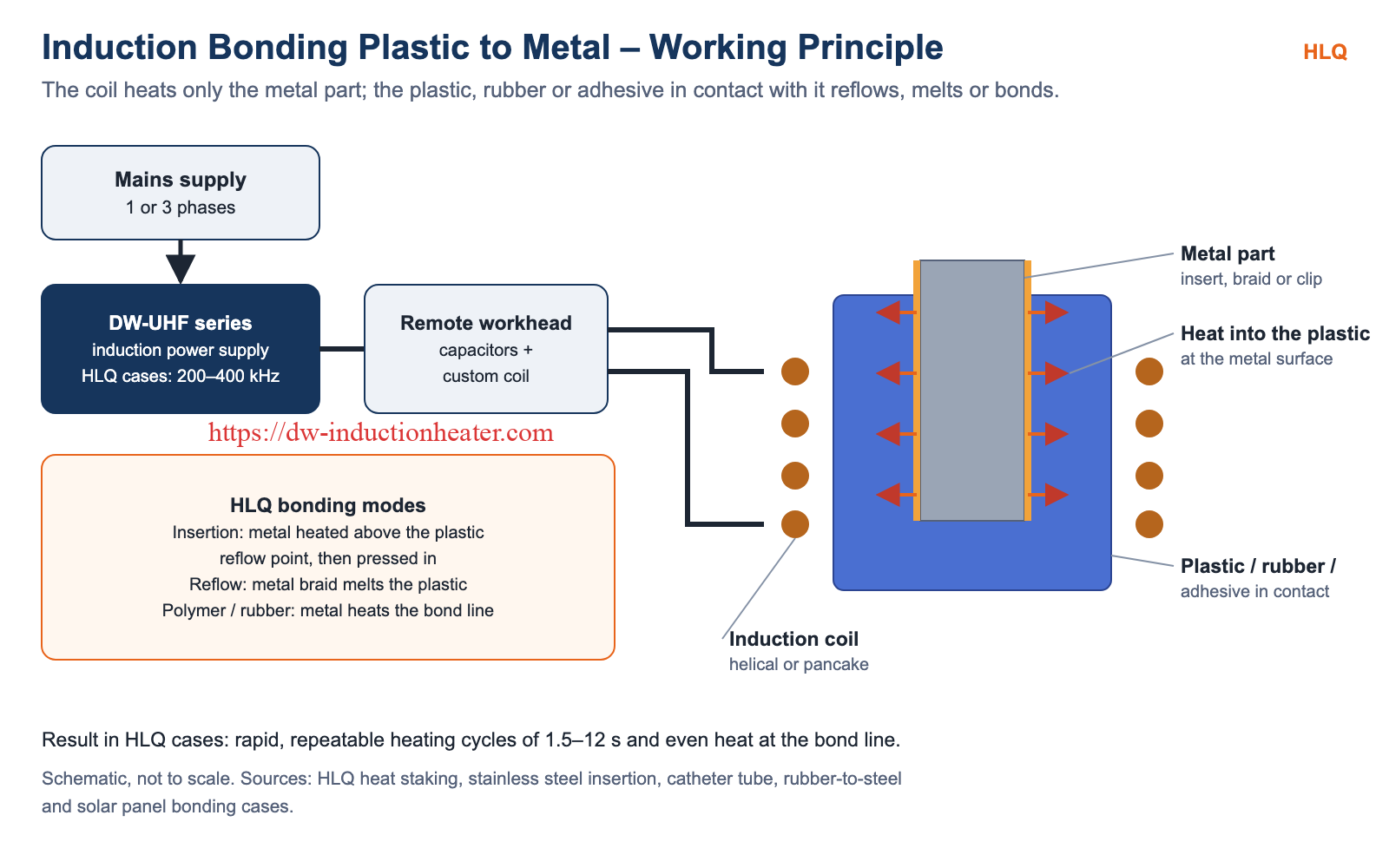
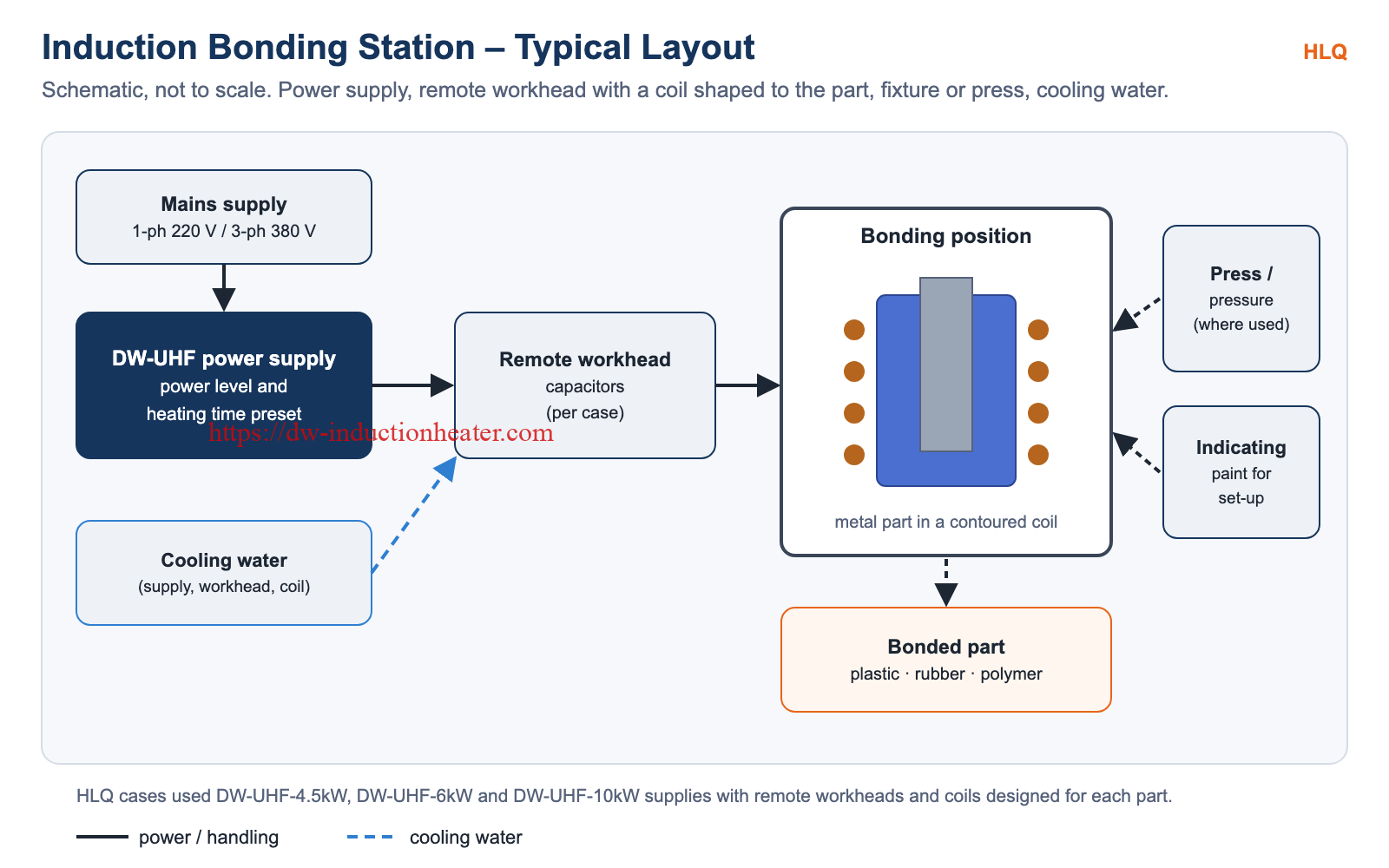
An induction power supply drives high-frequency current through a remote workhead and a coil designed for the part, and the coil induces heat in the metal part. HLQ cases use three bonding modes:
- Insertion: the metal is heated above the plastic reflow point and pressed in.
- Reflow: a metal braid melts the plastic around it.
- Rubber and polymer bonding: the metal substrate heats the bond line.
Heating is fast, precise and repeatable, which matters because long heating softens the internal threads of inserts.
Technical Specifications
| Parameter | Stainless inserts into plastic | Rubber gaskets to steel tank | Catheter tube braid |
|---|---|---|---|
| Temperature | 500 °F (260 °C) | 320 °F (160 °C) | 250 °F (121 °C) |
| Frequency | 230 kHz | 200 kHz flat gasket; 231 kHz round gasket | 306 kHz |
| Equipment | DW-UHF-6kW-I; remote workhead, two 0.17 µF capacitors (total 0.34 µF, as stated) | DW-UHF-10kW; remote workhead, two 1.25 µF capacitors (total 0.625 µF) | DW-UHF-4.5kW; remote workhead, one 1.2 µF capacitor |
| Coil | Six-position three-turn helical coil | Two two-turn pancake coils contoured to the assembly | Single-turn helical coil |
| Heating time | Within 10 seconds (ultrasonic: 90 seconds) | 6.5 seconds | 3.5 seconds |
| Result | Faster heating, higher production potential, repeatable | Repeatable, rapid and accurate cycles; even heat | Controlled rapid heat; consistent results; ceramic rod keeps the tube ID |
Recommended Model Selection
The DW-UHF and DW-HF series are the primary induction heating power supplies for induction bonding. DW-UHF data from the HLQ model table (100% duty cycle):
| Model | Power | Max. input current | Frequency | Supply | HLQ bonding case |
|---|---|---|---|---|---|
| DW-UHF-4.5kW | 4.5 kW | 20 A | 1.1–2.0 MHz | 1-phase 220 V | Catheter tube; solar panel; steel clips (cases state 300–400 kHz) |
| DW-UHF-6.0kW | 6.0 kW | 28 A | 300–1100 kHz | 1-phase 220 V | Stainless inserts (case states 230 kHz); nylon powder on spring wire |
| DW-UHF-10kW | 10 kW | 15 A | 100–500 kHz | 3-phase 380 V | Rubber gaskets to steel gas tank |
Process Workflow
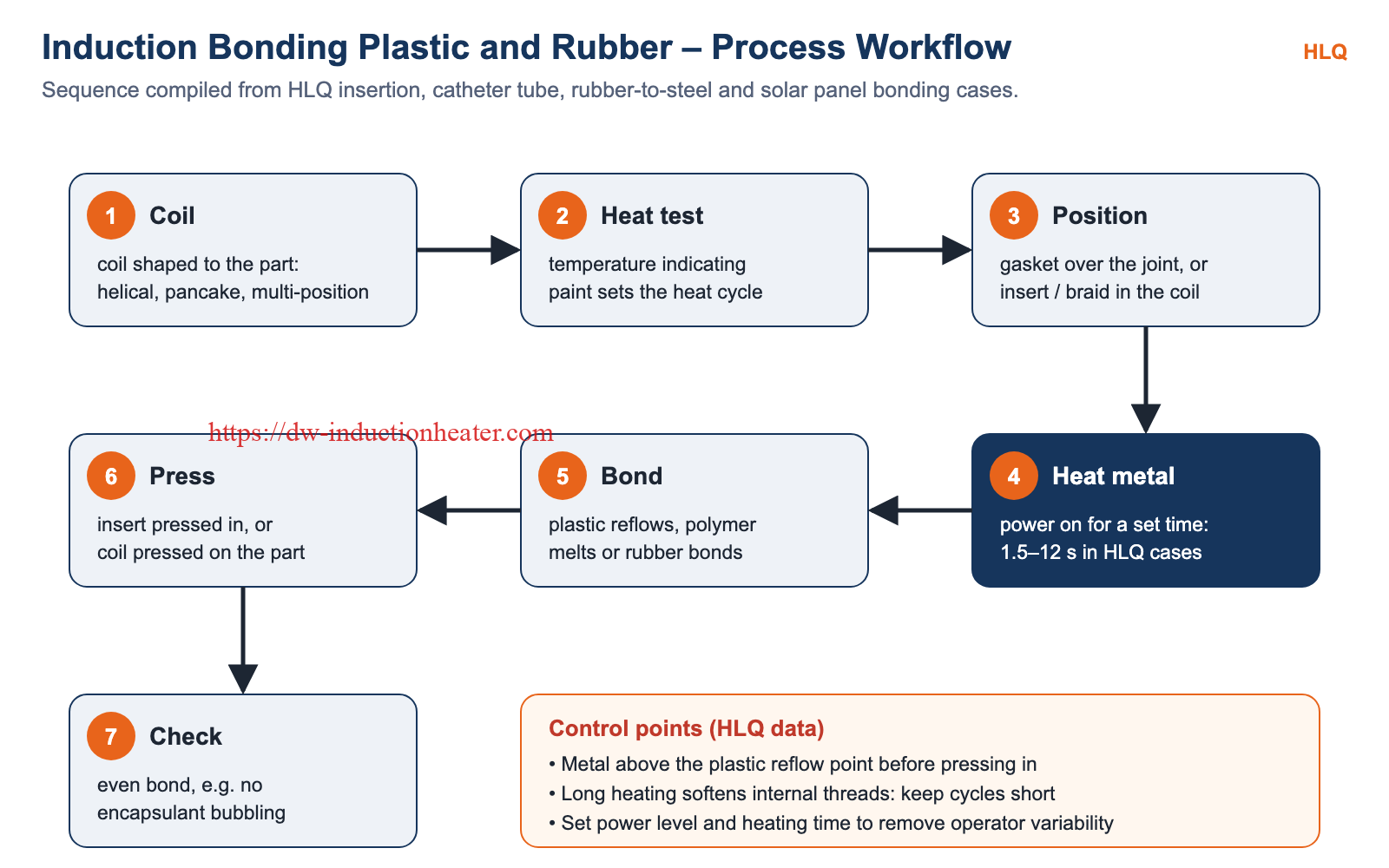
- Coil – a coil is shaped to the part: helical, pancake, contoured or multi-position.
- Heat test – temperature indicating paint is used to set the heat cycle.
- Position – the gasket goes over the joint, or the insert or braid goes into the coil.
- Heat the metal – power is applied for a set time (1.5–12 s in the HLQ cases).
- Bond – the plastic reflows, the polymer melts or the rubber bonds.
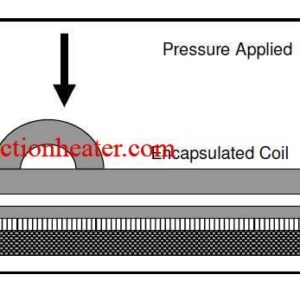
- Press – the insert is pressed in; in the solar panel case, the water-cooled coil was pressed against the shingle.
- Check – the bond is even; for example, the solar case showed no encapsulant bubbling.

Common Problems and Solutions
| Problem | Cause | Solution (HLQ data) |
|---|---|---|
| Softened internal threads of inserts | Long heating process | Fast, precise induction heating |
| Slow insertion cycle | Ultrasonic heating (90 s) | Induction heated stainless inserts in 10 s |
| Uneven heat at gasket areas | Coil not matched to the part | Pancake coils contoured to the shape of the steel assembly |
| Tube inside diameter changes during reflow | Plastic flow | A ceramic rod is inserted through the tubing |
| Encapsulant bubbling | Non-uniform melt | Stationary heating with the coil on top and pressure applied; no bubbling in the HLQ test |
| Operator variability | Manual heating control | Equipment programmed for a specific power level and heating time |
Engineering Selection Guide
- Small inserts, clips and tubes: DW-UHF-4.5kW or DW-UHF-6kW (single-phase 220 V), 1.5–12 s cycles in HLQ cases.
- Larger steel assemblies with rubber gaskets: DW-UHF-10kW (3-phase 380 V), 6.5 s with contoured pancake coils.
- Several parts per cycle: multi-position coils, such as the six-position helical coil for stainless inserts.
- Set-up: use temperature indicating paint to set the heating time.
- Data to send: metal part and plastic or rubber material, bonding or reflow temperature, bonding mode, cycle time and output.
Advantages and Limitations
| Advantages | Limitations |
|---|---|
| Fast: 10 s for inserts versus 90 s with ultrasonics | Only conductive (metal) parts are heated; the plastic must contact a metal part |
| Repeatable, preset power and heating time | Coils must be designed for each part |
| Even heat distribution at the bond line | Heat cycles must be set by testing (e.g. indicating paint) |
| Flameless, instant on/instant off heating | Water cooling of the coil and workhead is required |
| Small heat affected zones; no clamping needed for steel panel bonding | Long heating can soften plastic threads |
Why Choose HLQ?
- Published plastic, rubber and polymer bonding data from six applications.
- Coils designed for each part: helical, pancake, contoured and multi-position.
- Compact single-phase DW-UHF systems and three-phase models.
- Programmable power level and heating time for repeatable bonding.
10 Core FAQs
1. What is induction bonding?
The use of induction heating to cure bonding adhesives and to join plastics, rubber and polymers to metal.
2. Does induction heat the plastic directly?
No. The coil heats the metal part, and the plastic, rubber or adhesive in contact with it reflows, melts or bonds.
3. What are spot bonding and full-ring bonding?
Spot bonding heats small segments of the materials; full-ring bonding heats complete joints.
4. How fast is induction insertion?
HLQ heated stainless steel inserts to 500 °F (260 °C) in 10 seconds; ultrasonic heating had taken 90 seconds.
5. Can rubber be bonded to steel?
Yes. Rubber gaskets were bonded to a steel gas tank at 320 °F (160 °C) in 6.5 seconds with a DW-UHF-10kW.
6. Can plastic tubing be bonded?
Yes. A metal braid in a catheter tube was heated to 250 °F (121 °C) in 3.5 seconds to reflow the plastic.
7. Which coils are used?
Helical, pancake, contoured and multi-position coils designed for each part.
8. Which equipment is used?
DW-UHF systems from 4.5 kW to 10 kW in HLQ cases; the DW-UHF and DW-HF series are the primary power supplies for bonding.
9. Where is induction bonding used?
Automotive body parts, composites and carbon fiber, brake shoes and magnets, white goods, medical tubing, seals and solar panels.
10. What information is needed for a quotation?
Part drawings, metal and plastic or rubber materials, bonding temperature, bonding mode, cycle time and output.