
Induction PWHT Machine vs Resistance PWHT Machine for Post Weld Heat Treatment
Table of Contents
- Quick Answer
- Comparison Overview
- Working Principle Comparison
- Key Technical Parameters
- Efficiency and Energy Cost Comparison
- Temperature Control Comparison
- Material Quality and Surface Condition
- Safety and Compliance Comparison
- Maintenance Comparison
- Total Cost of Ownership
- Engineering Selection Guide
- Common Engineering Mistakes
- Common Problems and Solutions
- Real Project Case Study
- Honest Limitations of Both Methods
- Final Recommendation
- FAQ
This engineering comparison explains the differences between an induction PWHT machine and a resistance PWHT machine for post weld heat treatment, weld preheating, hydrogen bake-out and stress relieving. It is written for welding engineers, heat treatment contractors, pressure vessel manufacturers, pipeline companies, refinery maintenance teams, boiler repair companies and procurement managers who need to select the right PWHT equipment. The article compares working principle, heating efficiency, temperature control, setup time, safety, maintenance, total cost, limitations and practical selection rules for real industrial projects.
Quick Answer
For most modern pipe welds, pressure vessel welds, boiler tube welds, refinery piping and high-productivity field heat treatment projects, an induction PWHT machine is usually the better long-term solution because it heats the metal directly, reaches temperature faster, improves energy efficiency, reduces setup time, supports precise digital control and creates a cleaner working environment. A resistance PWHT machine remains useful for lower-budget projects, occasional repair jobs, simple stress-relief work and irregular surfaces where ceramic heating pads can be placed easily. In short, choose induction PWHT when speed, efficiency, repeatability and lower operating cost are important; choose resistance PWHT when initial purchase cost and simple conventional operation are the main priorities.
Comparison Overview
Post weld heat treatment is not a simple heating task. It is a controlled thermal process used to reduce welding residual stress, lower hardness, remove diffusible hydrogen, improve dimensional stability and increase the reliability of welded components. The quality of PWHT depends on many engineering factors: heating method, power capacity, temperature feedback, thermocouple layout, insulation quality, heated band width, holding time, cooling rate and operator skill.
Two common technologies are used for local PWHT: induction heating and resistance heating. Both methods can meet project requirements if they are correctly selected and operated. However, their engineering behavior is very different.
An induction PWHT machine uses electromagnetic induction to generate heat directly inside the metal workpiece. A flexible induction cable or coil is wrapped around the weld area, and alternating current creates a magnetic field. This field induces current in the metal, and the metal heats because of its electrical resistance. The workpiece itself becomes the heat source.
A resistance PWHT machine uses ceramic heating pads or resistance heaters. Electrical current passes through the resistance heater element, the heater becomes hot, and heat is transferred into the metal by contact, conduction and radiation. In this system, the heater is the heat source, and the workpiece receives heat from the outside.
This difference affects almost every practical result: heating speed, energy consumption, temperature uniformity, surface condition, installation labor, accessory consumption, maintenance and long-term cost.
| Comparison Item | Induction PWHT Machine | Resistance PWHT Machine |
|---|---|---|
| Heating method | Direct electromagnetic heating inside the metal | External ceramic heater transfers heat to the metal |
| Typical advantage | Fast, efficient, clean and highly controllable | Simple, familiar and lower initial cost |
| Best applications | Pipe welds, vessel seams, boiler tubes, repeated field PWHT | Traditional site PWHT, simple repairs, irregular surfaces |
| Main limitation | Higher initial investment and need for proper coil design | Slower heating, more consumables and higher heat loss |
Working Principle Comparison
How an Induction PWHT Machine Works
In an induction PWHT system, a medium-frequency or high-frequency power supply sends alternating current through an induction coil or flexible induction heating cable. The coil does not need to touch the metal directly. When current flows through the coil, it creates an alternating magnetic field around the workpiece. This field induces eddy current in the conductive metal. The resistance of the metal converts this induced current into heat.
For magnetic steels, induction heating can also benefit from magnetic hysteresis at lower temperatures, but eddy current heating is the dominant heating mechanism in many practical PWHT operations. As the steel temperature rises, magnetic properties change, so the equipment must have stable power control and proper frequency selection.
The key engineering point is that the heat is generated in the metal itself. This gives induction PWHT a fast thermal response. When power increases, the workpiece temperature responds quickly. When the controller reduces output, the heat input drops immediately. This makes induction heating very suitable for programmed heating curves.
How a Resistance PWHT Machine Works
In a resistance PWHT system, ceramic heating pads are placed on or around the weld area. Each pad contains resistance wire or heating elements. When current passes through the element, electrical resistance causes the pad to heat. The heat then passes from the ceramic pad into the workpiece surface.
The heat transfer path is longer: electrical energy first heats the resistance wire, then the ceramic pad, then the metal surface, and finally the heat conducts into the workpiece thickness. If the pad contact is poor, if the insulation is loose, or if wind removes heat from the surface, heating efficiency decreases.
Resistance heating is a proven and widely used technology. Many workers are familiar with ceramic pads, extension cables and zone controllers. The equipment is relatively simple, but the quality of installation strongly affects temperature uniformity and heating time.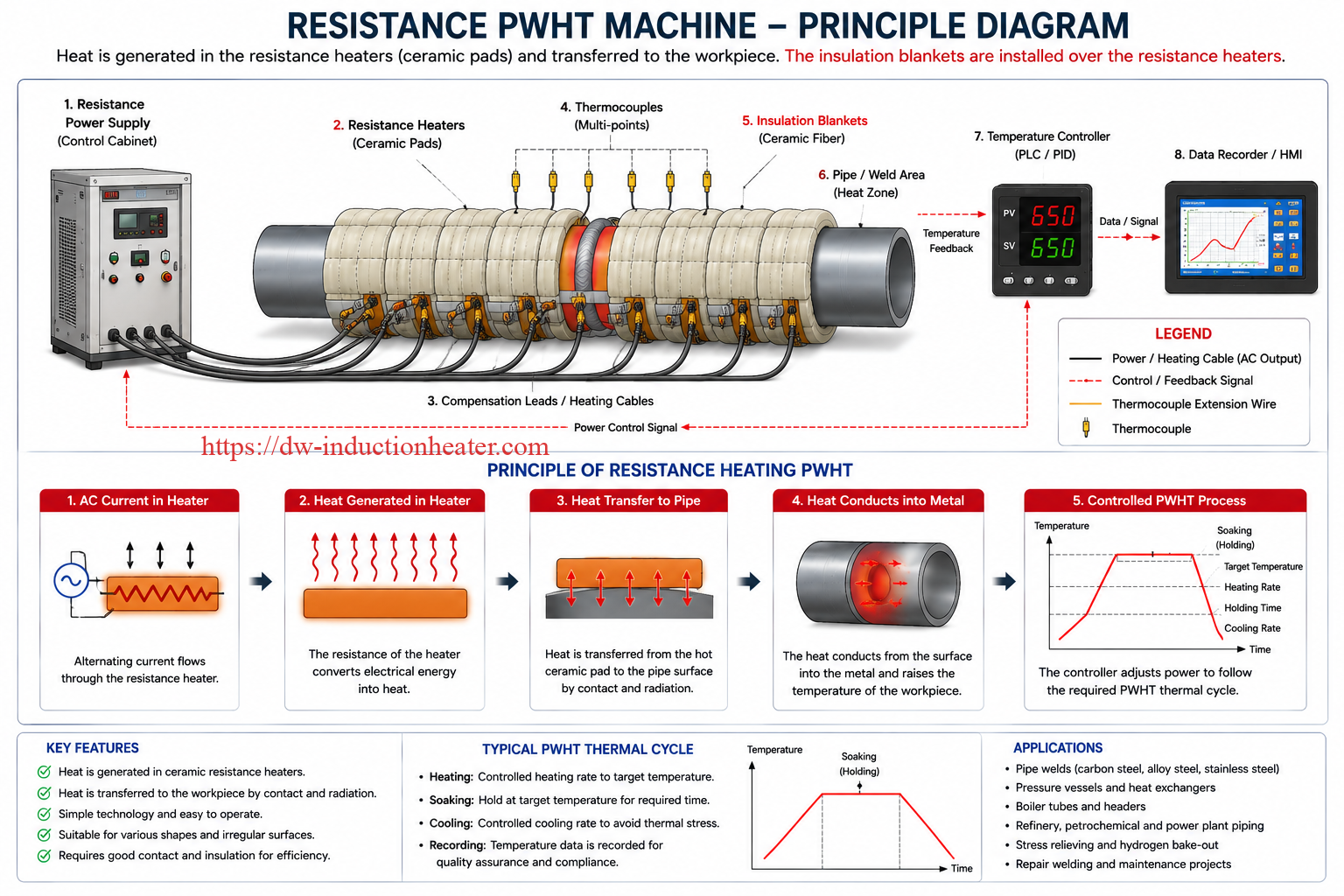
Engineering Meaning of the Difference
The difference between direct heating and external heat transfer is not only theoretical. It changes how the equipment behaves on site. Induction heating normally requires fewer heating elements, less installation labor and less time to reach the target temperature. Resistance heating normally requires more pad arrangement, more cable connections and more attention to contact quality.
Key Technical Parameters
| Parameter | Technology A | Technology B | Engineering Impact |
|---|---|---|---|
| Technology | Induction PWHT machine | Resistance PWHT machine | Defines how heat is generated and controlled |
| Heat generation position | Inside the metal surface and near-surface zone | Inside ceramic heating pads | Induction has faster response and lower transfer loss |
| Typical heating element | Flexible induction cable, induction coil, water-cooled coil | Ceramic resistance pad, resistance heater mat | Affects setup time, service life and maintenance |
| Typical power range | 30–500 kW or customized | 30–360 kW or customized | Both can be scaled for small or large jobs |
| Frequency | Usually medium-frequency or high-frequency range | Industrial power frequency output to heaters | Induction frequency affects heating depth and coupling |
| Temperature control | Thermocouple feedback with PID, PLC or HMI control | Thermocouple feedback with zone controller | Both can be controlled, but induction responds faster |
| Heating speed | Fast | Medium to slow | Induction reduces project downtime |
| Energy efficiency | Higher | Lower to medium | Resistance heating loses more heat through transfer path |
| Setup labor | Lower for regular pipes and cylindrical parts | Higher due to multiple pads and cables | Labor cost may be significant in large projects |
| Consumables | Lower; coils and cables are reusable | Higher; ceramic pads and leads wear out | Resistance PWHT may have higher long-term accessory cost |
| Cooling requirement | Air cooling or water cooling depending on power | Usually air cooling | High-power induction may require cooling equipment |
| Best geometry | Pipe, vessel, ring, cylinder and regular geometry | Flat, curved and some irregular surfaces | Workpiece shape affects equipment selection |
Efficiency and Energy Cost Comparison
Energy efficiency is one of the strongest advantages of induction PWHT. Because heat is generated directly in the steel, less energy is wasted in heating external components. The induction cable or coil creates a magnetic field, and the workpiece converts electromagnetic energy into heat.
In resistance PWHT, the ceramic pad must become hot first. Heat then transfers into the workpiece. During this transfer, energy is lost to the surrounding air, pad surfaces, imperfect contact zones and cable heating. If the insulation blanket is installed poorly, the loss becomes even higher.
In field projects, the difference in energy cost is not only about electricity price. Heating time also matters. If induction PWHT can shorten setup and heating time, the project saves labor hours, crane time, shutdown time and inspection waiting time. In refinery or power plant maintenance, reduced downtime can be more valuable than electricity savings.
| Energy Factor | Induction PWHT | Resistance PWHT |
|---|---|---|
| Heat transfer loss | Lower | Higher |
| Thermal response | Fast | Slower |
| Insulation sensitivity | Important | Very important |
| Energy use per heating cycle | Usually lower | Usually higher |
| Best efficiency condition | Regular geometry with good coil coupling | Good pad contact with full insulation coverage |
However, induction is not automatically efficient in every case. If the coil is poorly designed, too far from the metal, incorrectly wound, or matched with the wrong frequency, energy efficiency will drop. Similarly, resistance heating can perform acceptably if pad contact is excellent and insulation is properly installed.
Temperature Control Comparison
PWHT is a controlled process. The goal is not maximum heating speed. The goal is to follow the required heating curve: controlled heating rate, target soaking temperature, holding time and controlled cooling rate. For alloy steel, thick-wall pipe and pressure equipment, accurate temperature control is essential.
Induction PWHT Temperature Control
Induction PWHT provides very responsive control because the heat input can be adjusted quickly. When the thermocouple detects that temperature is approaching the setpoint, the power supply reduces output. When heat loss increases, the power supply can raise output rapidly. This fast response makes induction suitable for PID control, PLC automation and multi-zone temperature management.
For pipe welds, induction heating can produce good circumferential uniformity if the coil is wound evenly. For thick-wall pipes, the heating band must be wide enough to avoid excessive surface-to-core temperature difference. For pressure vessel seams, multi-zone control may be needed to prevent one section from overheating while another remains cold.
Resistance PWHT Temperature Control
Resistance PWHT can also be controlled by thermocouples and zone controllers. It is a mature method. However, the response is slower because the heater pad has thermal mass. If the controller reduces current, the ceramic pad remains hot for some time and continues transferring heat to the workpiece. This thermal lag can cause temperature overshoot if the control settings are not optimized.
Resistance heating also depends heavily on pad placement. If one pad contacts the pipe tightly and another pad has an air gap, the temperature distribution may be uneven. More thermocouples and careful pad layout are required for critical work.
| Temperature Control Item | Induction PWHT | Resistance PWHT |
|---|---|---|
| Power response | Very fast | Slower because heater pads retain heat |
| Risk of overshoot | Lower with proper PID tuning | Higher if pad thermal lag is not managed |
| Uniformity on pipe circumference | Good with even coil pitch | Good with correct pad layout |
| Multi-zone control | Highly suitable | Available but more wiring and pads are required |
| Temperature recording | Digital recorder or PLC data logging | Digital recorder or chart recorder |
Material Quality and Surface Condition
The final purpose of PWHT is to improve or stabilize material performance after welding. The heating method must not create new quality problems such as local overheating, excessive hardness variation, distortion, surface damage or rejected temperature records.
Induction heating is clean because there is no direct combustion and no heater pad surface rubbing against the workpiece. This is useful for stainless steel, alloy piping and components where surface cleanliness matters. The heating area can be controlled accurately, and less surrounding structure is exposed to unnecessary heat.
Resistance heating exposes the component to hot ceramic pads. In many industrial applications this is acceptable, but pads can break, leave debris, or create uneven contact. If pads are not arranged correctly, some areas may be overheated while other areas remain below the required soaking temperature.
For thick-wall alloy steel, the most important issue is not only surface temperature but through-thickness temperature behavior. Both induction and resistance methods require enough soak time and correct thermocouple placement. A fast surface temperature rise does not guarantee that the full weld region has reached the required thermal condition. Engineering judgment is necessary.
| Quality Factor | Induction PWHT | Resistance PWHT |
|---|---|---|
| Surface cleanliness | Cleaner, no ceramic pad contact required in many setups | Pad contact may leave dust or debris |
| Local overheating risk | Low with correct coil design and feedback control | Possible if pad contact and layout are poor |
| Distortion control | Good with symmetrical coil layout and controlled heating | Good if pads are balanced and heating is uniform |
| Suitability for high-quality documentation | Excellent with digital control and recording | Good with proper recorder and thermocouple layout |
Safety and Compliance Comparison
Both induction PWHT and resistance PWHT are electrical heating methods, so both require safe electrical installation, proper grounding, insulation inspection, trained operators and temperature protection. Neither method should be treated as a simple plug-and-play heating tool for critical welds.
Safety of Induction PWHT
Induction PWHT is flameless and produces no combustion gas. This makes it attractive for refineries, petrochemical plants, offshore platforms, shipyards and maintenance areas where open flame is restricted. The work area can also be cleaner because there are fewer heater pads and less accessory wiring around the component.
However, induction systems require attention to high-current output cables, coil insulation, water cooling where applicable, electromagnetic field exposure distance, grounding and power supply protection. A damaged induction cable should not be used. Cooling flow alarms and over-temperature protection are important for high-power systems.
Safety of Resistance PWHT
Resistance PWHT is also flameless, but the ceramic pads become very hot. The risk of burns is higher because a large heated surface may be exposed during installation, operation or removal. Damaged pads, loose terminals, poor cable connections or broken insulation can create electrical and fire hazards.
For compliance, the critical issue is not only the heating method. The complete process must meet the project specification: approved heating procedure, calibrated temperature measurement, proper thermocouple placement, acceptable heating and cooling rates, correct soaking temperature and complete heat treatment record.
| Safety Item | Induction PWHT | Resistance PWHT |
|---|---|---|
| Open flame | No | No |
| Combustion gas | No | No |
| Hot exposed heating element | Lower risk | Higher risk due to ceramic pads |
| Electrical hazard | Requires strict cable and grounding control | Requires strict pad, cable and terminal inspection |
| Field work cleanliness | Better | More accessories and wiring |
| Compliance documentation | Excellent with digital recorder | Good with proper recorder |
Maintenance Comparison
Maintenance is often underestimated when buying PWHT equipment. A low-cost system may become expensive if heating pads break frequently, connectors overheat or cables require constant replacement.
Induction PWHT machines require maintenance of the power supply, cooling system, output cable, coil insulation, connectors, control panel, thermocouples and software or recorder system. Water-cooled coils require clean cooling water, proper flow rate and leak inspection. The induction power supply is more technically advanced, so professional service support is important.
Resistance PWHT machines are mechanically simpler, but ceramic heating pads are consumable items. Pads may crack, wires may fail, terminals may loosen and insulation may become damaged after repeated high-temperature use. For contractors who perform many PWHT jobs, the cost and storage of spare ceramic pads can be significant.
| Maintenance Item | Induction PWHT | Resistance PWHT |
|---|---|---|
| Power supply maintenance | Requires skilled electrical service | Usually simpler |
| Heating element life | Long if cable or coil is used correctly | Ceramic pads are consumable and fragile |
| Cooling system | May require water flow inspection | Usually not required |
| Accessory replacement | Lower frequency | Higher frequency |
| Downtime risk | Low if cooling and cables are maintained | Higher if pads fail during operation |
Total Cost of Ownership
The purchase price is only one part of the real cost. Total cost of ownership includes equipment cost, electricity, labor, installation time, consumables, maintenance, downtime, spare parts, operator training and project acceptance risk.
Resistance PWHT usually has a lower initial investment. This can be attractive for small workshops, occasional field repair teams or companies with limited budgets. If the work volume is low and heating time is not critical, resistance heating may be acceptable.
Induction PWHT usually has a higher purchase price, especially when the system includes digital control, flexible induction cables, water cooling, multi-zone control and data recording. However, for frequent PWHT work, induction can reduce long-term cost by saving energy, labor and time.
| Cost Factor | Induction PWHT Machine | Resistance PWHT Machine |
|---|---|---|
| Initial investment | Higher | Lower |
| Electricity consumption | Lower in most well-designed applications | Higher due to heat transfer loss |
| Labor cost | Lower because setup is faster | Higher because pad installation takes time |
| Consumables | Lower | Higher due to ceramic pad wear |
| Maintenance cost | Moderate; requires technical service | Moderate to high if pads fail frequently |
| Downtime cost | Lower for repeated production work | Higher if setup and heating cycles are long |
| Long-term value | Better for frequent and high-quality PWHT work | Better for low-frequency, budget-sensitive work |
For a company performing one or two occasional PWHT jobs per year, resistance equipment may be financially reasonable. For a pipeline contractor, pressure vessel manufacturer or maintenance company performing many weld heat treatment jobs, induction PWHT often provides better return on investment.
Engineering Selection Guide
| Condition | Recommended Option | Reason |
|---|---|---|
| Repeated pipe weld PWHT | Induction PWHT machine | Fast setup, good circumferential heating and lower long-term cost |
| Large-diameter pipeline construction | Induction PWHT machine | Flexible induction cable can cover pipe circumference efficiently |
| Thick-wall Cr-Mo or P91 steel pipe | Induction PWHT machine | Strong heating capacity and precise temperature control |
| Low-budget occasional repair | Resistance PWHT machine | Lower initial cost and simple operation |
| Irregular casting repair surface | Resistance PWHT machine or custom induction coil | Ceramic pads can adapt to some irregular surfaces; induction requires special coil design |
| Offshore or refinery maintenance | Induction PWHT machine | Clean, flameless, efficient and reduced accessory clutter |
| Factory production with many repeated parts | Induction PWHT machine | Better automation, repeatability and productivity |
| Simple flat plate stress relief | Resistance PWHT machine or induction blanket system | Selection depends on area size, temperature and production frequency |
| Limited site power supply | Case-by-case evaluation | Induction is efficient but still requires stable power; resistance can be modular |
| Strict quality documentation | Induction PWHT machine with digital recorder | Fast response and digital data recording improve traceability |
Common Engineering Mistakes
1. Selecting Equipment Only by Rated Power
Rated power alone does not guarantee heating performance. A 100 kW machine with poor coil design may perform worse than a lower-power system with better coupling and insulation. Engineers should evaluate material, wall thickness, heated band width, target temperature, heating time and site conditions.
2. Ignoring Insulation Quality
Poor insulation wastes power and creates temperature instability. Whether using induction or resistance heating, high-temperature insulation must cover the heated area properly. Gaps, loose blankets and wind exposure can cause heat loss and rejected thermal cycles.
3. Poor Thermocouple Placement
The controller can only respond to the temperature it measures. If thermocouples are installed at non-representative points, the machine may overheat one area and underheat another. Multiple thermocouples are recommended for large pipes, thick sections and critical welds.
4. Heating Too Fast
Induction heating is fast, but PWHT must follow the approved heating rate. Rapid surface heating may create thermal gradients, especially in thick-wall steel. Fast equipment should still be used with controlled programming.
5. Using Damaged Heating Accessories
Damaged induction cables, broken ceramic pads, loose terminals and worn insulation increase safety risk and reduce heating quality. Accessories should be inspected before every job.
6. No Process Documentation
For critical welds, a temperature record is part of the quality evidence. Without a proper chart or digital report, even a technically successful heat treatment may be rejected by the client or inspector.
Common Problems and Solutions
| Problem | Likely Cause | Recommended Solution |
|---|---|---|
| Slow heating | Insufficient power, poor insulation, weak coil coupling or poor pad contact | Improve insulation, check coil/pad layout, increase power or reduce heat loss |
| Temperature difference around pipe circumference | Uneven coil pitch, uneven pad placement, wind exposure or poor insulation overlap | Rewrap coil or pads, add insulation, use more thermocouples and multi-zone control |
| Temperature overshoot | Controller response too aggressive, thermal lag in heater pads or incorrect sensor position | Adjust PID settings, reduce heating rate and verify thermocouple location |
| Ceramic pads fail frequently | Mechanical damage, overheating, poor handling or repeated thermal cycling | Use correct pad rating, train operators and keep spare pads available |
| Induction cable overheats | Insufficient cooling, overload operation, cable damage or incorrect coil design | Check cooling flow, inspect cable, reduce load or redesign coil |
| PWHT curve is rejected | Incomplete record, incorrect thermocouple placement or temperature outside tolerance | Use calibrated recorder, document sensor layout and follow approved procedure |
| High electricity consumption | Heat loss, long heating cycle or inefficient setup | Improve insulation, reduce exposed hot area and consider induction heating for repeated work |
| Uneven surface condition after heating | Local hot spots, dirty pads, poor surface preparation or uneven contact | Clean workpiece, improve heating layout and verify temperature uniformity |
Real Project Case Study
Project Background
A petrochemical maintenance contractor needed to perform post weld heat treatment on several thick-wall alloy steel pipe welds during a planned shutdown. The pipe material was low alloy Cr-Mo steel. The welds were located in a congested pipe rack with limited working space. The client required controlled heating, soaking temperature recording and fast completion because the shutdown schedule was tight.
Original Method: Resistance PWHT
The contractor had previously used ceramic resistance pads for similar jobs. The process was familiar, but installation took a long time. Workers had to position many ceramic pads around each weld, connect multiple leads, apply insulation blankets and check each pad circuit. In the pipe rack, access was difficult. Some pads did not sit tightly on the pipe surface because of nearby supports and branch connections.
During heating, several thermocouples showed temperature differences around the circumference. The team had to adjust insulation and pad placement. The target temperature was eventually reached, but the heating stage took longer than expected. After the job, several pads showed damage and had to be replaced.
Improved Method: Induction PWHT
For the next maintenance campaign, the contractor tested an induction PWHT machine with flexible induction cables and digital temperature recording. The flexible cable was wrapped around the pipe weld area with uniform pitch. Ceramic fiber insulation was applied over the heated zone. Multiple thermocouples were installed around the circumference and connected to the controller and recorder.
The induction system heated the weld area faster and responded quickly to control adjustments. The working area had fewer loose pads and fewer cable connections. Temperature uniformity improved after the coil pitch and insulation overlap were optimized. The digital recorder generated a complete heating curve for project documentation.
Engineering Result
| Item | Resistance PWHT Result | Induction PWHT Result |
|---|---|---|
| Setup time | Longer due to pad arrangement | Shorter with flexible coil wrapping |
| Heating speed | Moderate | Faster while still following required heating rate |
| Temperature uniformity | Acceptable after adjustment | Good after coil pitch optimization |
| Accessory wear | Several ceramic pads damaged | No major coil damage |
| Worksite cleanliness | Many pads and cables | Cleaner and easier to manage |
| Documentation | Accepted with recorder | Accepted with digital recorder |
The case showed that induction PWHT was more suitable for repeated thick-wall pipe welds under tight maintenance schedules. Resistance PWHT remained technically capable, but induction reduced labor, simplified setup and improved operating efficiency.
Honest Limitations of Both Methods
Limitations of Induction PWHT
- Higher initial cost: Induction power supplies, flexible cables, cooling systems and digital controls usually cost more than conventional resistance systems.
- Coil design is important: Poor coil layout can cause inefficient heating or uneven temperature distribution.
- Cooling may be required: High-power systems may need water-cooled cables or coils, adding equipment complexity.
- Operator training is necessary: Workers must understand coil wrapping, frequency matching, grounding, cooling and temperature control.
- Complex geometry may need customization: Nozzles, elbows and irregular castings may require special coil designs.
Limitations of Resistance PWHT
- Lower efficiency: Heat must transfer from the heater pad into the metal, causing more thermal loss.
- Longer setup time: Ceramic pads, wires and insulation require careful arrangement.
- Higher consumable cost: Ceramic pads can crack, wear or fail after repeated heating cycles.
- Thermal lag: Heater pads remain hot after power reduction, which may increase overshoot risk.
- More cluttered work area: Many pads and cable connections can complicate field work.
- Contact-dependent performance: Poor pad contact can cause cold spots or hot spots.
The honest conclusion is that neither method is perfect for every job. The best solution depends on the component geometry, material, wall thickness, project frequency, site condition, budget and quality requirements.
Final Recommendation
From an engineering and production-efficiency viewpoint, the induction PWHT machine is the preferred choice for most modern post weld heat treatment applications involving pipe welds, pressure vessel welds, boiler tubes, refinery pipelines, offshore maintenance and repeated industrial heat treatment. It provides faster heating response, better energy utilization, shorter setup time, cleaner operation, strong automation potential and lower long-term operating cost.
The resistance PWHT machine remains a practical choice for companies that perform occasional heat treatment, have limited investment budgets, or need a familiar method for simple repair work. It can also be useful for some irregular surfaces where ceramic pads are easier to arrange than a standard induction coil.
For customers choosing between the two technologies, the most important question is not “Which machine is cheaper today?” The better question is: “Which method will complete our weld heat treatment safely, repeatedly, efficiently and with acceptable documentation over the next several years?”
If the project involves frequent PWHT work, strict temperature control, pipe weld productivity, reduced shutdown time and lower long-term cost, induction PWHT is usually the better investment. If the work is occasional, simple and budget-sensitive, resistance PWHT can still be a reasonable solution.
FAQ
1. What is the main difference between induction PWHT and resistance PWHT?
Induction PWHT heats the metal directly through electromagnetic induction. Resistance PWHT heats ceramic pads first, and the pads transfer heat into the metal. This difference makes induction faster and more efficient in many applications.
2. Which method is better for pipe weld PWHT?
Induction PWHT is usually better for pipe welds because the flexible induction cable can be wrapped around the pipe circumference, providing fast setup, good heating uniformity and efficient energy transfer.
3. Is resistance PWHT still useful?
Yes. Resistance PWHT is still useful for simple field jobs, lower-budget projects, occasional repairs and some irregular surfaces where ceramic heating pads can be installed easily.
4. Which method has lower operating cost?
Induction PWHT usually has lower operating cost for repeated industrial use because it can reduce electricity consumption, labor hours, setup time and consumable replacement.
5. Which method has lower initial cost?
Resistance PWHT usually has a lower initial purchase cost. Induction PWHT normally requires a higher investment because the power supply and coil system are more advanced.
6. Can both methods meet PWHT quality requirements?
Yes. Both methods can meet quality requirements if the equipment is correctly selected, thermocouples are properly installed, insulation is adequate and the approved heating procedure is followed.
7. Which method is safer?
Both methods are flameless electrical heating systems. Induction PWHT often provides a cleaner work area and lower exposed heater risk, while resistance PWHT has very hot ceramic pads that require careful handling.
8. Does induction PWHT need water cooling?
Some induction PWHT systems are air-cooled, while high-power systems or heavy-duty flexible cables may require water cooling. Cooling flow protection is important for reliable operation.
9. Which method is better for thick-wall alloy steel?
Induction PWHT is often better for thick-wall alloy steel because it offers strong heating capacity and responsive temperature control. However, the heating rate, soaking time and cooling rate must follow the approved procedure.
10. Can induction PWHT overheat the surface?
It can if the coil design, frequency, power level or control settings are incorrect. Proper coil width, thermocouple layout and controlled heating rate are necessary for thick sections.
11. Why do ceramic resistance pads fail?
Ceramic pads may fail due to repeated thermal cycling, mechanical impact, overheating, poor handling, loose electrical connections or operation beyond their rated temperature.
12. Which method is better for offshore maintenance?
Induction PWHT is usually preferred for offshore maintenance because it is clean, flameless, efficient and reduces the number of loose heater pads and cables in a restricted work area.
13. What information is needed before selecting a PWHT machine?
The key information includes material grade, pipe or component size, wall thickness, weld type, target temperature, holding time, heating rate, cooling rate, number of welds, site power supply and documentation requirements.
14. Is induction PWHT suitable for pressure vessels?
Yes. Induction PWHT can be used for pressure vessel seams, nozzles and local heat treatment areas if the coil design, heating band width, insulation and temperature control are properly engineered.
15. Which technology is better for long-term investment?
For companies performing frequent PWHT work, induction PWHT is usually the better long-term investment because it improves efficiency, reduces labor and consumables, and supports modern digital process control.