
Medium Frequency Induction Quenching and Tempering Heating Production Line – High‑Efficiency Induction Heat Treatment
A Medium Frequency Induction Quenching and Tempering Heating Production Line is a fully automatic, continuous heat‑treatment system for bars, shafts and tubes. By using medium frequency induction heating instead of traditional gas or resistance furnaces, manufacturers can achieve higher efficiency, more stable quality and lower energy consumption.
If you produce high‑strength steel parts that must withstand heavy load, impact and fatigue, a medium frequency quenching and tempering line is one of the most effective ways to upgrade your heat‑treatment workshop.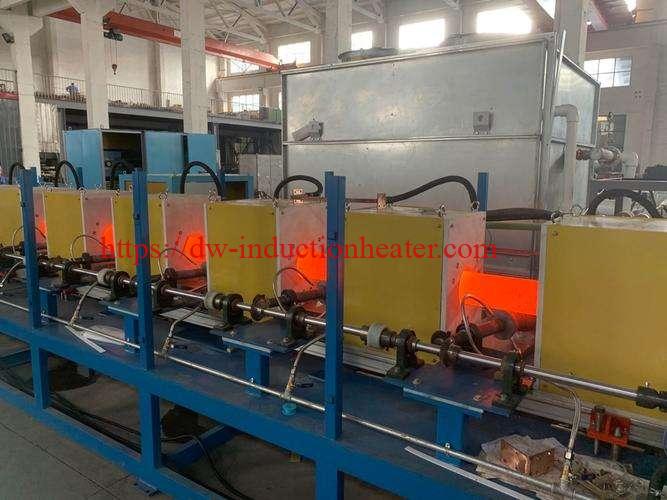
What Is a Medium Frequency Quenching and Tempering Heating Production Line?
A medium frequency Q&T production line combines three key technologies:
- Medium frequency induction heating (1–20 kHz)
Alternating current flows through a copper coil, generating a magnetic field. This induces eddy currents inside the steel workpiece, heating it rapidly and uniformly. - Induction Quenching
The workpiece is heated to its austenitizing temperature (typically 830–880 °C for many structural steels), held for a short time, then rapidly cooled in water, polymer or oil. This forms a hard martensitic structure and boosts strength. - Induction Tempering
After quenching, the workpiece is reheated to a lower tempering temperature (about 500–650 °C). Tempering reduces brittleness and delivers the required balance of hardness, toughness and fatigue resistance.
In a Medium Frequency Quenching and Tempering Heating Production Line, these steps are integrated into a continuous, inline process. Workpieces move from loading to quenching and tempering to unloading without manual transfer, maximizing consistency and throughput.
Working Principle and Process Flow
A typical process flow of a medium frequency Q&T line is:
- Feeding and Positioning
Bars, tubes or shafts are automatically loaded onto roller tables or chain conveyors, aligned and fed at a controlled speed into the inductors. - Medium Frequency Induction Heating for Quenching
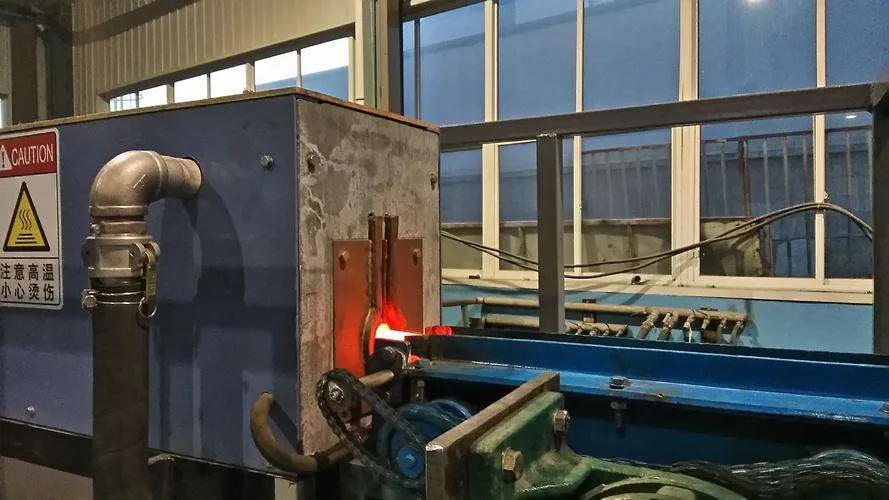
The workpieces pass through custom‑designed induction coils and are heated to the set quenching temperature. Power, frequency and line speed are matched to workpiece size and required heating depth (through‑hardening or partial hardening). - Online Temperature Monitoring
Infrared pyrometers or thermal cameras measure surface temperature. The control system automatically adjusts power and speed to keep the process within tight temperature tolerances. - Quenching Section
Immediately after heating, workpieces enter the quenching zone. Spray rings, laminar flow or immersion tanks provide controlled cooling, ensuring uniform transformation and hardness along the length. - Induction Tempering Section
Quenched parts move directly into the tempering unit. Induction heating quickly brings the steel to the tempering temperature, where it is held for a controlled time to achieve the desired mechanical properties. - Final Cooling, Straightening and Unloading
After tempering, parts cool on a cooling bed or roller table. For bars and shafts, an inline straightening machine can be added. Finally, parts are automatically counted, bundled and unloaded.
Main Components of the Production Line
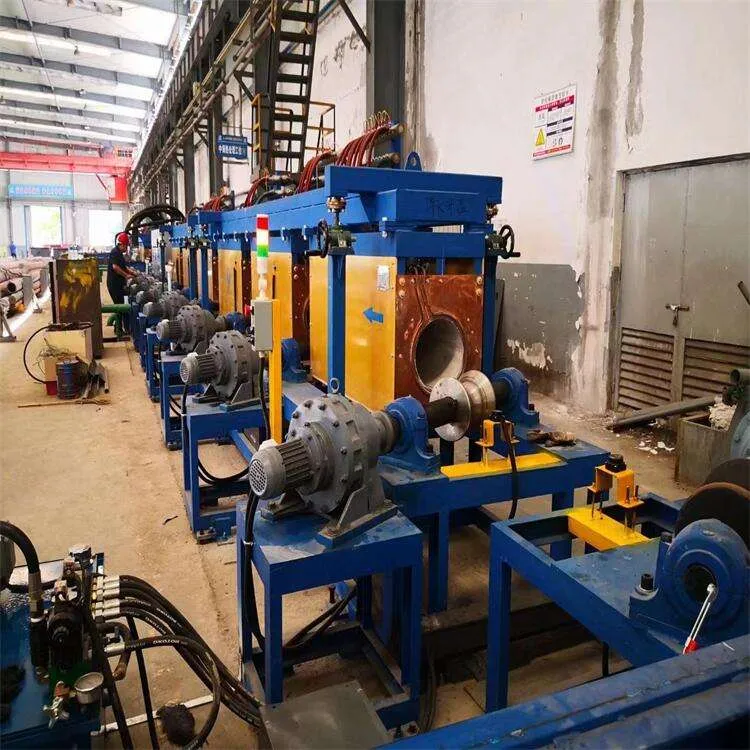
A modern Medium Frequency Quenching and Tempering Heating Production Line typically includes:
- Loading & Feeding System
- Automatic loaders, chain magazines or bundle loaders
- Roller conveyors with stepless speed control
- Accurate alignment and spacing of bars/shafts

- Medium Frequency Power Supply & Induction Coils
- IGBT or SCR‑based MF power sources (1–20 kHz)
- High power factor and high efficiency
- Custom coils for different diameters and shapes
- Quick‑change inductors for fast product changeover
- Quenching System
- Spray ring or laminar flow cooling station
- Immersion tanks for special applications
- Adjustable flow, pressure and temperature of water/polymer/oil
- Filtration and cooling system for quenching medium
- Tempering System
- Medium or low frequency induction tempering stations, or
- Continuous tempering furnace, depending on process design
- Precise temperature and time control
- Cooling, Straightening & Unloading
- Cooling beds or roller conveyors
- Hydraulic or mechanical straightening units
- Automatic counting, bundling and stacking devices
- PLC Control & Monitoring
- PLC + HMI or industrial PC control
- Recipe management for different steel grades and sizes
- Real‑time monitoring of power, frequency, temperature, line speed and quenching parameters
- Data logging for quality traceability and production reports


Technical Parameters of Medium Frequency Q&T Production Lines
The exact configuration of a Medium Frequency Quenching and Tempering Heating Production Line is tailored to your products and capacity requirements. The following tables show typical reference parameters.
Table 1 – Typical Line Configuration Parameters
| Model | Power (kW) | Frequency (kHz) | Workpiece Diameter (mm) | Workpiece Length (m) | Line Speed (m/min) | Productivity (t/h) |
|---|---|---|---|---|---|---|
| MF‑Q&T‑150 | 150 | 8–15 | Ø 15–40 | 2–6 | 2–8 | 0.3–0.8 |
| MF‑Q&T‑300 | 300 | 5–10 | Ø 20–60 | 3–8 | 2–10 | 0.6–1.5 |
| MF‑Q&T‑500 | 500 | 3–8 | Ø 30–80 | 4–10 | 3–12 | 1.0–2.5 |
| MF‑Q&T‑800 | 800 | 3–5 | Ø 40–120 | 4–12 | 3–15 | 2.0–4.0 |
| MF‑Q&T‑1000 | 1000 | 2–4 | Ø 50–150 | 5–14 | 3–18 | 3.0–5.0 |
All values are typical examples; actual design is customized for your product mix and required output.
Table 2 – Typical Process Parameters for Common Steel Grades
| Material | Quenching Temp (°C) | Tempering Temp (°C) | Cooling Medium | Target Hardness (HRC) | Typical Application |
|---|---|---|---|---|---|
| 45# steel | 840–860 | 550–600 | Water / Polymer | 28–34 | General shafts, rods, pins |
| 40Cr | 840–870 | 520–600 | Oil / Polymer | 30–38 | Axle shafts, gear shafts, high‑strength bolts |
| 42CrMo | 840–880 | 540–620 | Oil / Polymer | 32–40 | Heavy‑duty shafts, drill rods |
| 35CrMo | 840–870 | 500–580 | Oil / Polymer | 30–36 | Connecting rods, high‑load parts |
| Alloy tube | 850–900 | 550–650 | Water / Polymer | 28–36 | Mechanical tubes, hydraulic cylinders |
These parameters show how flexible a medium frequency induction quenching and tempering line is when handling different steel grades and performance requirements.
Key Advantages Over Traditional Furnace Heat Treatment
A Medium Frequency Quenching and Tempering Heating Production Line offers multiple competitive advantages:
- Higher Efficiency and Productivity
- Induction heating drastically reduces heating time.
- Continuous operation with adjustable line speed supports mass production.
- Less waiting and intermediate handling between quenching and tempering.
- Superior Quality and Process Control
- Precise control of temperature profile, heating depth and quench intensity.
- Uniform hardness and microstructure along the full length.
- Lower distortion, minimal decarburization and better repeatability.
- Energy Saving and Environmental Performance
- High electrical efficiency; only the workpiece is heated, not the entire furnace volume.
- No combustion gases, cleaner workshop, easier to meet environmental regulations.
- Reduced heat loss and lower cooling and ventilation demand.
- Automation, Flexibility and Digitalization
- Programmed recipes for different diameters, lengths and steel grades.
- Fast coil change enables quick changeover between product types.
- Easy integration with cutting, machining and packaging lines; data can feed MES/ERP systems.
- Lower Total Cost of Ownership
- Less energy and manpower per ton of finished product.
- Lower maintenance compared to large fuel‑fired furnaces.
- Shorter payback period due to higher uptime and reduced scrap rate.
Typical Applications and Industries
Medium frequency quenching and tempering lines are widely used in:
- Automotive & Commercial Vehicles
- Drive shafts, axle shafts, torsion bars, stabilizer bars
- Gear shafts, steering components and suspension parts
- Construction Machinery & Agriculture
- Pins, bushings, bucket rods, track links
- Hydraulic cylinder rods, tie rods, structural bars
- Oil, Gas & Mining
- Drill rods, drill pipes, sucker rods
- Casing, tubing and coupling sleeves
- Metallurgy & General Engineering
- Roller shafts, mandrels, transmission shafts
- High‑strength bolts, spindles, tool and machine components
Wherever components must withstand bending, torsion, impact and cyclic loading, a medium frequency quenching and tempering heating production line helps ensure long service life and stable performance.
How to Choose the Right Medium Frequency Q&T Line
When selecting or designing a Medium Frequency Quenching and Tempering Heating Production Line, consider:
- Workpiece Range
Minimum and maximum diameter, length, weight and material type. - Required Throughput
Tons per hour or pieces per shift, including growth plans. - Mechanical Property Targets
Hardness range, tensile strength, impact toughness and fatigue life. - Automation Level and Layout
Straight or U‑shaped line, available workshop space, integration with upstream cutting and downstream machining/finishing. - Future Expansion
Reserve power capacity, room for additional coils or stations, and compatibility with future digitalization (data collection, traceability, remote diagnostics).
Choosing an experienced induction heating partner ensures that your line is engineered for stable operation, high energy efficiency and long‑term reliability.
Conclusion
A Medium Frequency Quenching and Tempering Heating Production Line is a powerful solution for modern, high‑volume steel heat treatment. By combining medium frequency induction quenching and precise tempering in a fully automated, continuous process, you gain:
- Higher productivity and faster delivery
- Stable, repeatable mechanical properties
- Lower energy consumption and operating cost
- Better environmental performance and easier automation
For manufacturers of shafts, bars, tubes and high‑strength structural components, investing in a medium frequency Q&T production line is a strategic step toward higher product quality and stronger competitiveness in the global market.
FAQS
1. What is the difference between Medium Frequency and High Frequency for Quenching and Tempering?
The main difference lies in the depth of heat penetration. High Frequency (typically 100 kHz+) utilizes the “skin effect,” heating only the very surface of the metal, which is ideal for surface hardening gears or small shafts. Medium Frequency (1 kHz – 20 kHz) penetrates much deeper into the core of the workpiece. For Quenching and Tempering (Q&T), where the goal is to achieve uniform mechanical properties throughout the entire cross-section of a thick bar or pipe, Medium Frequency is the required standard to ensure the core is heated as thoroughly as the surface.
2. Can one production line handle multiple diameters of steel bars or pipes?
Yes, but it requires some setup changes. A modern Q&T line is designed for flexibility. The PLC control system can store specific “recipes” (power settings, speed, and quench pressure) for different diameters. However, to maintain electrical efficiency, the induction coils usually need to be physically changed when there is a significant change in workpiece diameter (e.g., switching from 20mm to 80mm). Most lines feature “quick-change” coil assemblies to minimize downtime during these changeovers.
3. How does induction heating compare to traditional gas furnaces in terms of energy efficiency?
Induction heating is significantly more efficient. A traditional gas furnace often has a thermal efficiency of only 40-60% and requires hours of pre-heating and idling, burning fuel even when not processing steel. An induction line has an electrical efficiency of over 95% and generates heat directly inside the metal instantly. It creates “instant-on, instant-off” capability, meaning you only consume energy when a workpiece is actually passing through the coil.
4. How does the production line prevent long bars from bending or warping during heat treatment?
Straightness is maintained through the use of skew rollers (V-rollers) and rotation. As the workpiece travels through the heating and quenching sections, the angled rollers force it to rotate continuously. This rotation ensures that the heat is applied evenly to the entire circumference, and the cooling spray hits all sides equally. This uniform thermal expansion and contraction drastically reduce internal stresses that lead to warping.
5. What are the most critical maintenance tasks for a Medium Frequency Q&T line?
Based on common operational issues, the three most critical maintenance tasks are:
- Coil Cleaning: Regularly removing oxide scale (buildup) from the inside of the induction coils to prevent arcing.
- Cooling System Checks: Ensuring the closed-loop water system uses clean, distilled water to prevent blockages in the IGBT power supply or copper coils.
- Sensor Calibration: Cleaning the lenses of the infrared pyrometers (thermometers) to ensure smoke or steam isn’t blocking the view, which guarantees accurate temperature control.