
10 Key Applications of Induction Heating for Thermal Disassembly and Assembly on Large Machinery
Induction heating has become a core technology in modern heavy industry. From wind turbines and mining equipment to steel mills and marine propulsion systems, maintenance teams rely on induction for fast, controlled, and contactless heating during both disassembly and assembly.
By generating heat directly inside metal components using electromagnetic induction fields, induction heating avoids open flames, reduces energy waste, and minimizes thermal damage to surrounding parts. This makes it ideal for precision thermal expansion and contraction when working on large machinery.
Below are 10 key applications where induction heating delivers major advantages for thermal disassembly and assembly.

1. Induction Mounting and Dismounting Large Bearings
Large roller, spherical, and taper bearings are critical in gearboxes, generators, crushers, and turbines. They must be installed and removed without damage to raceways or shafts.
How induction helps:
- Assembly: Bearings are heated uniformly to a controlled temperature, causing them to expand and slide easily onto shafts without excessive force.
- Disassembly: Controlled heating of the inner ring releases the interference fit, allowing safe removal without cracking or scoring the shaft.
Benefits:
- No mechanical hammering or pressing
- Reduced risk of bearing distortion
- Faster changeovers and longer shaft life
2. Shrink-Fitting Gears on Shafts
Large gears in heavy machinery often use shrink fits for high torque transmission and precise alignment.
How induction helps:
- Gears or hubs are heated rapidly and uniformly, expanding enough to slip over the shaft.
- After cooling, the interference fit restores a secure, backlash-free connection.
Benefits:
- Precise, repeatable fits without machining on-site
- Reduced assembly time compared to ovens or torches
- No contamination from open flames or combustion byproducts
3. Mounting and Removing Couplings and Hubs
Flexible and rigid couplings, pulleys, and hubs are common in pumps, compressors, and marine drives. Many are shrink-fitted on shafts.
How induction helps:
- Heats only the coupling or hub, not the shaft, for controlled expansion.
- Enables easy removal of seized or corroded couplings during maintenance shutdowns.
Benefits:
- Minimal risk of shaft damage
- Faster turnaround on critical rotating equipment
- Clean, localized heating in confined spaces
4. Induction Thermal Disassembly of Stuck or Corroded Bolts and Fasteners
In large structures—turbines, press frames, offshore equipment—bolts can seize due to corrosion, high temperature, or long service.
How induction helps:
- Induction heating concentrates heat in the bolt or nut, causing slight expansion and breaking rust bonds.
- Targeted thermal cycling (heating and cooling) can free even heavily seized fasteners.
Benefits:
- Reduced need for cutting, grinding, or drilling
- Lower risk of damaging flanges and mating surfaces
- Safer and faster than oxy-fuel torches

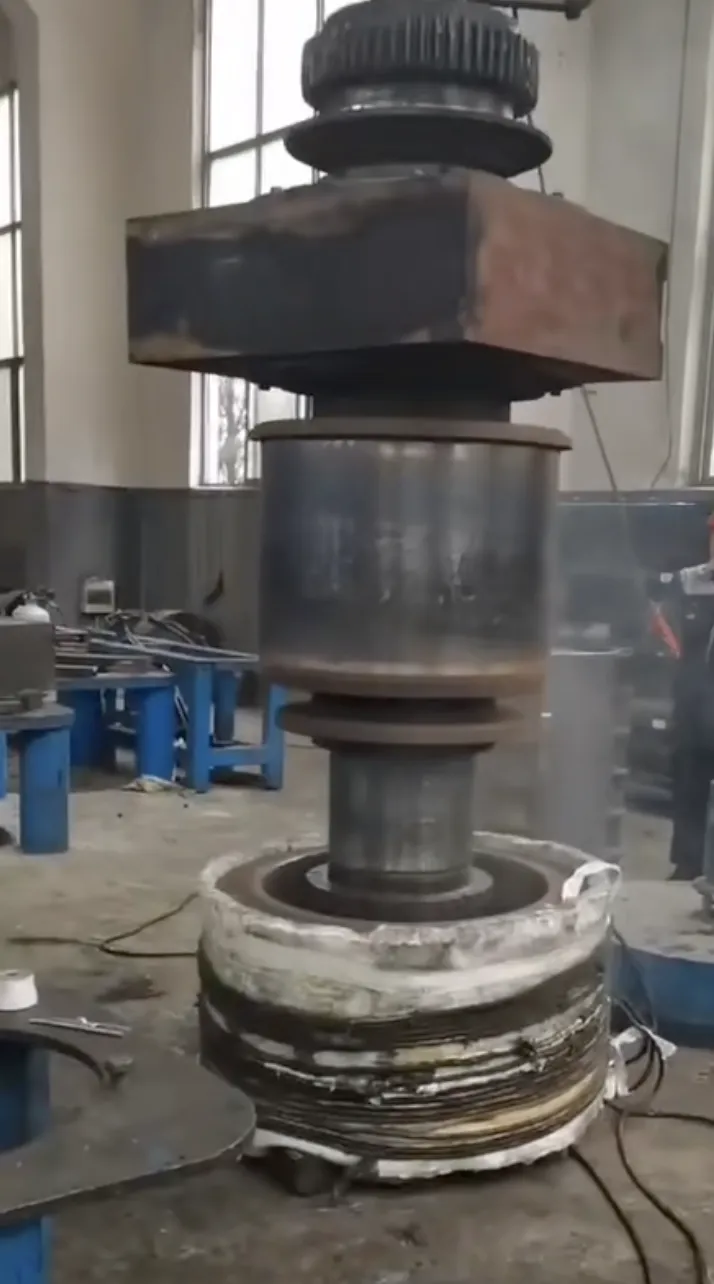
5. Removal of Bushings, Sleeves, and Bearing Races
Shrink-fitted bushings, sleeves, and outer bearing races are often pressed into housings, gearboxes, or casings where access is limited.
How induction helps:
- Heats the bushing or race from the inside or outside, depending on coil design.
- Differential heating breaks the interference fit so the component can be extracted with minimal force.
Benefits:
- Less risk of deforming housings or casings
- Reduced mechanical stress and fewer scrap parts
- Ideal for thick sections and large diameters
6. Induction Assembly and Disassembly of Large Rings and Tires
In rolling mills, cement kilns, and heavy wheels, large rings or “tires” are mounted on drums or shells using shrink fits.
How induction helps:
- Rapidly heats large rings uniformly, allowing quick mounting over drums.
- During disassembly, controlled heating allows safe removal without cutting.
Benefits:
- Precise temperature control for uniform expansion
- Shorter downtime for kiln or mill maintenance
- Improved safety over traditional flame heating
7. Rotor and Shaft Component Assembly in Generators and Motors
High-power generators, traction motors, and large electric machines use shrink-fitted rotor shafts, end rings, and laminated cores.
How induction helps:
- Controlled heating of rotor components for interference fits.
- Localized heating of areas to be disassembled without affecting windings or insulation.
Benefits:
- Protection of sensitive electrical insulation
- High repeatability for OEM and service centers
- Reduced risk of core distortion or misalignment
8. Turbine and Compressor Rotor Stack Assembly
In gas and steam turbines, disks, spacers, and shaft sections are assembled into rotor stacks with tight tolerance fits.
How induction helps:
- Precision heating of individual turbine disks for stacking.
- Enables repeatable assembly procedures that meet strict aerospace and power-generation standards.
Benefits:
- Tight control of axial clearances and alignment
- Minimal oxidation compared to furnace heating
- Higher productivity in OEM and overhaul operations
9. Controlled Heating for Casing and Frame Alignment
Large machinery casings, frames, and welded structures may require controlled thermal movement for alignment, straightening, or correction.
How induction helps:
- Applies localized heat lines or patterns to induce controlled expansion.
- Used to relieve stresses, correct distortions, or adjust alignment between mating surfaces.
Benefits:
- Non-contact, highly controllable heat input
- Less risk of overheating adjacent components
- Reduced reliance on mechanical bending or re-machining
10. On-Site Maintenance and Retrofit of Heavy Industrial Equipment
Portable induction systems enable in-situ repairs on mining trucks, wind turbines, marine propulsion systems, and steel plant equipment.
Typical tasks:
- Removing large bearings and gears in the field
- Dismounting couplings on propulsion shafts
- Heating seized pins, studs, or flanges for removal
- Installing retrofit components via shrink fitting
Benefits:
- Less dismantling of surrounding equipment
- Reduced transport of heavy parts to workshops
- Shorter outage times and lower maintenance costs
Advantages of Induction Heating for Thermal Disassembly and Assembly
Across all these applications, induction heating offers consistent benefits for large machinery work:
- Speed: Rapid, direct heating of metal parts reduces downtime.
- Precision: Accurate temperature control improves fit quality and consistency.
- Safety: No open flames; lower surface temperatures around the heated zone.
- Energy Efficiency: High efficiency compared to resistance or furnace heating.
- Quality: Less risk of overheating, warping, or degrading adjacent components.
For industries that depend on high uptime—power generation, steel, cement, mining, oil & gas, marine—induction heating has become the go-to solution for reliable, controlled thermal disassembly and assembly of critical components.
10 Key Applications of Induction Heating for Thermal Disassembly and Assembly on Large Machinery