Induction Brazing Stainless Steel Tubes
Induction Brazing Stainless Steel to Brass: Valve Seat Joints at 1325 °F in 7 Seconds
Quick Answer
Induction brazing of stainless steel to brass joins the two dissimilar metals with a braze alloy that is melted by an induction coil and drawn into the joint, without melting either part. In this HLQ case, a stainless steel valve seat was brazed to a 0.25″ ID threaded brass plumbing fixture to improve assembly reliability. With a braze ring preform, black flux, a 0.002″–0.003″ joint clearance and a two-turn helical coil, a DW-UHF-6kW-III induction power supply at 300 kHz brought the joint to 1325 °F (718 °C) in 7 seconds in open air. The braze alloy flowed into the joint and formed a strong, clean bond with consistent, repeatable results.
Table of Contents
- What is Induction Brazing of Stainless Steel to Brass?
- Key Applications
- Suitable Materials
- Working Principle
- Technical Specifications
- Recommended Model Selection
- Process Workflow
- Common Problems and Solutions
- Engineering Selection Guide
- Advantages and Limitations
- Why Choose HLQ?
- 10 Core FAQs
What is Induction Brazing of Stainless Steel to Brass?
Induction brazing of stainless steel to brass uses an induction coil to heat the joint between a stainless steel part and a brass part until a braze alloy melts and flows into the close-fitting gap. In the HLQ case, the research objective was to braze a stainless steel valve seat to a brass plumbing fixture and improve assembly reliability. Induction brazing produces a strong, clean joint, which is ideal for this type of consumer product.
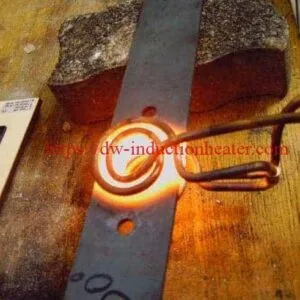
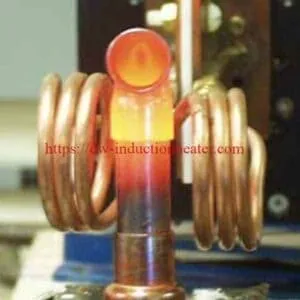
 The image shows the stainless steel to brass brazing application from the HLQ case.
Key Applications

| HLQ case | Filler / flux | Temperature | Time | Equipment |
|---|---|---|---|---|
| Stainless valve seat to brass fixture (this page) | Braze ring preform, black flux | 1325 °F (718 °C) | 7 s | DW-UHF-6kW-III, 300 kHz |
| Induction brazing stainless steel tubes | BAg-24 wire preforms, black flux | 1330 °F (721 °C) | 20 s | DW-UHF-10kW, 300 kHz |
| Induction brazing stainless steel tubing joints | Stay Silv filler | 1472 °F (800 °C) | 15 s, 8 kW | DW-UHF-10kW |
| Brass fitting to copper tube | Silver solder rings | 1300 °F (704 °C) | – | DW-UHF-20kW, 283 / 250 kHz |
| Brass tube to brass disk | Sil-Fos rod, flux | 1475–1500 °F (801–815 °C) | 45 s, 5 kW | DW-HF-15kW |
Suitable Materials
| Item | This case | Related HLQ data |
|---|---|---|
| Base metals | Stainless steel valve seat; brass plumbing fixture (0.25″ ID, threaded) | Stainless tubes; copper to stainless steel; brass to copper |
| Filler | Braze ring preforms | BAg-24 wire, Stay Silv, silver solder rings, Sil-Fos rod |
| Flux | Black flux | Black flux, B1 flux, Stay Silv flux |
| Joint clearance | 0.002″–0.003″ (0.05–0.08 mm) | – |
Working Principle

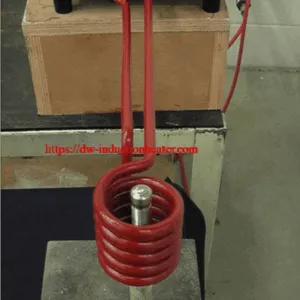
The DW-UHF-6kW-III supplies 300 kHz current to a specially designed two-turn helical inductor around the joint area of the plumbing assembly. Eddy currents heat the stainless steel seat and the brass fixture at the joint. At 1325 °F the braze ring melts, and the 0.002″–0.003″ clearance lets capillary action draw the alloy into the joint. Neither base metal is melted.
Technical Specifications
| Parameter | Case data |
|---|---|
| Research objective | Braze a stainless steel valve seat to a brass plumbing fixture and improve assembly reliability |
| Parts | Stainless steel valve seat; 0.25″ (6.35 mm) ID threaded brass plumbing fixture |
| Filler and flux | Braze ring preforms; black flux |
| Temperature required | 1325 °F (718 °C) |
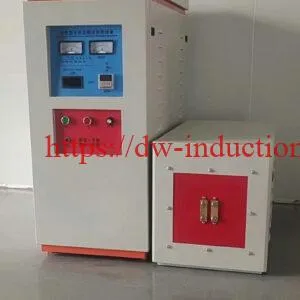
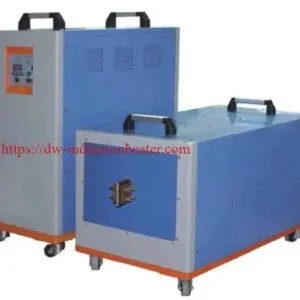
| Induction heating equipment | DW-UHF-6kW-III induction heating power supply; two-turn helical inductor (coil) |
| Operating frequency | 300 kHz |
| Joint clearance | 0.002″–0.003″ (0.05–0.08 mm) |
| Atmosphere | Open air |
| Heating time | 7 seconds to brazing temperature |
| Result | Consistent, repeatable results at 1325 °F within 7 seconds; the braze flowed well and formed a strong bond |
Recommended Model Selection
DW-UHF series from the HLQ induction heating device model table (all 100% duty cycle):
| Model | Power | Max. input current | Frequency | Supply |
|---|---|---|---|---|
| DW-UHF-4.5kW | 4.5 kW | 20 A | 1.1–2.0 MHz | 1-phase 220 V |
| DW-UHF-6.0kW (this case: 6kW-III) | 6.0 kW | 28 A | 300–1100 kHz | 1-phase 220 V |
| DW-UHF-10kW | 10 kW | 15 A | 100–500 kHz | 3-phase 380 V |
| DW-UHF-20kW | 20 kW | 30 A | 50–250 kHz | 3-phase 380 V |
| DW-UHF-30kW | 30 kW | 45 A | 50–200 kHz | 3-phase 380 V |
Process Workflow

- Profile – heat bare parts with temperature sensing paints to establish time-to-temperature and heating profiles.
- Position – place the valve seat in the brass fixture with a joint clearance of 0.002″–0.003″.
- Preform – position the braze ring preform.
- Flux – apply black flux to the assembly.
- Heat – apply induction power for 7 seconds to reach 1325 °F.
- Flow – the braze alloy flows into the joint.
- Result – a strong, clean, repeatable joint.

Common Problems and Solutions
| Problem | Possible cause | Solution (HLQ case data) |
|---|---|---|
| Braze alloy does not flow into the joint | Clearance too large or too small | Use a joint clearance of 0.002″–0.003″, as in this case |
| Unknown heating time | New assembly or coil | Establish time-to-temperature on bare parts with temperature sensing paints |
| Oxidation in open air | Heating without protection | Apply flux (black flux in this case) |
| Uneven heating of seat and fixture | Coil not matched to the joint | Use a specially designed coil; a two-turn helical inductor gave optimal heating here |
| Unreliable assemblies | Manual, variable heating | Same coil position and 7-second cycle for every assembly |
| Coil overheats | Insufficient cooling water | Check water flow, pressure and water quality |
Engineering Selection Guide
- Small plumbing parts: DW-UHF-6kW-III at 300 kHz brazed the valve seat joint in 7 seconds.
- Stainless tubes: DW-UHF-10kW at 300 kHz, 20 seconds per joint.
- Larger brass parts: DW-HF-15kW (brass tube to brass disk, 45 seconds).
- Joint design: keep a clearance of about 0.002″–0.003″ for capillary flow.
- Supply: the DW-UHF-6kW runs on single-phase 220 V; DW-UHF-10kW and above use 3-phase 380 V.
- Data to send: part drawings, materials, joint clearance, filler and flux, cycle time, parts per hour, supply voltage and cooling water.
Advantages and Limitations
| Advantages | Limitations |
|---|---|
| Joins stainless steel to brass | A close joint clearance is required |
| 7-second heating cycle | Flux is needed in open air |
| Strong, clean joints for consumer products | The coil must be designed for the assembly |
| Consistent, repeatable results; improved assembly reliability | Heating profile must be established by test |
Why Choose HLQ?
- Published stainless steel and brass brazing cases with temperature, time and equipment data.
- Compact single-phase DW-UHF-6kW systems for small assemblies.
- Heating profiles established with temperature sensing paints before production.
- Specially designed coils for each joint.
10 Core FAQs
1. What was brazed in this case?
A stainless steel valve seat to a 0.25″ ID threaded brass plumbing fixture.
2. Why use induction brazing?
To improve assembly reliability. Induction brazing produces a strong, clean joint, ideal for consumer products.
3. Which filler was used?
Braze ring preforms.
4. Was flux used?
Yes. Black flux was applied to the assembly.
5. What temperature was required?
1325 °F (718 °C).
6. How long did heating take?
7 seconds.
7. Which equipment and frequency were used?
A DW-UHF-6kW-III induction heating power supply at 300 kHz.
8. Which coil was used?
A specially designed two-turn helical inductor.
9. What joint clearance was used?
0.002″ to 0.003″ (0.05–0.08 mm).
10. What information is needed for a quotation?
Part drawings, materials, joint clearance, filler and flux, cycle time, output, and available power supply and cooling water.