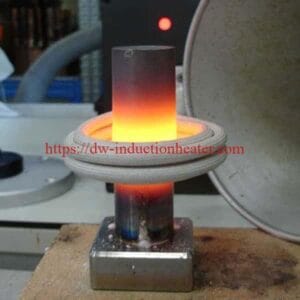


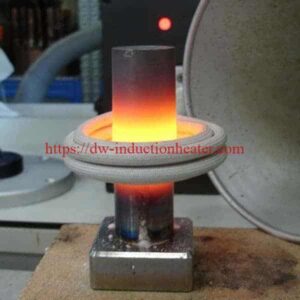
Induction Brazing Copper
Induction Brazing Copper: Brass Fittings with O-Rings to 3/8″–7/8″ Copper Tubes
Quick Answer
Induction brazing copper joins copper tubes to fittings with a filler melted by an induction coil, heating only the joint zone. In this HLQ case, female brass fittings with O-rings were brazed to copper tubes from 3/8″ to 7/8″ diameter using silver solder rings at 1300 °F (704 °C). A three-turn helical coil with a 1.5″ ID heated the tube–fitting junction for 30 seconds. Meanwhile, the brass fitting stood on a ceramic mandrel in a beaker of water, half submerged, so the O-ring did not melt. The solder ring flowed evenly and created a strong, aesthetically pleasing bond without overheating the fitting. Equipment stated in the case: DW-UHF-20kW with a 0.75 µF remote workhead.
Table of Contents
- What is Induction Brazing of Copper?
- Key Applications
- Suitable Materials
- Working Principle
- Technical Specifications
- Recommended Model Selection
- Process Workflow
- Common Problems and Solutions
- Engineering Selection Guide
- Advantages and Limitations
- Why Choose HLQ?
- 10 Core FAQs
What is Induction Brazing Copper?
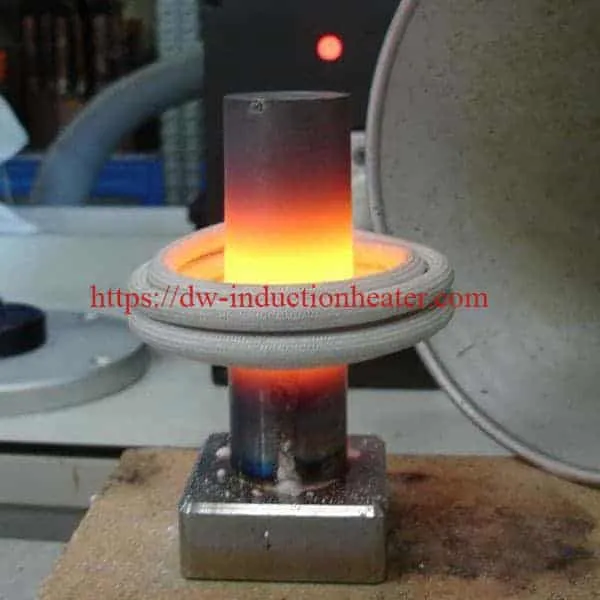
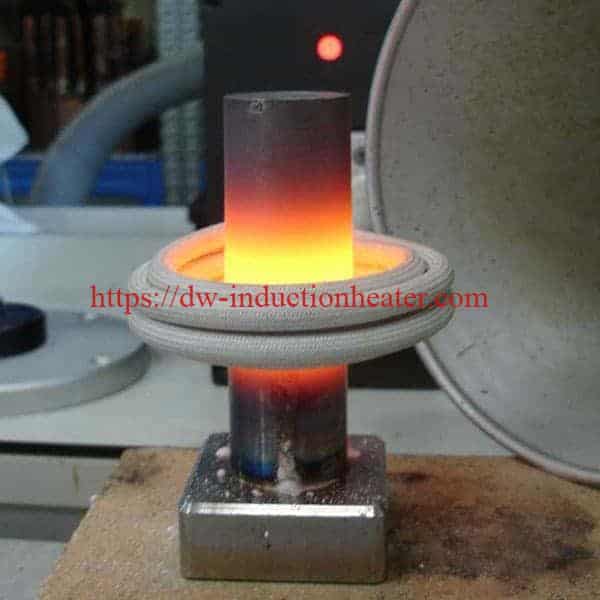
Induction brazing of copper uses a coil around the joint to heat copper tubes and fittings until a filler, here a silver solder ring, melts and flows into the joint. Because the coil directs heat only to the required zone, heat-sensitive parts such as O-rings can be protected. The objective of this HLQ case was to braze a brass fitting with an O-ring to various diameters of copper tube. For the general method, see the induction brazing process.
Key Applications
- Brass fittings with O-rings on copper tubes: water-bath brazing (this case).
- Copper tube assemblies without flux: see induction brazing copper tube in an argon/hydrogen atmosphere.
- Copper tube to brass fitting joints: see brazing copper tube to brass fitting.
- HVAC and refrigeration tubing: see HVAC brazing with induction heating system.
| HLQ copper brazing case | Filler / flux | Temperature | Time | Equipment |
|---|---|---|---|---|
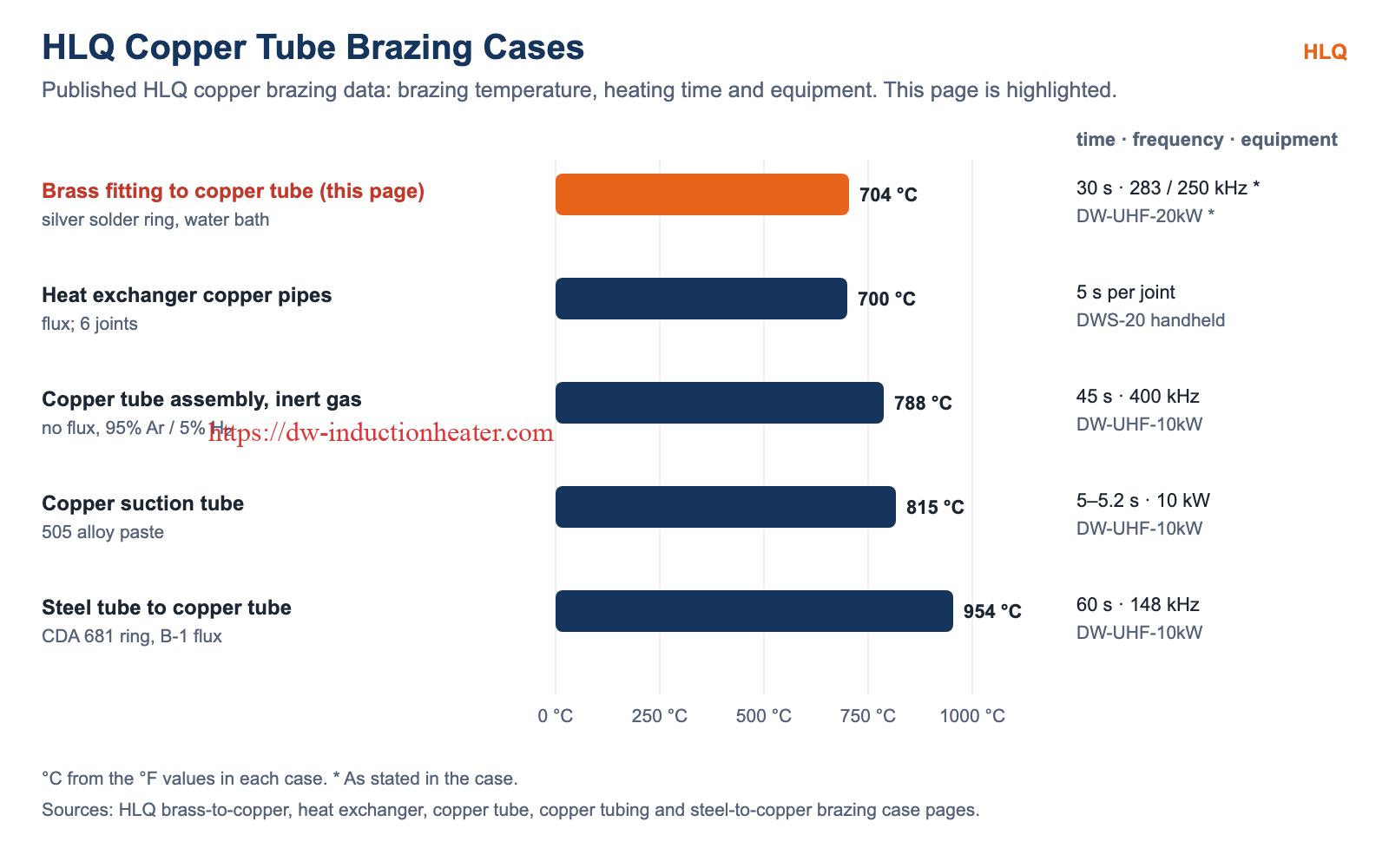
| Brass fitting to copper tube, water bath (this page) | Silver solder rings | 1300 °F (704 °C) | 30 s | DW-UHF-20kW, 283 / 250 kHz (as stated) |
| Copper tube assembly, inert gas | Braze pre-forms, no flux | 1450 °F (788 °C) | 45 s | DW-UHF-10kW, 400 kHz |
| Brazing copper tubing with induction (suction tube) | 505 alloy paste | ≈ 1500 °F (815 °C) | 5–5.2 s | DW-UHF-10kW |
| Heat exchanger copper pipes | Brazing flux | ≈ 1292 °F (700 °C) | 5 s per joint | DWS-20 handheld |
| Steel tube to copper tube | CDA 681 ring, B-1 flux | ≈ 1750 °F (954 °C) | 60 s | DW-UHF-10kW, 148 kHz |
Suitable Materials
| Item | This case | Related HLQ data |
|---|---|---|
| Tubes | Copper, 3/8″–7/8″ (9.5–22.2 mm) diameter, 2–3 ft (0.6–0.9 m) long | Copper suction tube; copper tube assemblies |
| Fittings | Female brass fittings with O-ring | Brass to brass: induction brazing brass tube to brass disk |
| Filler | Silver solder rings | 505 alloy paste; Sil-Fos rod; braze pre-forms |
| Heat-sensitive component | O-ring, protected by a water bath | – |
Working Principle
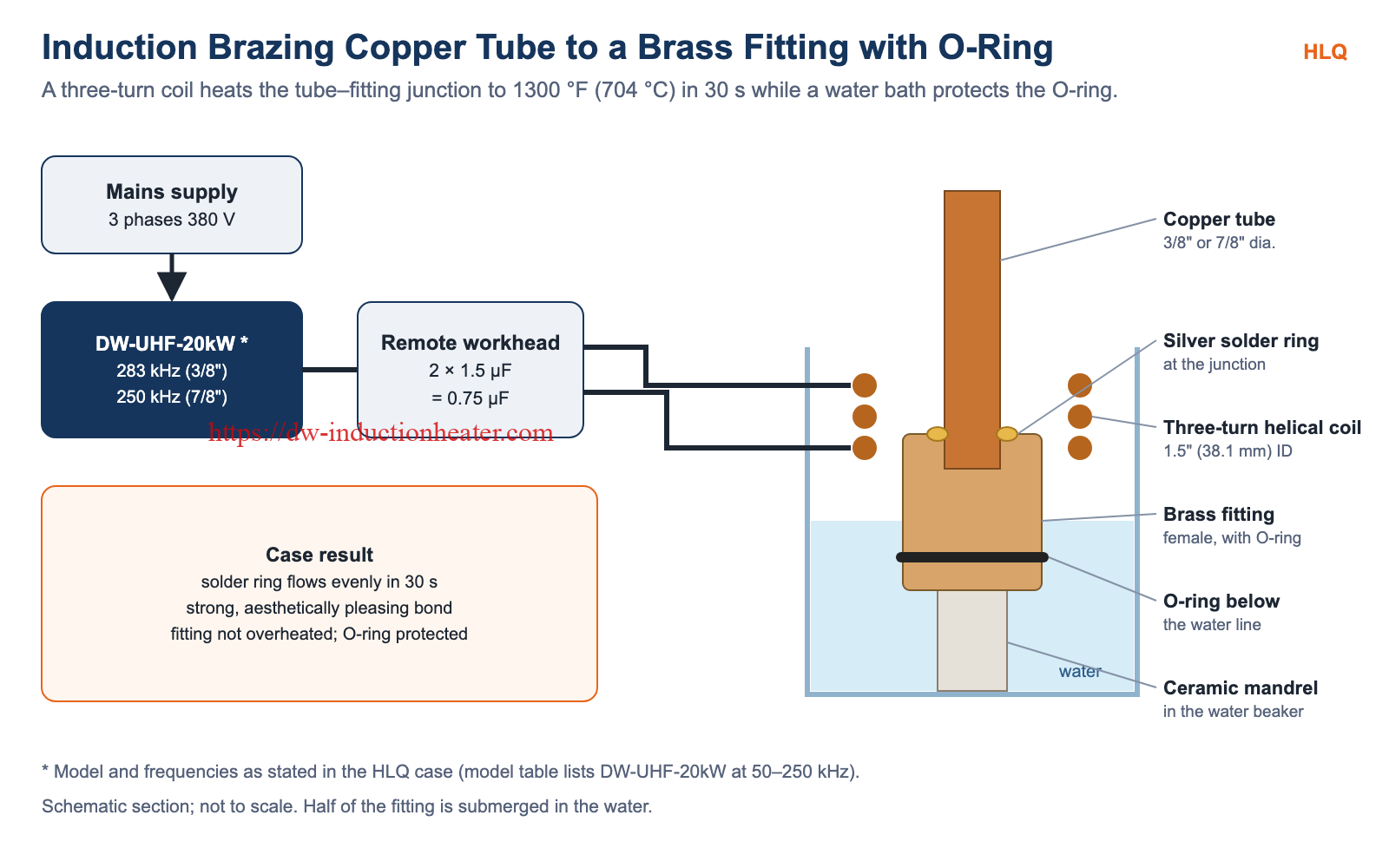
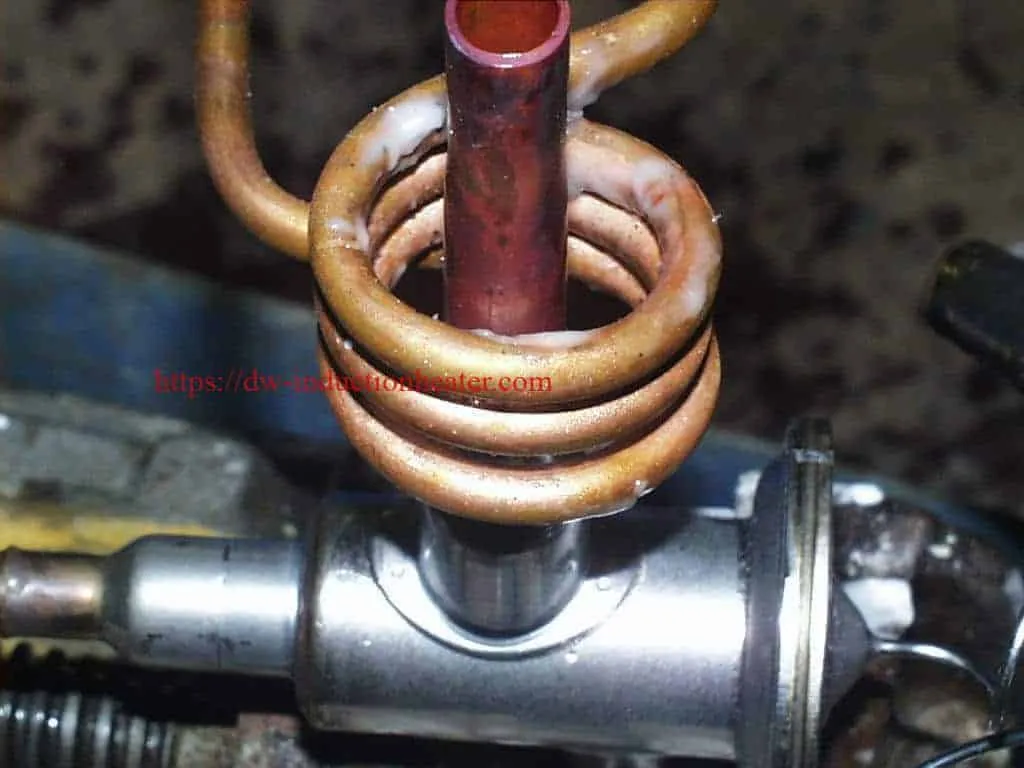
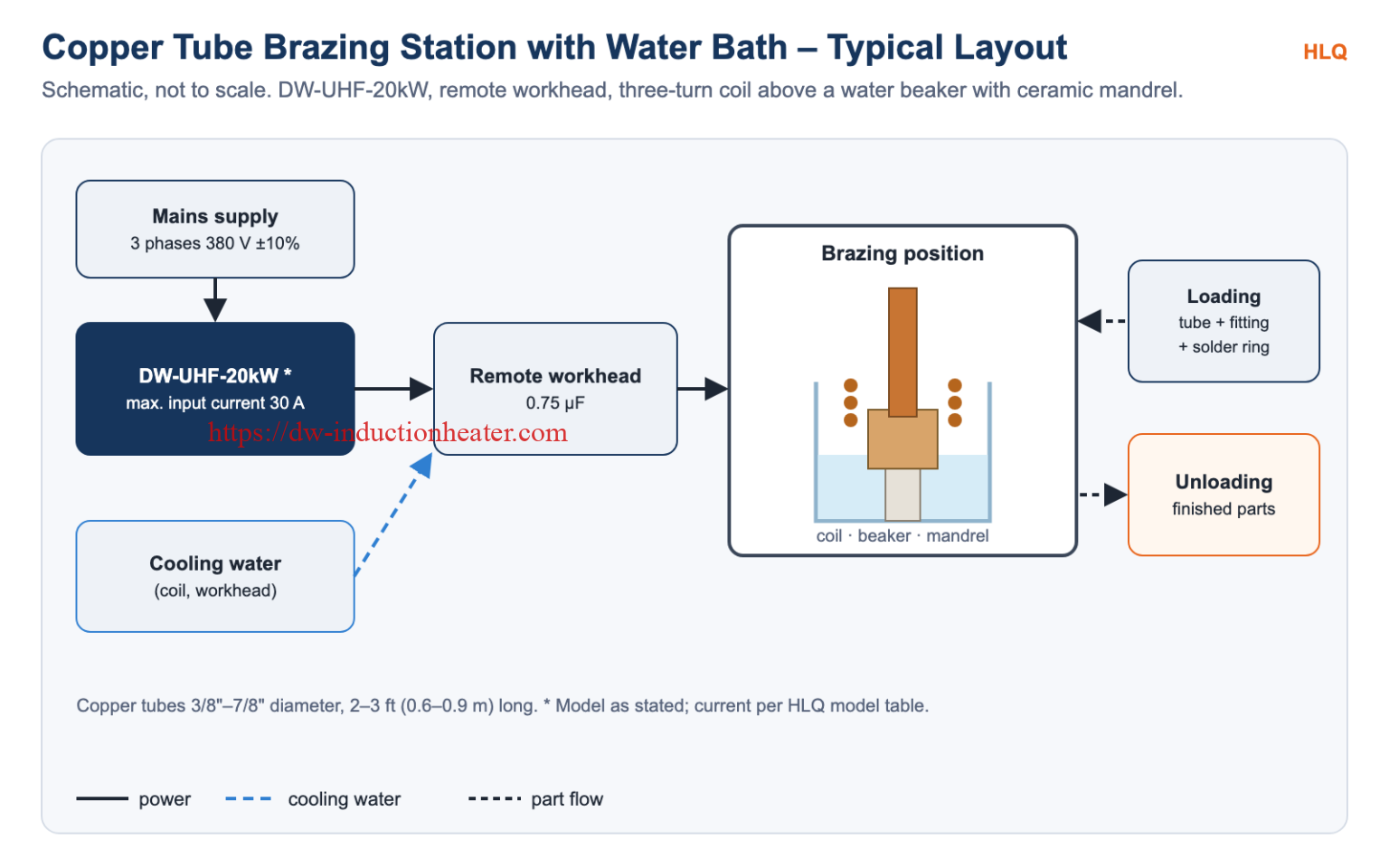
The induction power supply and remote workhead (two 1.5 µF capacitors, 0.75 µF total) drive current through a three-turn helical coil placed at the junction of the copper tube and the brass fitting. The coil heats only the required zone, so the silver solder ring melts and flows evenly into the joint. The brass fitting stands on a ceramic mandrel in a beaker of water with half of the fitting submerged, which keeps the O-ring from melting.
Technical Specifications
| Parameter | Case data |
|---|---|
| Objective | Braze a brass fitting with O-ring to various diameters of copper tube |
| Materials | Copper tubes 3/8″–7/8″ (9.5–22.2 mm) diameter, 2–3 ft long; female brass fittings with O-ring; silver solder rings; glass beaker |
| Temperature | 1300 °F (704 °C) |
| Frequency (as stated) | 283 kHz for the 3/8″ (9.5 mm) tube; 250 kHz for the 7/8″ (22.2 mm) tube |
| Equipment (as stated) | DW-UHF-20kW induction heating system; remote workhead with two 1.5 µF capacitors (0.75 µF total) |
| Coil | Three-turn helical coil, 1.5″ (38.1 mm) ID, for the 3/8″ tube; slightly larger three-turn coil for the 7/8″ tube |
| Fixture | Ceramic mandrel in a beaker of water; half of the fitting submerged |
| Heating time | 30 seconds |
| Result | Solder ring flows evenly, creating a strong, aesthetically pleasing bond without overheating the fitting |
Recommended Model Selection
DW-UHF series from the HLQ induction heating device model table (all 100% duty cycle):
| Model | Power | Max. input current | Frequency | Supply |
|---|---|---|---|---|
| DW-UHF-6.0kW | 6.0 kW | 28 A | 300–1100 kHz | 1-phase 220 V |
| DW-UHF-10kW | 10 kW | 15 A | 100–500 kHz | 3-phase 380 V |
| DW-UHF-20kW (stated in this case) | 20 kW | 30 A | 50–250 kHz | 3-phase 380 V |
| DW-UHF-30kW | 30 kW | 45 A | 50–200 kHz | 3-phase 380 V |
| DW-UHF-40kW | 40 kW | 60 A | 50–200 kHz | 3-phase 380 V |
Note: the case states 283 kHz for the 3/8″ tube, above the 250 kHz upper limit listed for the DW-UHF-20kW. Confirm the model and frequency for your application.
Process Workflow
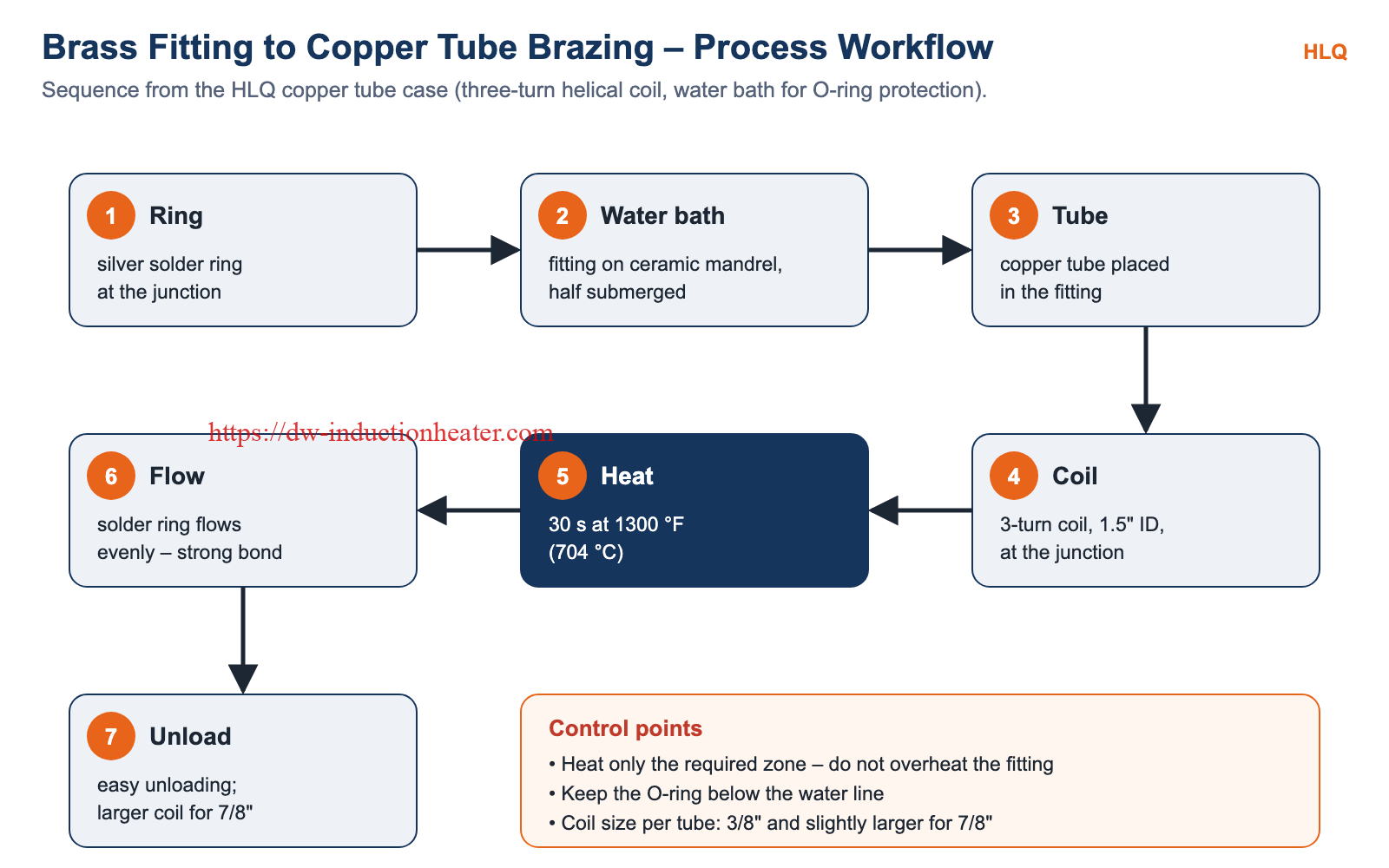
- Ring – place the silver solder ring at the tube–fitting junction.
- Water bath – set the brass fitting on a ceramic mandrel in a beaker of water, with half of the fitting submerged.
- Tube – insert the copper tube into the fitting.
- Coil – position the three-turn, 1.5″ ID helical coil at the junction (a slightly larger coil for 7/8″ tube).
- Heat – apply heat for 30 seconds to reach 1300 °F.
- Flow – the solder ring flows evenly and forms a strong bond.
- Unload – the coil size and geometry allow easy unloading of finished parts.

Common Problems and Solutions
| Problem | Possible cause | Solution (HLQ case data) |
|---|---|---|
| O-ring melts | Heat spreading into the fitting | Stand the fitting on a ceramic mandrel in water with half of it submerged |
| Fitting overheats | Heat not limited to the joint | Direct heat only to the required zone with a three-turn coil at the junction |
| Uneven solder flow | Coil not matched to the tube size | Use a 1.5″ ID three-turn coil for 3/8″ tube and a slightly larger coil for 7/8″ tube |
| Slow loading and unloading | Coil geometry obstructs the part | Choose a coil size and geometry that allow easy loading and unloading |
| Coil overheats | Insufficient cooling water | Check water flow, pressure and water quality |
Engineering Selection Guide
- Heat-sensitive seals: combine zoned induction heating with a water bath, as in this case.
- Coil per tube size: 1.5″ ID three-turn coil for 3/8″ tube; slightly larger for 7/8″ tube.
- Fluxless copper assemblies: inert-gas brazing with DW-UHF-10kW at 400 kHz.
- Fast copper joints in air: DW-UHF-10kW, 5–5.2 seconds in the suction tube case.
- Frequency: choose a model whose range covers the required frequency.
- Data to send: tube diameter and length, fitting type and seals, filler and flux, cycle time, parts per hour, supply voltage and cooling water.
Advantages and Limitations
| Advantages | Limitations |
|---|---|
| Heat directed only to the required zone | A water bath and ceramic mandrel are needed to protect the O-ring |
| Coil size and geometry allow easy loading and unloading | Each tube size needs its own coil |
| Coil works with the water-bath process for O-ring stability | Heating time is set by test (30 seconds here) |
| Strong, aesthetically pleasing, even solder joints | Water cooling is required for the coil |
Why Choose HLQ?
- Published copper brazing cases: brass fittings, inert-gas assemblies, suction tubes, heat exchangers and steel-to-copper joints.
- Coils sized for each tube diameter.
- Processes that protect heat-sensitive seals during brazing.
- DW-UHF power supplies from 4.5 kW to 60 kW, all rated for 100% duty cycle.
10 Core FAQs
1. What was brazed in this case?
Female brass fittings with O-rings to copper tubes of 3/8″ to 7/8″ diameter.
2. Which filler was used?
Silver solder rings.
3. What temperature was required?
1300 °F (704 °C).
4. How long did each joint take?
Heat was applied for 30 seconds.
5. How was the O-ring protected?
The brass fitting stood on a ceramic mandrel in a beaker of water, with half of the fitting submerged.
6. Which coil was used?
A three-turn helical coil with a 1.5″ (38.1 mm) ID for the 3/8″ tube, and a slightly larger three-turn coil for the 7/8″ tube.
7. Which equipment does the case state?
A DW-UHF-20kW induction heating system with a remote workhead of two 1.5 µF capacitors (0.75 µF total).
8. What frequencies does the case state?
283 kHz for the 3/8″ tube and 250 kHz for the 7/8″ tube.
9. What are the benefits?
Heat directed only to the required zone, easy loading and unloading, and O-ring stability with the water-bath process.
10. What information is needed for a quotation?
Tube diameter and length, fitting type and seals, filler and flux, cycle time, output, and available power supply and cooling water.