brazing copper to stainless steel
Induction Brazing Copper to Stainless Steel for Cryogenic Pump Components
How Do You Braze Copper to Stainless Steel with Induction Heating?
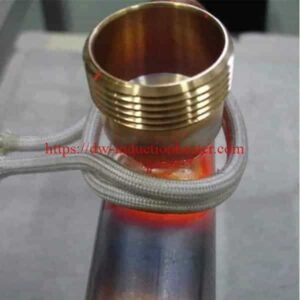
Induction brazing copper to stainless steel uses a controlled electromagnetic field to heat the dissimilar-metal joint until the brazing alloy melts and flows between the copper and stainless-steel surfaces by capillary action.
Objective
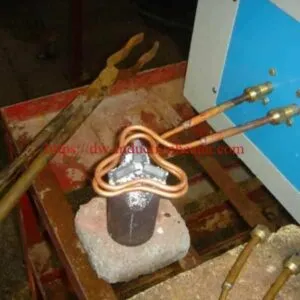
Induction Brazing copper pipe to stainless steel pipe. Cryogenic Pumps and Housings.
Equipment
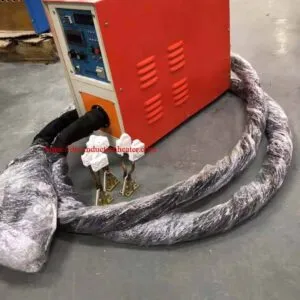
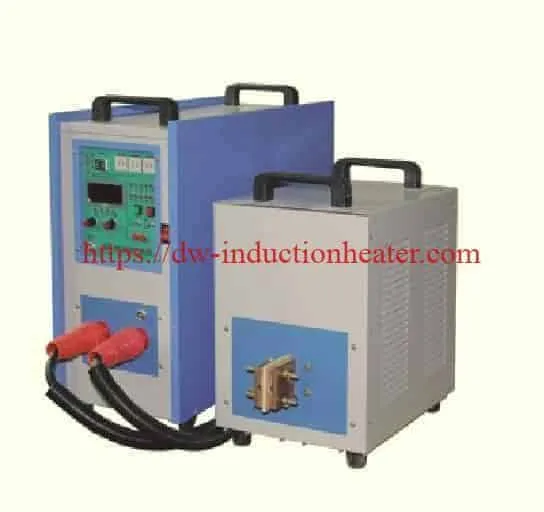
DW-HF-15kw/25KW/45KW induction heating equipment
Test 1
Materials
Cryogenic Pumps and Housings – Copper cap (2” (25.4mm) OD, 3” (76.2mm) long, 0.15” (3.81mm) thick wall, sits on stainless steel shaft 1.4” (3.81mm) deep), stainless steel shaft (1.7” (43.18mm) OD, 6” (152.4mm) long and attached to larger mass when it ends, 0.1”(2.54mm) thick.)
Power: 25 kW
Temperature: 1145°F +(618°C)
Time: Under 40 seconds

Test 2
Materials
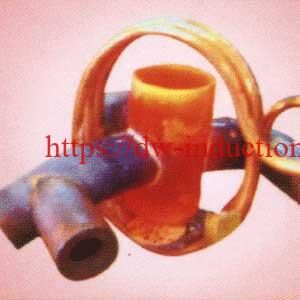
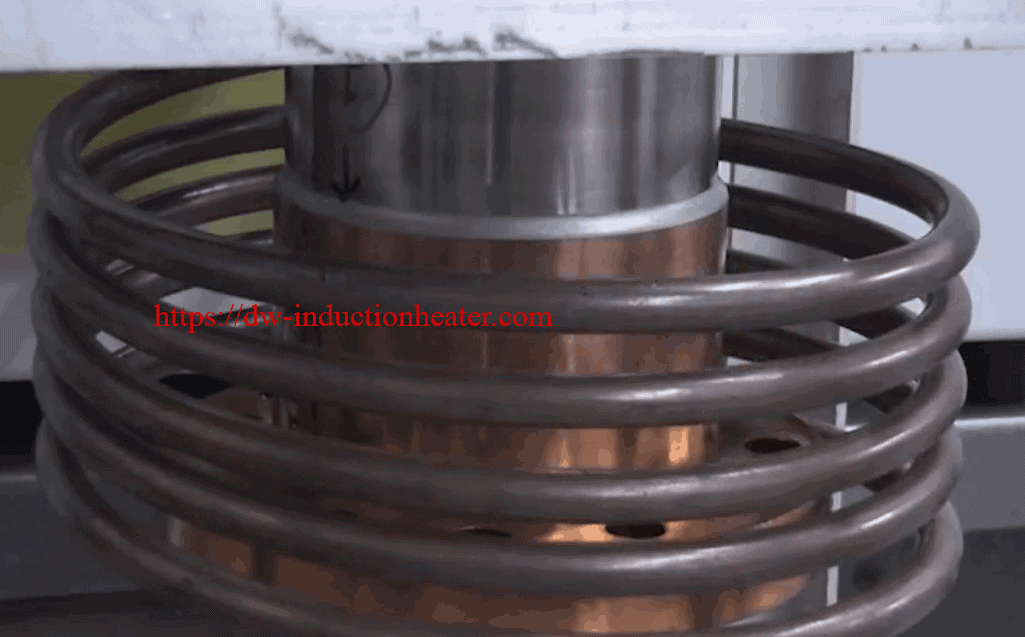
Cryogenic Pumps and Housings – Copper Sleeve (3.6” (91.44mm) OD, 0.1”(2.54mm) thick wall that is 2.7” (68.5mm) tall, 3.8” (96.52mm) OD lip on the bottom that is 0.6”(15.2mm) tall with a thickness of approximately 0.85”(21.5mm), part with lip is 3.14”(79.7mm) tall overall, SS shaft sits 2.66” (67.5mm) deep), SS Shaft (3.4”(86.3mm) OD, 3.2”(81.2mm) ID, over 7.5”(190.5mm) tall, has smaller cap and shaft attached on one end and a larger 8”(203.2mm) base at the other)
Power: 16.06kW
Temperature: 1145°F + (618°C)
Time: 1 minute 30 seconds to 3 minutes
Test 3
Materials
Cryogenic Pumps and Housings – Copper Sleeve (3.5” (88.9mm) OD, 0.1” (2.54mm) thick wall that is 2.1” (53.3mm) tall, 5.3” (134.6mm) OD lip on the bottom that is 0.74” (18.7mm) tall with a thickness of approximately 1” (25.4mm), part with lip is 2.8” (71.1mm) tall overall, stainless steel shaft sits 2.66” (67.5mm) deep), stainless steel shaft (3.35”(85.0mm) OD, 3.2” (81.2mm) ID, over 7.5” (190.5mm) tall, has smaller cap and shaft attached on one end and a larger 5.5” (139.7mm) base at the other)
Power: 9.09kW
Temperature: 1145°F + (618°C)
Time: approximately 20 to 30 seconds

Test 4
Materials
Cryogenic Pumps and Housings – Copper cap (2.7” (68.5mm) OD, 2.85” (72.3mm) high, 0.6” (15.2mm) wall, sits on stainless steel shaft 1.4” (35.5mm) deep), stainless steel shaft (1.54” (39.1mm) OD, 0.9” (22.8mm) thick wall, 6.5″ (165.1mm) high and attached to larger mass when it ends) additional stainless steel cap on the other side of the copper, 2.44” (61.9mm) OD, 0.8” (20.3mm) high or more, 0.88” (22.35mm) stem on top that is 1.4” (35.5mm) tall with 0.66” (16.7mm) ID
Power: 14kW
Temperature: 1145°F + (618°C)
Time: 1 minute 50 seconds

Results and Conclusions:
Test 1: Test started with much lower power and ramped up to 25 kW after 15 seconds. The induction brazing was successful.
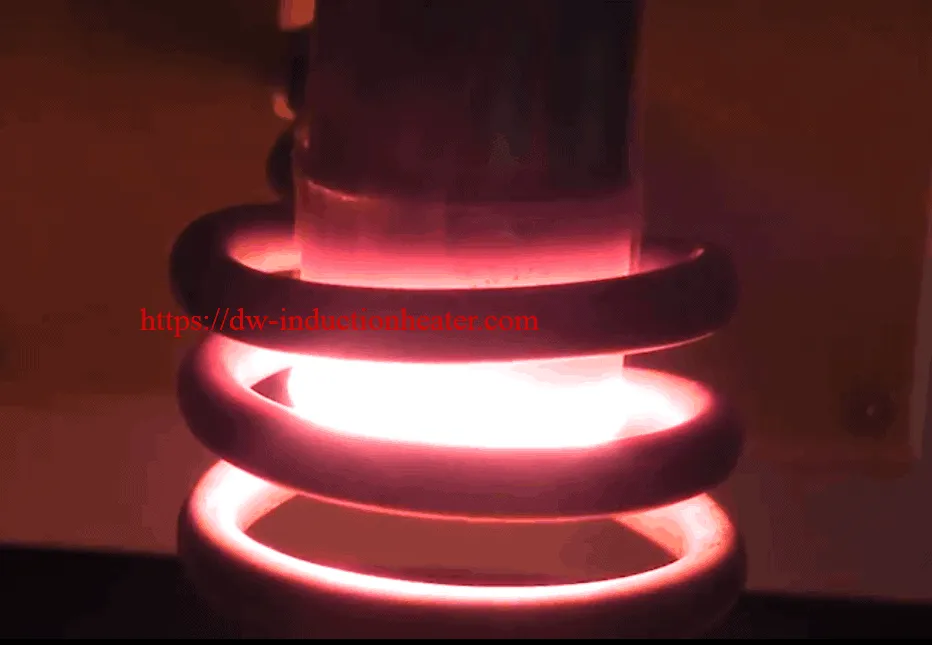
Recommended to use a tighter coil that wraps around only half of the copper cap. This would concentrate the heat at only the location of where the alloy is and should decrease the heat time.
Test 2: Test was done with an oversized coil due to clearance issues created by the lip on the part. The approximate time for full cycle is 20 to 30 seconds. The lower frequency seemed to be beneficial for the application by causing the field to penetrate deeper past the copper and into the steel itself, resulting in quicker heat times.
Test 3: Test was done with 14 kW to simulate the time cycle necessary for our DW-HF-15KW induction heating system. This part will require the longest heat time due to the mass of the copper. Heat times can be decreased by using a larger power supply.
The heat times for all the tests can be improved upon by optimizing the induction heating coils for the specific parts and by lowering the frequency. A temperature controller and pyrometer are strongly recommended to ensure no damage is done to the parts if going with a larger induction system. If using a 15kW induction heating system, the temperature controller and pyrometer are still recommended but the risk of part damage is reduced.

Technical Table – Copper to Stainless Steel Induction Brazing
| Parameter | Test 1 | Test 2 | Test 3 | Test 4 |
|---|---|---|---|---|
| Application | Copper cap to SS shaft | Copper sleeve to SS shaft | Copper sleeve to SS shaft | Copper cap / SS assembly |
| Induction Equipment | DW-HF Series | DW-HF Series | DW-HF Series | DW-HF Series |
| Applied Power | 25 kW | 16.06 kW | 9.09 kW | 14 kW |
| Brazing Temperature | 1145°F+ / 618°C+ | 1145°F+ / 618°C+ | 1145°F+ / 618°C+ | 1145°F+ / 618°C+ |
| Heating Time | Under 40 sec | 1.5–3 min | Approx. 20–30 sec | Approx. 1 min 50 sec |
| Copper Component | Cap | Sleeve with lip | Sleeve with lip | Heavy-wall cap |
| Stainless Component | SS shaft | Hollow SS shaft | Hollow SS shaft | SS shaft + additional SS cap |
| Heating Method | Localized induction | Localized induction | Localized induction | Localized induction |
| Joint Type | Copper-to-stainless brazed joint | Copper sleeve-to-SS shaft | Copper sleeve-to-SS shaft | Multi-mass dissimilar joint |
| Recommended Improvement | Tighter coil | Lower frequency / optimized coil | Optimized coil | Temperature control |
| Temperature Monitoring | Recommended | Strongly recommended | Recommended | Strongly recommended |
The four tests on the current page use different workpiece masses, which explains the large cycle-time variation. The source page also states that optimized coils and lower frequency can improve heat transfer into the stainless-steel section.
General Process Parameters
| Technical Item | Recommended Approach |
|---|---|
| Base Materials | Copper + stainless steel |
| Process | Induction brazing |
| Typical Equipment | HLQ DW-HF-15/25/45kW series |
| Temperature | Approx. 618°C+ in existing tests |
| Power Range Tested | Approx. 9.09–25 kW |
| Coil Design | Custom coil matched to joint geometry |
| Frequency Strategy | Lower frequency may improve penetration on larger assemblies |
| Temperature Control | Pyrometer + temperature controller recommended |
| Brazing Alloy | Select for Cu-to-stainless compatibility |
| Flux | Suitable flux generally required for stainless steel |
| Automation | Manual, semi-automatic or automatic |
Why Is Copper-to-Stainless Steel Brazing More Difficult?
Copper and stainless steel have very different thermal and electrical properties.
Copper has extremely high thermal conductivity, so it rapidly carries heat away from the joint. Stainless steel conducts heat much more slowly and couples differently with the induction field. If the coil is poorly designed, the copper may heat unevenly while the stainless component remains below the ideal brazing temperature.
The original HLQ testing found that lower operating frequency could help the electromagnetic field penetrate past the copper and heat the steel more effectively, particularly on larger assemblies. Coil geometry was also identified as one of the main opportunities for shortening cycle time.
For repeatable production, the system should therefore control:
power + frequency + coil position + filler alloy + joint clearance + temperature + heating time.

FAQs
1. Can copper be brazed directly to stainless steel?
Yes. Copper can be brazed to stainless steel using a compatible filler alloy, appropriate flux and carefully controlled heating.
Induction heating is particularly suitable because the energy can be concentrated around the joint instead of heating the complete assembly.
2. What temperature is required to braze copper to stainless steel?
The exact temperature depends on the brazing filler alloy.
In the four tests on this HLQ page, the target joint temperature was approximately 1145°F+ (618°C+).
The production temperature should be determined from the selected brazing alloy rather than treated as one universal value.
3. How long does induction brazing copper to stainless steel take?
It depends strongly on component mass and joint geometry.
The existing tests ranged from approximately 20–30 seconds for one configuration to approximately 1.5–3 minutes for a larger copper sleeve and stainless-steel shaft assembly.
This is why coil design should be optimized individually for each component.
4. What power induction brazing machine is needed for copper-to-stainless joints?
The required power depends on:
- Copper mass
- Stainless-steel mass
- Joint dimensions
- Required cycle time
- Coil coupling
- Brazing temperature
- Production rate
The current application tested approximately 9.09 kW, 14 kW, 16.06 kW and 25 kW on different components.
HLQ lists DW-HF-15kW, 25kW and 45kW equipment for this application.
5. What induction frequency is best for brazing copper to stainless steel?
The optimum frequency depends on component size and required penetration depth.
For relatively massive copper/stainless assemblies, a somewhat lower induction frequency can improve field penetration and increase heating of the stainless-steel component rather than concentrating too much energy close to the copper surface.
The original testing specifically reported that lower frequency was beneficial for one of the larger assemblies.
6. Why is a custom induction coil important?
A custom coil determines where electromagnetic energy is concentrated.
For copper-to-stainless brazing, the coil should balance heating between two metals with very different thermal characteristics.
The original testing recommends using a tighter coil around the actual brazing area to concentrate energy at the filler-metal location and reduce cycle time.
7. Is a pyrometer required for copper-to-stainless induction brazing?
For industrial production, it is strongly recommended.
The current application specifically recommends a temperature controller and pyrometer, especially when higher-power induction equipment is used, to reduce the risk of overheating or damaging the components.
8. Can copper-to-stainless induction brazing be automated?
Yes.
The system can be integrated with:
- PLC controls
- Automatic coil positioning
- Pneumatic fixtures
- Pyrometers
- Closed-loop temperature control
- Automatic filler placement
- Robotic loading
- Multi-station production cells
This is particularly useful for repeat manufacturing of pump housings, cryogenic equipment and tubular assemblies.