


Induction Brazing Stainless Steel Tools
Induction Brazing Stainless Steel Tools: Three-Joint Dental Prophy Jet Assembly at 1400 °F
Quick Answer
Induction brazing of stainless steel tools joins small stainless parts with braze alloy rings melted by an induction coil, without melting the parts. In this HLQ case, three joints on a stainless steel dental prophy jet assembly (nose piece, two tubes and a tube support collar) were brazed at 1400 °F (760 °C) with braze alloy rings and B1 flux. A four-turn, double-wound helical inductor heated the upper tube end for 10 seconds, then the reversed lower end for another 10 seconds. The assembly was rinsed in hot water to remove the flux and blown dry. The results were consistent and repeatable, with each joint sealed by an even fillet. Equipment stated in the case: DW-UHF-4.5kW, 400 kHz.
Table of Contents
- What is Induction Brazing of Stainless Steel Tools?
- Key Applications
- Suitable Materials
- Working Principle
- Technical Specifications
- Recommended Model Selection
- Process Workflow
- Common Problems and Solutions
- Engineering Selection Guide
- Advantages and Limitations
- Why Choose HLQ?
- 10 Core FAQs
What is Induction Brazing of Stainless Steel Tools?
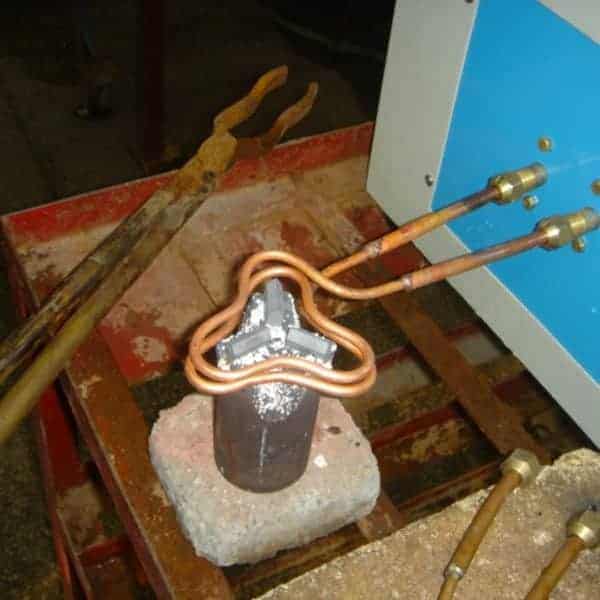
Induction brazing of stainless steel tools uses a specially designed induction coil to heat the joint areas of a small stainless assembly until preplaced braze alloy rings melt and flow into the joints. The research objective of this HLQ case was to braze three joints on a dental prophy jet assembly with induction heating, to improve yield consistency and reduce cycle time. For the general method, see the induction brazing process.
 The case drawing shows the metal tubes, the support collar and the nose piece, with joint 1, joint 2 and joint 3 at the lower and upper ends of the assembly.
Key Applications

| HLQ stainless brazing case | Filler / flux | Temperature | Time | Equipment |
|---|---|---|---|---|
| Stainless dental prophy jet, 3 joints (this page) | Braze alloy rings, B1 flux | 1400 °F (760 °C) | 2 × 10 s | DW-UHF-4.5kW, 400 kHz (as stated) |
| Induction brazing stainless steel tubes | BAg-24 wire preforms, black flux | 1330 °F (721 °C) | 20 s | DW-UHF-10kW, 300 kHz |
| Induction brazing stainless steel to brass | Braze ring preform, black flux | 1325 °F (718 °C) | 7 s | DW-UHF-6kW-III, 300 kHz |
| Induction brazing stainless steel tubing joints | Stay Silv filler | 1472 °F (800 °C) | 15 s, 8 kW | DW-UHF-10kW |
Other HLQ tool brazing work includes carbide tips; see brazing carbide tips with induction.


Suitable Materials
| Item | This case | Related HLQ data |
|---|---|---|
| Parts | Stainless steel prophy nose piece, two tubes, tube support collar | Stainless tubes; stainless to brass; copper to stainless steel |
| Filler | Braze alloy rings | BAg-24 wire preforms; braze ring preforms; Stay Silv |
| Flux | B1 flux (thin coat on the entire assembly) | Black flux |
| Flux removal | Hot-water bath, then hot-air drying | – |
Working Principle

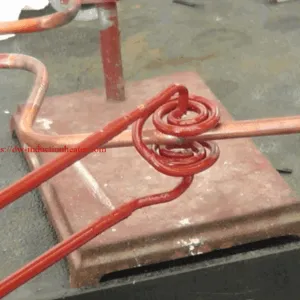
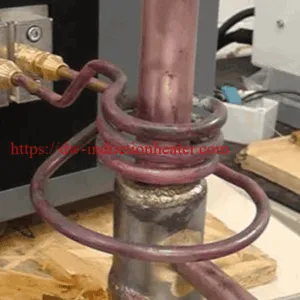
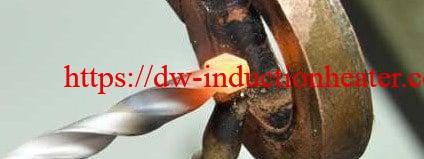
A specially designed four-turn, double-wound helical inductor delivers even heat to the joint areas. The tube end placed in the heating zone is heated until the braze alloy rings melt and flow into the joints; the assembly is then reversed so the other end can be brazed. The B1 flux protects the stainless steel surfaces during heating in air.
Skin depth calculation (δ = 503·√(ρ/f), austenitic stainless steel, µr = 1, ρ ≈ 0.72 µΩ·m at 20 °C): δ ≈ 0.67 mm at the stated 400 kHz.
Technical Specifications
| Parameter | Case data |
|---|---|
| Research objective | Braze three joints on a dental prophy jet assembly with induction heating; improve yield consistency and reduce cycle time |
| Parts and materials | Stainless steel prophy nose piece, two tubes, tube support collar, braze alloy rings, B1 flux |
| Temperature required | 1400 °F (760 °C) |
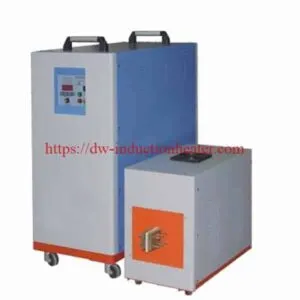
| Induction heating equipment (as stated) | DW-UHF-4.5kW induction heating power supply; specially designed inductor (coil) |
| Operating frequency (as stated) | 400 kHz |
| Coil | Four-turn, double-wound helical inductor |
| Fixturing | Temporary fixturing to hold the parts in position |
| Heating | Stage 1: upper tube end, 10 s; Stage 2: assembly reversed, lower end, 10 s |
| Post-braze cleaning | Bathed in hot water to remove the flux; blown dry with hot air |
| Result | Consistent, repeatable results with 10-second heat cycles; each braze joint sealed with an even fillet |
Recommended Model Selection
DW-UHF series from the HLQ induction heating device model table (all 100% duty cycle):
| Model | Power | Max. input current | Frequency | Supply |
|---|---|---|---|---|
| DW-UHF-4.5kW (stated in this case) | 4.5 kW | 20 A | 1.1–2.0 MHz | 1-phase 220 V |
| DW-UHF-6.0kW | 6.0 kW | 28 A | 300–1100 kHz | 1-phase 220 V |
| DW-UHF-10kW | 10 kW | 15 A | 100–500 kHz | 3-phase 380 V |
| DW-UHF-20kW | 20 kW | 30 A | 50–250 kHz | 3-phase 380 V |
Note: the case states 400 kHz, which is outside the 1.1–2.0 MHz range listed for the DW-UHF-4.5kW in the model table. Confirm the model and frequency for your application.
Process Workflow

- Profile – carry out initial tests to establish time-to-temperature and heating profiles.
- Assemble – assemble the two tubes, tube support collar and nose piece, held with temporary fixturing.
- Rings and flux – place the braze alloy rings and apply a thin coat of B1 flux to the entire assembly.
- Stage 1 – place the upper tube end in the heating zone and apply power for 10 seconds.
- Stage 2 – reverse the assembly and heat the lower end for another 10 seconds.
- Clean – bathe the assembly in hot water to remove the flux and blow it dry with hot air.
- Result – three joints, each sealed with an even fillet.

Common Problems and Solutions
| Problem | Possible cause | Solution (HLQ case data) |
|---|---|---|
| Joints at both ends cannot be heated evenly at once | Joints at opposite ends of the assembly | Two-stage process: upper end 10 s, then reversed lower end 10 s |
| Inconsistent yield | Variable manual heating | Induction with fixed 10-second heat cycles |
| Parts move during brazing | No fixturing | Hold the parts in position with temporary fixturing |
| Uneven heating of joint areas | Coil not matched to the assembly | Use a specially designed four-turn, double-wound helical inductor |
| Flux residue | B1 flux remaining after brazing | Hot-water bath, then hot-air drying |
| Unknown heating time | New assembly | Initial tests to establish time-to-temperature profiles |
Engineering Selection Guide
- Small multi-joint assemblies: heat joints in stages if they lie at opposite ends, as in this two-stage case.
- Coil: a double-wound helical inductor delivers even heat to closely spaced joints.
- Power supply: small stainless brazing cases used DW-UHF units (stated 4.5 kW here; 6 kW for stainless-to-brass; 10 kW for stainless tubes).
- Frequency: confirm a model whose frequency range covers the required operating frequency.
- Data to send: assembly drawing, materials, number and position of joints, filler and flux, cycle time, parts per hour, supply voltage and cooling water.
Advantages and Limitations
| Advantages | Limitations |
|---|---|
| Improved yield consistency | Joints at both ends need two heating stages |
| Reduced cycle time: 10-second heat cycles | Flux must be removed after brazing |
| Each joint sealed with an even fillet | Temporary fixturing is required |
| Consistent, repeatable results | The coil must be designed for the assembly |
Why Choose HLQ?
- Published stainless steel brazing cases for medical/dental assemblies, tubes and valve parts.
- Specially designed coils, including double-wound helical inductors.
- Heating profiles established before production.
- Compact single-phase DW-UHF power supplies for small parts.
10 Core FAQs
1. What was brazed in this case?
Three joints on a stainless steel dental prophy jet assembly.
2. Which parts make up the assembly?
A stainless steel prophy nose piece, two tubes and a tube support collar.
3. Which filler and flux were used?
Braze alloy rings and B1 flux.
4. What temperature was required?
1400 °F (760 °C).
5. How long did brazing take?
Two 10-second stages: the upper tube end first, then the reversed lower end.
6. Which coil was used?
A specially designed four-turn, double-wound helical inductor.
7. Which equipment does the case state?
A DW-UHF-4.5kW induction power supply at 400 kHz, as stated in the case.
8. How was the flux removed?
The assembly was bathed in hot water and blown dry with hot air.
9. What was the result?
Consistent, repeatable results; each braze joint was sealed with an even fillet.
10. What information is needed for a quotation?
The assembly drawing, materials, number and position of joints, filler and flux, cycle time, output, and available power supply and cooling water.