



Ultrahigh Frequency Brazing System
100kW Ultra-High-Frequency Induction Brazing System for Copper Bars and Industrial Metal Joining
What Is an Ultra-High-Frequency Induction Brazing System?
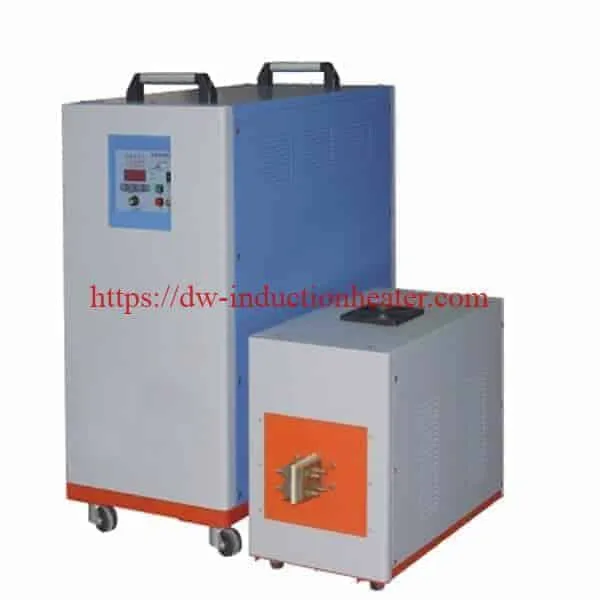
An ultra-high-frequency induction brazing system is an industrial electromagnetic heating solution that uses high-frequency alternating current to generate controlled heat in conductive metal components, enabling fast, precise, and repeatable brazing without direct flame contact.
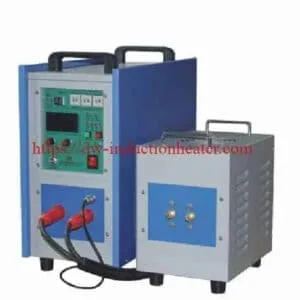
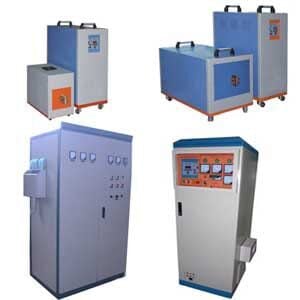
The HLQ DW-UHF-100KW Ultra-High-Frequency Induction Brazing System delivers 100kW of rated output power with an operating frequency range of 50–150kHz. It is designed for industrial brazing, copper busbar joining, precision metal heating, and other localized induction heating applications.
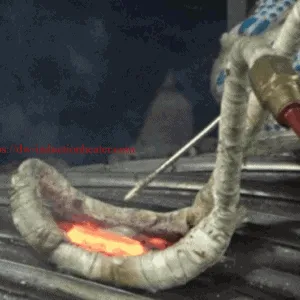
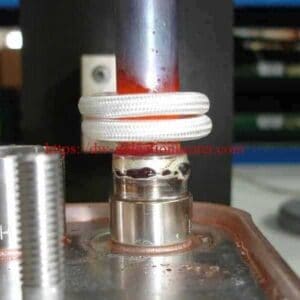
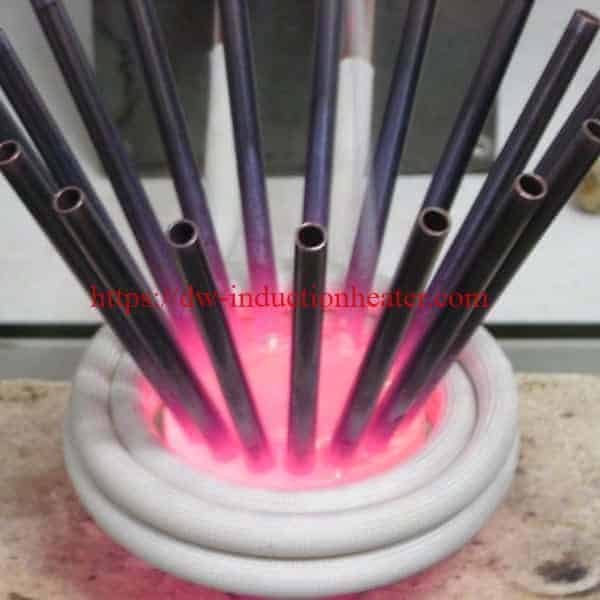
Powered by IGBT inverter technology, the system generates an alternating electromagnetic field through a customized water-cooled induction coil. The induced currents heat the metal assembly, allowing a suitable brazing filler metal to melt and form a metallurgical joint without melting the base materials.
Main Industrial Applications:
- Copper busbar induction brazing
- Copper bar and electrical conductor brazing
- Copper-to-copper induction brazing
- Copper-to-brass induction brazing
- Steel-to-copper metal joining
- Industrial electrical connector brazing
- Copper terminal and conductor joining
- Precision metal component brazing
- Industrial cutting tool brazing
- Localized heating of mechanical assemblies
Additional Induction Heating Applications:
- Gear induction hardening
- Shaft surface hardening
- Continuous wire annealing
- Precision metal heat treatment
- Specialized induction melting applications with suitable auxiliary equipment
Manufactured by HLQ Induction Equipment Co., Ltd., the DW-UHF-100KW supports adjustable heating power, constant-current or constant-power operation, interchangeable induction coils, and programmable heating cycles on timer-equipped configurations.
The system is suitable for manufacturers requiring localized heating, repeatable production cycles, and customized induction brazing solutions for industrial metal components.
Technical Specifications — DW-UHF-100KW Induction Brazing System
Main Technical Parameters
| Technical Parameter | Specification |
|---|---|
| Product Name | Ultra-High-Frequency Induction Brazing System |
| Brand | HLQ |
| Manufacturer | HLQ Induction Equipment Co., Ltd. |
| Model Number | DW-UHF-100KW |
| Rated Output Power | 100kW |
| Operating Frequency | 50–150kHz |
| Input Voltage | Three-Phase AC 380V ±10% |
| Input Frequency | 50/60Hz |
| Published Maximum Input Current | 145A — Requires Verification |
| Inverter Technology | IGBT Solid-State Inverter |
| Heating Principle | Electromagnetic Induction Heating |
| Operating Modes | Constant Current / Constant Power |
| Power Adjustment | Adjustable |
| Duty Cycle | 100% Under Specified Operating Conditions |
| Cooling Method | Water Cooling |
| Published Cooling Water Pressure | >0.2MPa |
| Published Cooling Water Flow | 10L/min |
| Machine Weight | Approximately 160kg |
| Main Power Unit Dimensions | 760 × 400 × 880mm |
| Heating Head Dimensions | 510 × 300 × 450mm |
| Operating Display | Heating Power, Heating Current and Frequency |
| Automatic Heating Time | 0.1–99.9 Seconds |
| Automatic Holding Time | 0.1–99.9 Seconds |
| Automatic Cooling Time | 0.1–99.9 Seconds |
| Heating Cycle Control | Programmable Timer on Applicable Configurations |
| Induction Coil | Interchangeable / Application-Specific Design |
| Brazing Temperature | Determined by Brazing Filler and Joint Requirements |
| Suitable Materials | Copper, Brass, Steel, Stainless Steel and Compatible Metal Assemblies |
| Primary Application | Industrial Induction Brazing |
| Secondary Applications | Hardening, Annealing, Localized Heating |
| Automation Integration | Customized According to Production Requirements |
| Installation | Industrial Workshop / Manufacturing Production Line |
Engineering Note: The published cooling-water flow should be verified for the complete 100kW installation, including the inverter, heating head, induction coil, and cooling circuit. Actual equipment performance depends on the workpiece, induction coil geometry, operating frequency, heating time, and cooling conditions.
Recommended Industrial Brazing Applications
| Application | Workpiece Materials | Typical Brazing Temperature | Recommended Process |
|---|---|---|---|
| Copper Busbar Brazing | Copper to Copper | 650–850°C | High-Frequency Induction Brazing |
| Copper Bar Brazing | Copper Conductors | 650–850°C | Customized Induction Brazing |
| Copper-to-Brass Brazing | Copper and Brass | 650–850°C | Precision Induction Brazing |
| Copper Electrical Connector Brazing | Copper and Brass | 650–850°C | Localized Induction Heating |
| Copper-to-Steel Brazing | Copper and Carbon Steel | 650–850°C | Silver Alloy Induction Brazing |
| Industrial Terminal Brazing | Copper Terminals and Conductors | 650–850°C | Controlled Induction Brazing |
| Stainless Steel Component Brazing | Stainless Steel Assemblies | 650–900°C | Flux-Assisted or Controlled-Atmosphere Brazing |
| Carbide Tool Brazing | Tungsten Carbide and Steel | 650–850°C | Precision Induction Brazing |
| Industrial Metal Assemblies | Copper, Brass and Steel | Application-Dependent | Custom Induction Brazing |
These temperatures are indicative engineering ranges, not validated process settings for every workpiece. The correct temperature must be selected according to the filler alloy, base materials, joint design, and operating conditions.
Key Advantages of the 100kW UHF Induction Brazing System
1. High-Power Industrial Heating
The 100kW output configuration provides substantial heating capacity for industrial metal joining applications. Actual brazing capacity depends on the workpiece size, electrical conductivity, coil coupling, and required heating cycle.
2. Precise and Localized Brazing
Electromagnetic induction concentrates heating in the selected area, helping reduce unnecessary thermal exposure to surrounding metal components.
3. Advanced IGBT Inverter Technology
Solid-state IGBT technology provides electronically controlled high-frequency power for repeatable industrial heating operations.
4. Customized Induction Coils
Different induction coil configurations can be designed for copper bars, electrical conductors, metal terminals, industrial fittings, and precision components.
5. Repeatable Heating Cycles
Adjustable power and programmable heating, holding, and cooling timers help manufacturers establish consistent operating procedures.
6. Suitable for Industrial Production
The system can be incorporated into customized brazing workstations, provided that electrical capacity, cooling, workpiece handling, and process controls are correctly engineered.
FAQs
FAQ 1: What is an ultra-high-frequency induction brazing system?
An ultra-high-frequency induction brazing system is industrial equipment that uses electromagnetic induction to generate localized heat for joining metal components with a brazing filler metal.
The induction power supply delivers high-frequency electrical energy to a specially designed copper coil, creating an alternating magnetic field that induces heating within electrically conductive workpieces.
The HLQ DW-UHF-100KW Induction Brazing System provides 100kW of rated output power and operates within a published frequency range of 50–150kHz.
It is designed for industrial applications such as copper busbar brazing, electrical conductor joining, precision metal assembly brazing, and localized heat treatment.
Unlike fusion welding, induction brazing joins components without melting the base metals.
FAQ 2: What are the main applications of a 100kW induction brazing machine?
A 100kW induction brazing machine can be used for various industrial metal joining applications requiring substantial heating power and controlled localized heating.
Typical applications include copper busbar brazing, copper conductor joining, electrical terminal brazing, copper-to-brass brazing, steel-to-copper brazing, and precision metal assembly manufacturing.
With suitable induction coils and process configurations, the same induction heating power supply may also support gear hardening, shaft hardening, and continuous wire annealing.
The exact workpiece dimensions and production capacity depend on material properties, heating requirements, induction coil design, and operating conditions.
FAQ 3: What frequency is recommended for induction brazing copper busbars?
The recommended frequency for copper busbar induction brazing depends on the busbar dimensions, joint configuration, copper conductivity, required heating depth, and heating cycle.
Higher-frequency induction heating can concentrate electromagnetic energy near the workpiece surface, while lower frequencies generally provide greater electromagnetic penetration.
The HLQ DW-UHF-100KW operates at 50–150kHz, making it a potential solution for localized brazing of suitably sized copper bars and electrical conductors.
However, thick or large-cross-section copper busbars may require lower-frequency equipment or specialized induction coils to achieve sufficiently uniform heating.
The optimal frequency should be established through engineering calculations and practical brazing trials.
FAQ 4: Can a 100kW UHF induction brazing machine join copper, brass, and steel?
Yes. A properly configured high-frequency induction brazing machine can join compatible combinations of copper, brass, carbon steel, and stainless steel.
Common applications include copper-to-copper joints, copper-to-brass connections, and copper-to-steel assemblies.
Successful brazing requires selecting a suitable filler alloy, joint clearance, flux or controlled atmosphere, heating temperature, and induction coil.
For dissimilar metals, differences in thermal conductivity and thermal expansion must be considered.
The DW-UHF-100KW provides a high-power induction heating platform, but the brazing process must be developed for the particular material combination.
FAQ 5: What temperature is required for ultra-high-frequency induction brazing?
The required induction brazing temperature depends primarily on the brazing filler metal and the materials being joined.
Many industrial copper and silver-alloy brazing applications operate within approximately 650–850°C, although some applications require temperatures outside this range.
During induction brazing, the filler metal melts and flows into the joint while the base materials remain solid.
The assembly must reach a temperature suitable for filler-metal wetting and capillary flow.
Excessive heating can cause oxidation, filler-metal degradation, distortion, or damage to temperature-sensitive components.
Proper temperature monitoring and heating-cycle control are therefore important for consistent brazing quality.
FAQ 6: What are the advantages of ultra-high-frequency induction brazing compared with traditional brazing?
Ultra-high-frequency induction brazing provides localized electromagnetic heating, adjustable electrical power, repeatable heating cycles, and easier integration into industrial production systems.
Compared with conventional flame brazing, induction heating eliminates direct flame contact with the workpiece.
It can also reduce unnecessary heating of surrounding components and improve repeatability when suitable fixtures and process controls are used.
Additional advantages include customized induction coil designs, programmable heating times, and compatibility with automated workpiece handling.
Actual energy efficiency, production speed, and joint quality depend on the specific industrial application.
FAQ 7: Can a 100kW induction brazing system operate continuously?
The HLQ DW-UHF-100KW has a published 100% duty-cycle rating, indicating that continuous operation is supported under the specified electrical and cooling conditions.
For reliable continuous production, the system requires stable cooling-water flow, appropriate water quality, sufficient cooling capacity, and correct operating parameters.
The published cooling-water specification is 10L/min with pressure above 0.2MPa. These figures should be confirmed for the complete machine and installation before commissioning.
Actual production throughput depends on the workpiece dimensions, heating time, brazing procedure, and material-handling cycle.
FAQ 8: How do I choose the right ultra-high-frequency induction brazing machine?
Selecting the right ultra-high-frequency induction brazing machine requires evaluating workpiece materials, dimensions, joint geometry, filler-metal composition, required brazing temperature, heating time, and production capacity.
Power and frequency selection should also account for induction coil efficiency, material conductivity, required heating distribution, and installation conditions.
The HLQ DW-UHF-100KW is a potential solution for industrial brazing applications requiring a 100kW high-frequency power supply.
For accurate equipment selection, customers should provide technical drawings, material specifications, joint dimensions, target brazing temperature, and required production rate.
HLQ Induction Equipment Co., Ltd. can recommend a suitable induction heating configuration and customized coil arrangement according to these requirements.