Induction Preheating Rivets Of Carbide Steel
Induction Heating of Carbon Steel Rivets and Bars for Hot Forming
Quick Answer
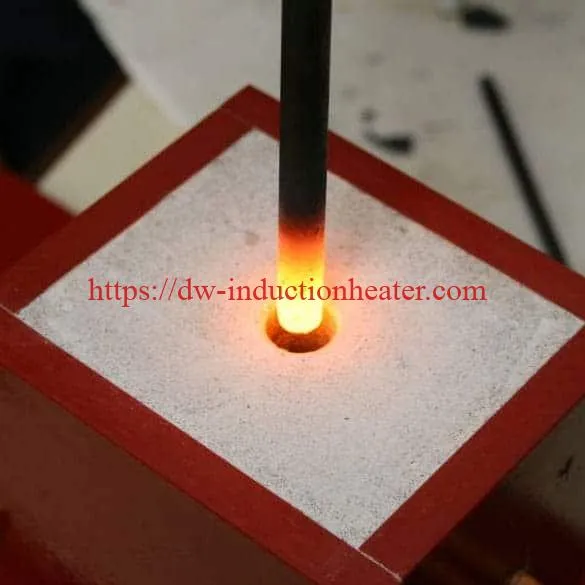
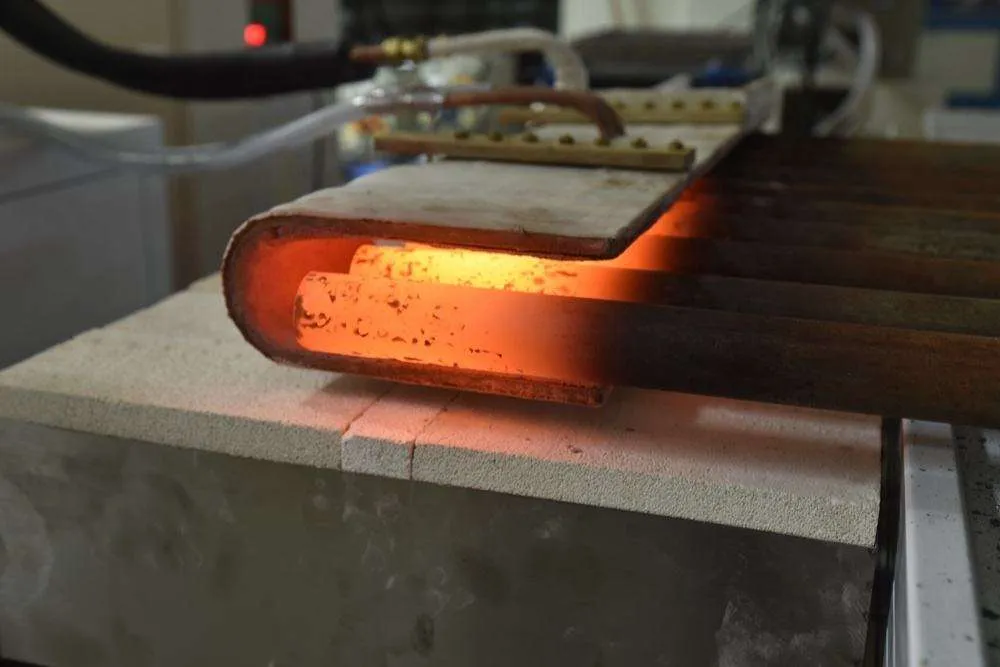
Induction heating of carbon steel rivets and bars brings only the end to be formed to forging temperature, about 1050 °C (1922 °F), for hot riveting or bar-end reforming. It can be done in the workshop or on a construction site.
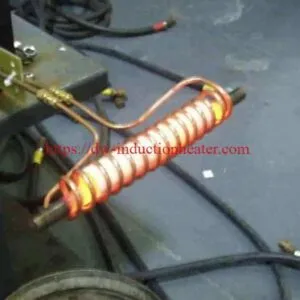
In HLQ’s application test, low-carbon steel rivets (Ø11.1 mm × 38/47 mm) reached 1050 °C in 22–25 seconds. A Ø32 mm handrail bar with a 75 mm heat zone reached it in 4 min 43 s. Both were heated with a DW-HF-25kW generator at 48–55 kHz and encapsulated helical coils, with no open flame.
What is Induction Heating of Carbon Steel Rivets and Bars?
Hot riveting and bar-end reforming need the steel at forging temperature, about 1050 °C, exactly where it will be formed. Traditionally this was done with a rivet forge or a gas torch. Both are slow to set up on site, heat unevenly and bring open flames into the work area.
An induction coil heats only the rivet or bar end, with a controllable heat pattern and a repeatable time. The generator can be moved around the site with the crew. For smaller rivets heated only at the head end, see induction heating of rivet ends.

| Method | Heat time | Control | Site safety |
|---|---|---|---|
| Induction coil | Seconds for rivets, minutes for bars | Timer; repeatable heat pattern | No flame, no gas |
| Rivet forge (coke or gas) | Continuous fire | Operator judgement | Open fire and fumes |
| Gas torch | Minutes | Uneven | Open flame and gas bottles |
| Cold forming | — | — | High force; risk of cracking |
Key Applications
| Application | Part | Typical temperature | Coil |
|---|---|---|---|
| Hot riveting of steel structures | Structural rivets | 950–1100 °C | Helical, 3 turns |
| Handrail and balustrade reforming | Bar ends Ø20–40 mm | 1000–1100 °C | Helical, 4 turns |
| Rivet head forming | Rivet ends | ≈ 700 °C (warm forming) to 1050 °C | Single-turn or helical |
| Bridge and heritage repair | Replacement rivets | 950–1100 °C | Portable coil |
| Bar and rod end forging | Bar ends | 1100–1250 °C | Helical or channel coil |
Application cases

Suitable Materials
| Material | Typical use | Hot forming range | Note |
|---|---|---|---|
| Low-carbon steel (e.g. 1010–1020, ASTM A502 Gr 1) | Structural rivets, handrail bars | 950–1150 °C | Used in this test; easy to form |
| Carbon-manganese steel (A502 Gr 2) | High-strength rivets | 950–1100 °C | Avoid long soaking |
| Medium-carbon steel (1035–1045) | Pins, bar ends | 950–1150 °C | Cool slowly to avoid hard spots |
| Stainless steel 304 | Architectural handrails | 1000–1150 °C | Heats less efficiently (non-magnetic) |
| Copper and brass bars | Bus bars, fittings | 700–900 °C | Needs higher power or frequency |
Typical ranges only. Burning starts above about 1250 °C for carbon steels, so do not overheat.
Working Principle
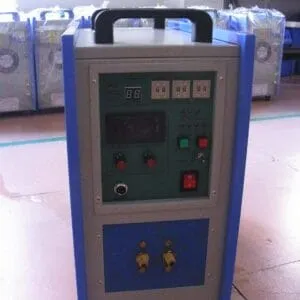
- Generator: The DW-HF-25kW IGBT generator produces 48 kHz current for rivets and 55 kHz for bars.
- Workhead: A remote workhead with two 1.5 μF capacitors in series (0.75 μF) tunes the coil.
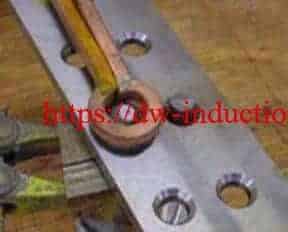
- Rivet coil: A 3-turn encapsulated helical coil surrounds the rivet, so only the length inside the coil is heated.
- Bar coil: A 4-turn encapsulated helical coil heats a 75 mm zone at the end of the Ø32 mm bar.
- Heating: Eddy currents heat the steel quickly up to the Curie point (≈ 770 °C). Above it, heating slows because the steel is no longer magnetic, and the zone soaks to an even 1050 °C.
- Encapsulation: The insulated coils resist scale, knocks and arcing on site and keep the heat pattern stable.
Background: how induction heating works.
Technical Specifications
Application test parameters
| Item | Value |
|---|---|
| Objective | Preheat low-carbon steel rivets and handrail bars for reforming in construction |
| Material | Low-carbon steel rivets, 7/16 in (11.1 mm) diameter × 1.5 in (38 mm) and 1.9 in (47 mm) long; low-carbon bar, 1.25 in (32 mm) diameter × 3 in (75 mm) heat zone |
| Temperature | 1922 °F (1050 °C) |
| Frequency | 48 kHz for the rivets; 55 kHz for the bars |
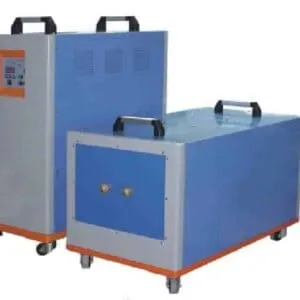
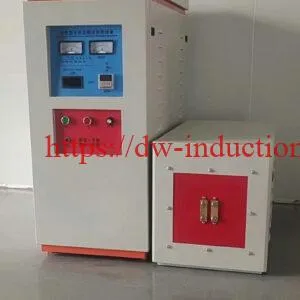
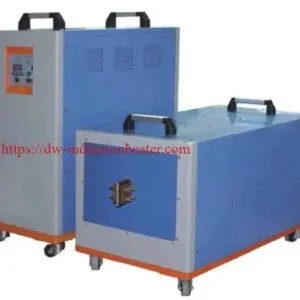
| Equipment | DW-HF-25kW induction heating system with a remote workhead containing two 1.5 μF capacitors (0.75 μF in series), and a coil designed for this application |
| Coils | 3-turn encapsulated helical coil for the rivets; 4-turn encapsulated helical coil for the handrail bars |
| Heating time | Rivets: 22–25 s to 1050 °C. Bars: 4 min 43 s to 1050 °C. |
| Results and benefits | Controllable heat pattern; easy to use on site; safe, with no open flames; even heat distribution |

Heated steel mass in the test
| Part | Size | Steel heated | Energy to 1050 °C (≈ 720 kJ/kg) |
|---|---|---|---|
| Short rivet | Ø11.1 × 38 mm | ≈ 29 g | ≈ 21 kJ |
| Long rivet | Ø11.1 × 47 mm | ≈ 36 g | ≈ 26 kJ |
| Handrail bar zone | Ø32 mm × 75 mm | ≈ 0.47 kg | ≈ 340 kJ, plus conduction losses along the bar |
DW-HF high-frequency induction generators
| Model | Max input power | Max input current | Frequency | Input | Duty cycle |
|---|---|---|---|---|---|
| DW-HF-15KW | 15 kVA | 32 A | 30–100 kHz | 1-ph 220 V | 80 % |
| DW-HF-25KW | 25 kVA | 23 A | 20–80 kHz | 3-ph 380 V | 100 % |
| DW-HF-35KW | 35 kVA | 51 A | 20–80 kHz | 3-ph 380 V | 100 % |
| DW-HF-45KW | 45 kVA | 68 A | 20–80 kHz | 3-ph 380 V | 100 % |
| DW-HF-60KW | 60 kVA | 105 A | 20–80 kHz | 3-ph 380 V | 100 % |

Full series details: high frequency induction heating device.
Recommended Model Selection
Heating time by heated mass and net power into the part
| Heated mass | 2 kW net | 5 kW net | 10 kW net |
|---|---|---|---|
| 0.036 kg (Ø11 × 47 mm rivet) | 13 s | 5 s | 3 s |
| 0.1 kg | 36 s | 14 s | 7 s |
| 0.25 kg | 90 s | 36 s | 18 s |
| 0.5 kg (Ø32 × 75 mm bar zone) | 180 s | 72 s | 36 s |
t = m · Δh / Pnet, with Δh ≈ 720 kJ/kg from 20 to 1050 °C. Net power into the part is lower than the generator rating, because small parts couple less efficiently and long bars conduct heat away from the zone.
| Requirement | Recommended | Reason |
|---|---|---|
| Rivets up to about Ø16 mm, single-phase site supply | DW-HF-15KW | Single-phase 220 V; 80 % duty cycle |
| Rivets and bars up to Ø32 mm (as tested) | DW-HF-25KW | Proven in this test; 100 % duty cycle |
| Faster bar heating, or bars Ø32–50 mm | DW-HF-35KW / DW-HF-45KW | More power for a shorter cycle |
| Production bar-end forging | DW-HF-60KW and above, or an MF bar-end heater | Continuous throughput |
Process Workflow

| Step | Action | Control point |
|---|---|---|
| 1 | Clean the rivets or bars; align the holes | Fit-up |
| 2 | Fit the coil: 3-turn for rivets, 4-turn for bars | Coil and tuning |
| 3 | Insert the set length into the coil, centred | Repeatable position |
| 4 | Heat to 1050 °C: 22–25 s for rivets, about 4 min 43 s for bars | Colour (light yellow-orange) or pyrometer |
| 5 | Transfer within seconds; put the rivet in the hole | Minimise heat loss |
| 6 | Form the rivet head or bar end with a hammer, press or jig | Forming finished while still hot |
| 7 | Cool in air; the rivet shrinks and clamps the joint | No quench |
| 8 | Inspect head shape and tightness, and check for cracks | Visual check and tap test |
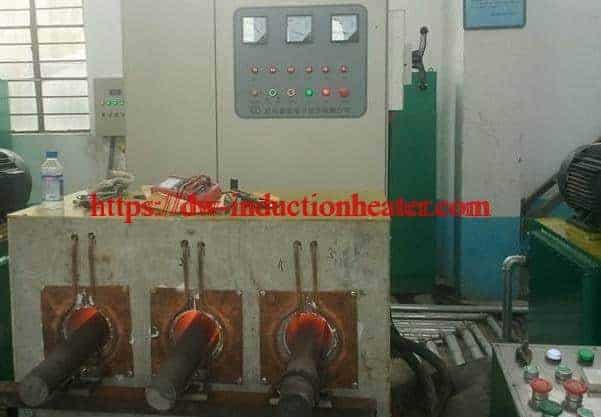
Typical on-site station layout

Common Problems and Solutions
| Problem | Likely cause | Solution |
|---|---|---|
| Rivet head cracks during forming | Too cold at forming | Shorten the transfer; form immediately after heating |
| Rivet burns or sparks | Overheated above about 1250 °C | Reduce the time; set a timer or pyrometer cut-off |
| Loose rivet after cooling | Rivet not hot enough along the shank | Heat the full shank length; check the coil position |
| Bar heating takes too long | Low power setting, poor coupling or heat conduction | Tighten the coil-to-bar gap; raise the power; use a larger model |
| Heat zone too long on the bar | Coil too long, or the bar inserted too far | Use a stop to set the insertion length |
| Coil damage on site | Scale, knocks or arcing | Use encapsulated coils and keep them clean |
Engineering Selection Guide
| Factor | Question to answer | Guideline |
|---|---|---|
| Part size | What are the rivet or bar diameter and the length to heat? | Calculate the heated mass; use the heating-time table |
| Temperature | Hot riveting or warm head forming? | 950–1100 °C for hot riveting; about 700 °C for warm forming |
| Cycle | How many rivets per hour? | More than 100 per hour: 100 % duty model, possibly two coils |
| Location | Workshop or site? | Cart-mounted generator with a remote workhead and long cable bundle |
| Supply | Single-phase or 3-phase? | Single-phase: DW-HF-15KW; 3-phase: DW-HF-25KW and above |
| Production forging | Many bars or billets? | See the induction billet heating system |
Advantages and Limitations
| Advantages | Limitations |
|---|---|
| Controllable heat pattern: only the end to be formed | One coil per diameter range |
| Easy to use on site with a remote workhead | Needs a power supply and water chiller on site |
| Safe: no open flame, no gas bottles | Thick bars take minutes at low power |
| Even heat distribution | Small rivets couple less efficiently |
| Repeatable, timer-controlled cycles | Higher investment than a coke forge |
Why Choose HLQ?
| Strength | What it means for you |
|---|---|
| Encapsulated coils | Robust, stable heat pattern on site |
| DW-HF 15–160 kVA platform | Covers everything from rivets to bar ends |
| Remote workhead | Generator stays on the cart; the coil goes to the work |
| No open flame | Safer construction and repair sites |
| Application testing | Coil and cycle proven on your parts |
Related HLQ applications: induction preheating for welding and induction preheating of blades and knives for hot stamping.
10 Core FAQs
1. Are these carbide or carbon steel rivets?
Low-carbon steel. The word “carbide” in the older page title was an error.
2. What temperature are the rivets heated to?
1050 °C (1922 °F), which is within the usual 950–1100 °C range for hot riveting.
3. How long does a rivet take to heat?
22–25 seconds for Ø11.1 mm rivets, 38 mm or 47 mm long, with a DW-HF-25kW at 48 kHz.
4. How long do the handrail bars take?
4 min 43 s for a 75 mm heat zone on a Ø32 mm bar at 55 kHz. More power or a tighter coil can shorten this.
5. Which coils are used?
A 3-turn encapsulated helical coil for the rivets and a 4-turn encapsulated helical coil for the bars.
6. What capacitors are in the workhead?
Two 1.5 μF capacitors in series, giving 0.75 μF.
7. Can it be used on a construction site?
Yes. The generator and chiller go on a cart, and the remote workhead and coils go to the work point.
8. Why use induction instead of a rivet forge?
It gives a controllable heat pattern, has no open flame, heats evenly and repeats from one rivet to the next.
9. What happens to the rivet after forming?
It cools in air and shrinks, which clamps the joint tightly.
10. Can the same heater forge bar ends in production?
Yes, for small batches. For continuous production, use a higher-power DW-HF model or a dedicated bar-end heater.