
Brazing Diamond Tools With Induction
Brazing Diamond Tools With Induction Heating Brazing Equipment
Quick Answer
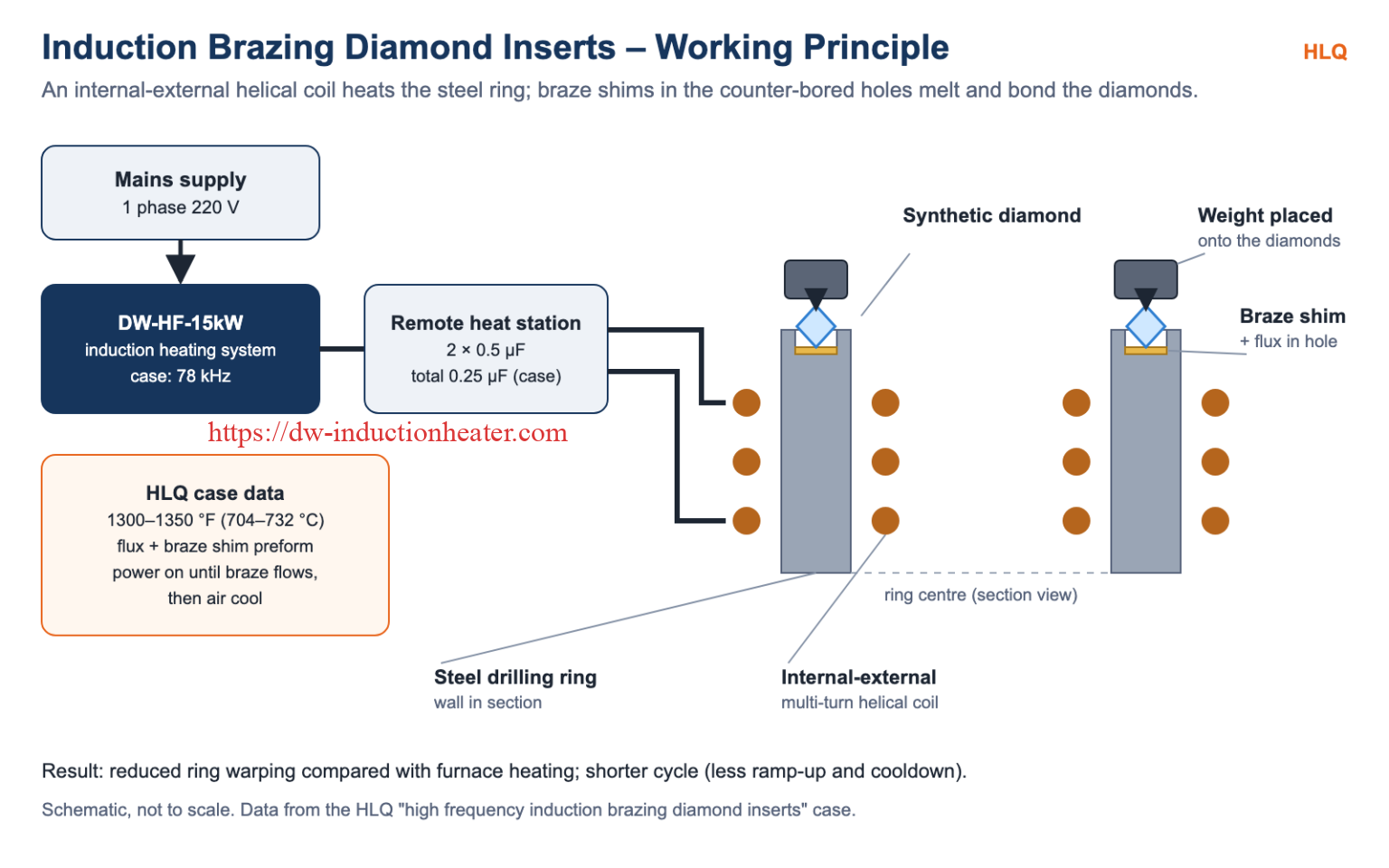
Brazing diamond tools with induction heats the steel tool body locally so a braze alloy melts and bonds the diamond inserts to the metal. In the published HLQ case, synthetic diamond inserts were brazed into counter-bored holes of a steel drilling ring with braze shim preforms and flux. The process ran at 1300–1350 °F (704–732 °C) with a DW-HF-15kW at 78 kHz and a multi-turn, internal-external helical coil, and power was applied until the braze flowed. Compared with furnace heating, induction reduced ring warping and shortened the cycle by cutting ramp-up and cooldown times.
Table of Contents
- What is Brazing Diamond Tools With Induction?
- Key Applications
- Suitable Materials
- Working Principle
- Technical Specifications
- Recommended Model Selection
- Process Workflow
- Common Problems and Solutions
- Engineering Selection Guide
- Advantages and Limitations
- Why Choose HLQ?
- 10 Core FAQs
What is Brazing Diamond Tools With Induction?
Induction brazing is the most reliable method of joining diamond to metals. It is also the most widely used, and in many companies the process is held as a trade secret.
Brazing joins two pieces with a third, molten filler metal: the braze alloy. The joint is heated above the melting point of the braze alloy but below the melting point of the materials being joined. The molten alloy flows into the gap by capillary action and forms a strong bond as it cools. When metals are joined, a diffusion bond is typically created between the two metals and the braze alloy.
Of all metal joining methods, induction brazing may be the most versatile. Brazed joints have high tensile strength, repel gas and liquid, withstand vibration and shock, and are unaffected by normal temperature changes. Because the metals are not melted, they are not warped and keep their original metallurgical characteristics. Brazing suits dissimilar metals, and complex assemblies can be made in stages with filler metals of progressively lower melting points. It is relatively fast, economical and adaptable to automation. For the general method, see the induction brazing process.
Induction brazing of diamond to metallic substrates differs significantly from brazing metals together: rather than relying on capillary action and a diffusion bond, brazing of diamonds relies on a chemical reaction.

Key Applications
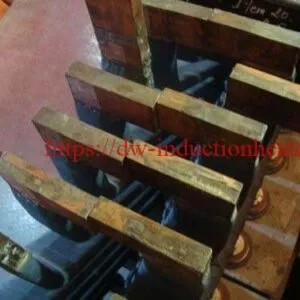
- Diamond inserts in drilling rings: see high frequency induction brazing diamond inserts.
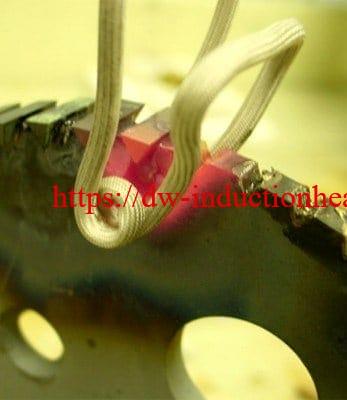
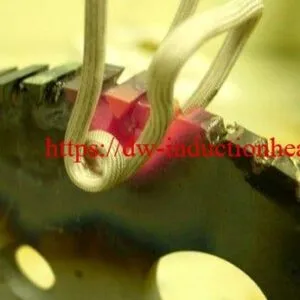
- Saw blade segments and tips: as shown in the original page image.
- Carbide tips on circular steel cutters: see brazing carbide tips to steel.
- Carbide cutters on steel impellers and shanks: see brazing carbide tool tips with induction.
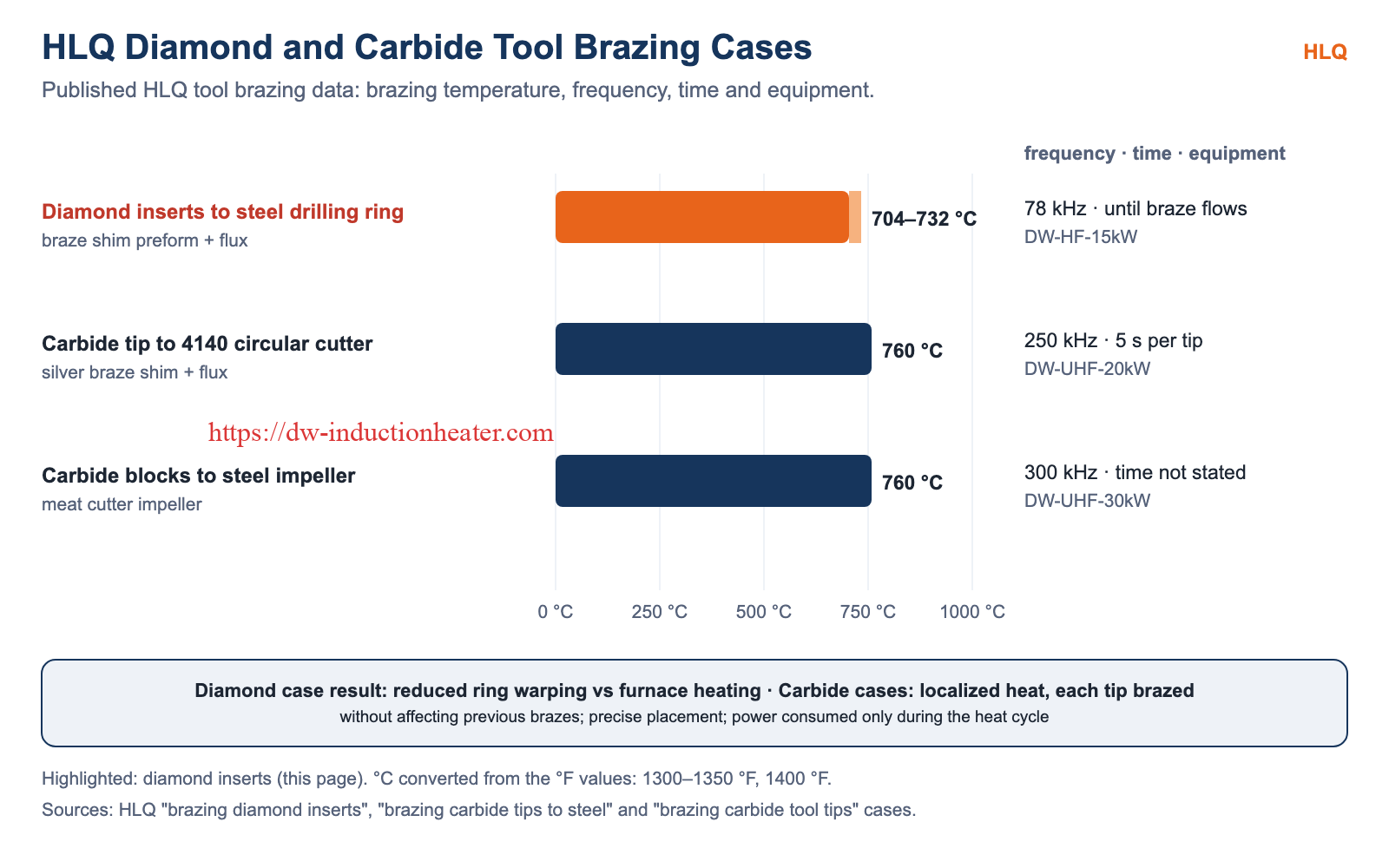
| HLQ case | Filler / flux | Temperature | Frequency | Time | Equipment |
|---|---|---|---|---|---|
| Diamond inserts to steel drilling ring | Braze shim preform, flux | 1300–1350 °F (704–732 °C) | 78 kHz | Until the braze flows | DW-HF-15kW |
| Carbide tip (C2 & C5) to 4140 circular cutter | Silver braze shim, flux | 1400 °F (760 °C) | 250 kHz | 5 s per tip | DW-UHF-20kW |
| Carbide blocks to steel meat cutter impeller | – | 1400 °F (760 °C) | 300 kHz (as stated) | – | DW-UHF-30kW |
Suitable Materials
| Insert | Substrate | Filler / flux | HLQ source |
|---|---|---|---|
| Synthetic diamond inserts | Steel drilling ring | Braze shim preform; flux | Diamond insert case |
| Carbide Isograde C2 & C5 tips | 4140 steel circular cutter | Silver braze shim; flux | Carbide tip case |
| Carbide blocks | Steel shank fitting / impeller | – | Carbide tool tip case |
Working Principle
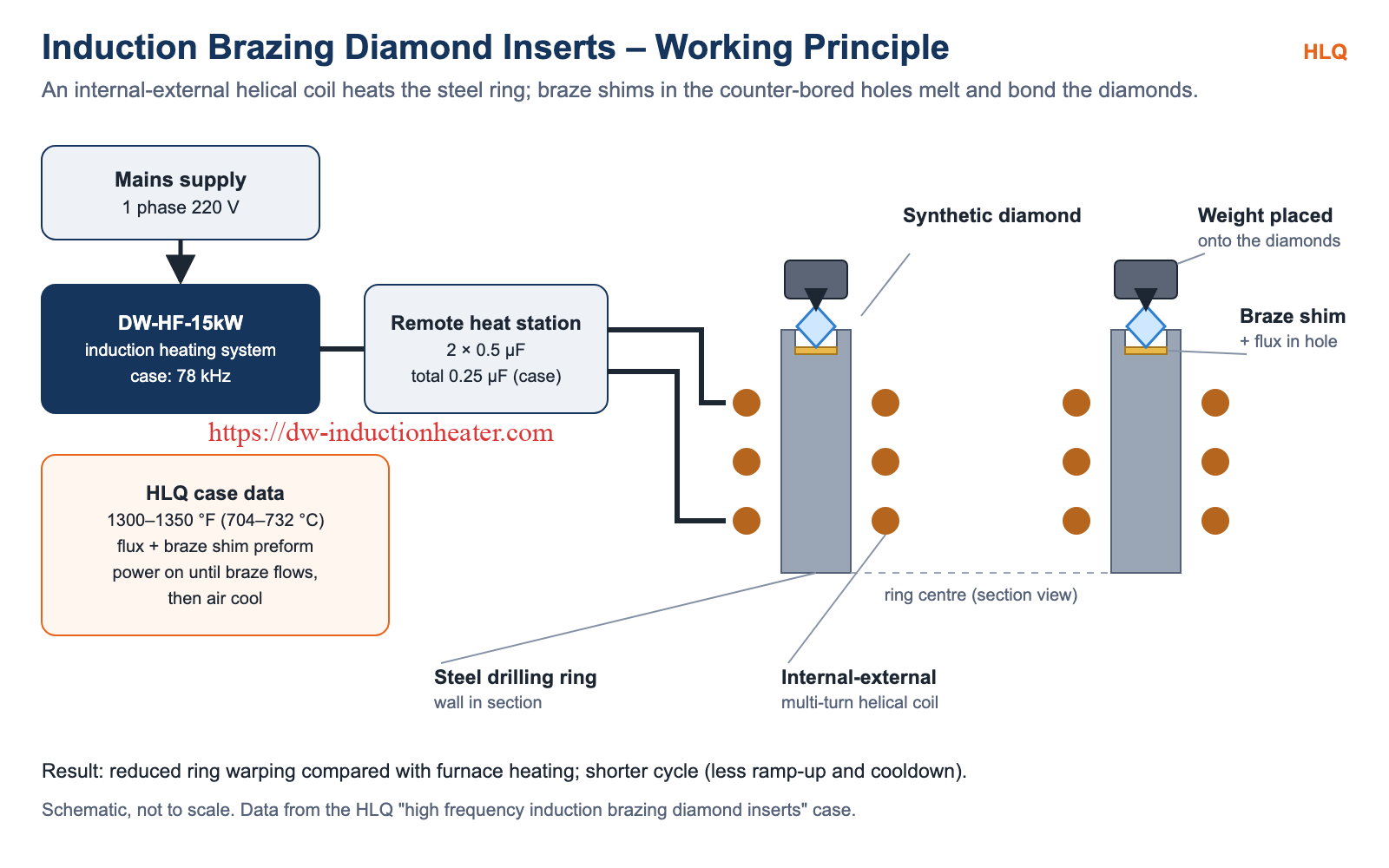
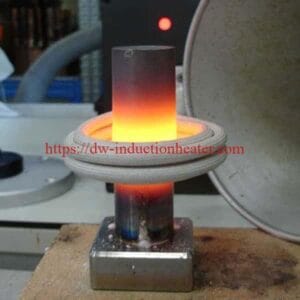
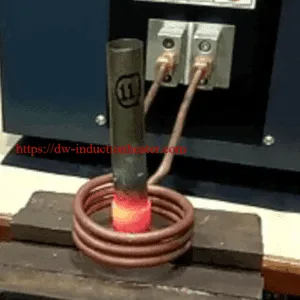
In the HLQ case, a DW-HF-15kW with a remote heat station drove 78 kHz current through a multi-turn, internal-external helical coil. The heat station held two 0.5 µF capacitors (total 0.25 µF). Coil turns inside and outside the ring heat the ring wall. The braze shims in the counter-bored holes melt under the diamonds, which are held down by a weight. Once the braze flows, power is switched off and the part air cools to room temperature.
Technical Specifications
| Parameter | HLQ diamond insert brazing case |
|---|---|
| Objective | Induction brazing diamond inserts to a steel drilling ring |
| Materials | Steel ring and diamond inserts; braze shim preform; flux |
| Temperature | 1300–1350 °F (704–732 °C) |
| Frequency | 78 kHz |
| Equipment | DW-HF-15kW induction heating system with remote heat station, two 0.5 µF capacitors (total 0.25 µF) |
| Coil | Multi-turn, internal-external helical coil designed for the application |
| Heating | Power applied until the braze flows; then air cooling to room temperature |
| Results | Reduced ring warping compared with furnace heating; decreased cycle time due to reduced ramp-up and cooldown times |
Recommended Model Selection
| Model | Power | Frequency range | Supply | HLQ tool brazing case |
|---|---|---|---|---|
| DW-HF-15kW | 15 kVA | 30–80 kHz | 1-phase 220 V | Diamond inserts, 78 kHz |
| DW-UHF-20kW | 20 kW | 50–250 kHz | 3-phase 380 V | Carbide tips, 250 kHz |
| DW-UHF-30kW | 30 kW | 50–200 kHz | 3-phase 380 V | Carbide blocks, 300 kHz (as stated) |
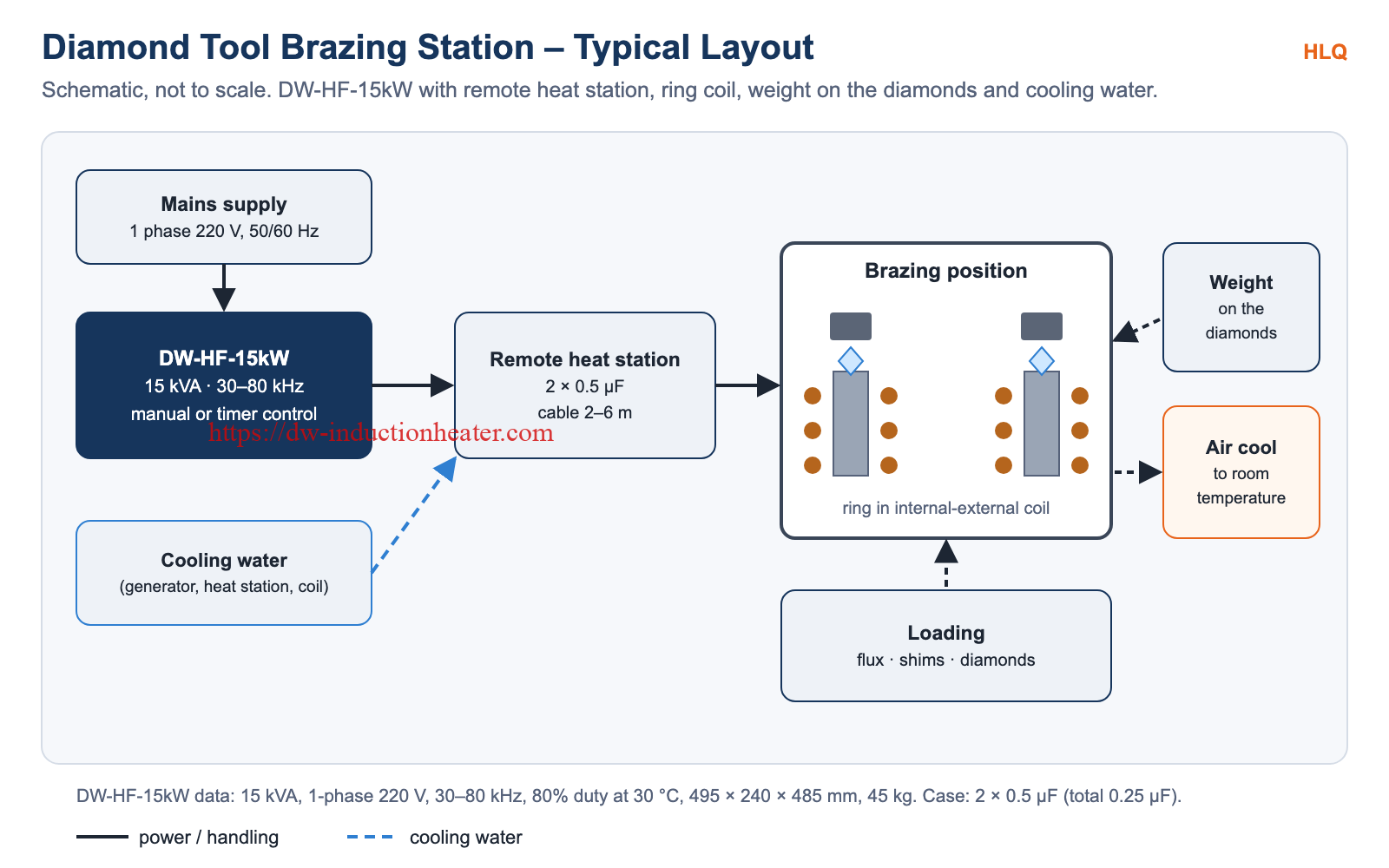
DW-HF-15kW induction heating equipment data:
| Parameter | Specification |
|---|---|
| Rated output | 15 kVA |
| Input | Single-phase 220 V, 50/60 Hz |
| Oscillation frequency | 30–80 kHz |
| Duty cycle | 80% at 30 °C |
| Host size | 495 × 240 × 485 mm |
| Weight | Approx. 45 kg |
| Cable length | 2–6 m |
| Cooling | Water cooling |
| Control | Manual or timer-controlled heating |
Process Workflow
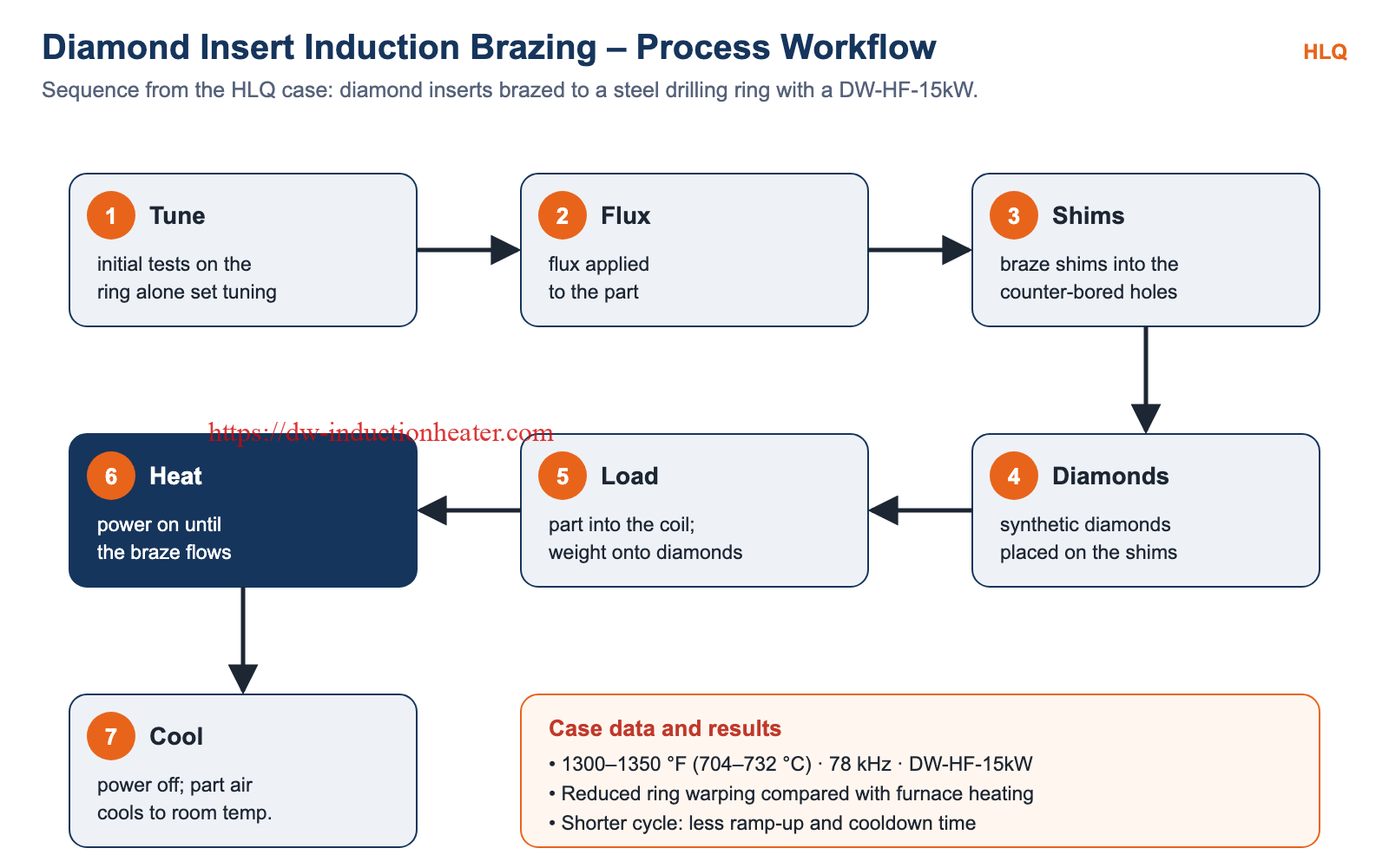
- Tune – initial tests on the ring alone determine system tuning.
- Flux – flux is applied to the part.
- Shims – braze shims are inserted into the counter-bored holes.
- Diamonds – the synthetic diamonds are placed.
- Load – the part is loaded into the coil and a weight is placed onto the diamonds.
- Heat – induction power is applied until the braze flows.
- Cool – power is turned off and the part air cools to room temperature.

Common Problems and Solutions
| Problem | Cause | Solution (HLQ data) |
|---|---|---|
| Ring warping | Furnace heating of the whole part | Induction heating reduced ring warping compared with furnace heating |
| Long cycle time | Furnace ramp-up and cooldown | Induction cut ramp-up and cooldown times |
| Wrong heating pattern | System not tuned to the part | Initial tests on the ring alone to determine tuning; coil designed for the application |
| Previous brazes affected on multi-tip tools | Heat spreading to neighbouring tips | Rapid, localized heat on the tip being brazed; rotate the cutter and braze each tip separately |
| Uneven heat between carbide and steel | Poor coil coupling | Helical coil giving uniform heating between the carbide and the steel shank |
| Carbide cracking or poor filler flow | Uncontrolled temperature | Control the temperature; use a flat or profile coil (DW-HF-15kW application data) |
Engineering Selection Guide
- Diamond inserts in steel rings: DW-HF-15kW at 78 kHz with an internal-external helical coil (HLQ case).
- Carbide tips on circular cutters: DW-UHF-20kW at 250 kHz with a split helical coil, 5 s per tip.
- Carbide blocks on shanks: DW-UHF-30kW with a five-turn helical coil (HLQ case).
- Coil: designed for the tool; see induction brazing coils.
- Supply: DW-HF-15kW runs on single-phase 220 V; DW-UHF-20/30kW need 3-phase 380 V.
- Data to send: tool drawing, substrate and insert materials, filler and flux, number of inserts, cycle time and output.
Advantages and Limitations
| Advantages | Limitations |
|---|---|
| Reduced ring warping compared with furnace heating | The coil must be designed for each tool geometry |
| Shorter cycle: less ramp-up and cooldown | System tuning tests are needed on the part |
| Localized heat; earlier brazes are not affected | Flux and braze shims must be prepared and placed |
| Power consumed only during the heat cycle | Water cooling is required |
| Repeatable joint quality | Diamond brazing relies on a chemical reaction, so the filler must suit diamond |
Why Choose HLQ?
- Published diamond insert and carbide tip brazing data.
- Custom coils, including internal-external helical and split helical designs.
- Single-phase DW-HF-15kW with manual or timer-controlled heating.
- DW-UHF systems for higher-frequency carbide tip brazing.
10 Core FAQs
1. Why is induction used for diamond tools?
It is the most reliable method of joining diamond to metals, with localized heat on the tool body.
2. How does diamond brazing differ from metal brazing?
Diamond brazing relies on a chemical reaction rather than capillary action and a diffusion bond.
3. What temperature is used for diamond inserts?
1300–1350 °F (704–732 °C) in the HLQ case.
4. Which frequency and equipment?
78 kHz with a DW-HF-15kW and a remote heat station (two 0.5 µF capacitors, total 0.25 µF).
5. Which coil was used?
A multi-turn, internal-external helical coil designed for the drilling ring.
6. How are the diamonds held during brazing?
They sit on braze shims in counter-bored holes, and a weight is placed onto them.
7. What are the benefits over a furnace?
Reduced ring warping and shorter cycles from less ramp-up and cooldown.
8. Can carbide tips be brazed the same way?
Yes. HLQ brazed carbide tips to a 4140 cutter at 1400 °F (760 °C) in 5 s per tip with a DW-UHF-20kW.
9. Does brazing one tip affect the others?
No. In the HLQ carbide case, the localized heat did not affect the previous brazes.
10. What information is needed for a quotation?
Tool drawing, substrate and insert materials, filler and flux, number of inserts, cycle time and output.