Induction Shrink Fitting Bearings
Induction Shrink Fitting of Bearings: Induction Bearing Heater for Mounting and Dismounting
Quick Answer
Induction shrink fitting of bearings means heating a rolling bearing with an induction heater until its inner ring expands, so that it slides onto the shaft without force. As the bearing cools, it grips the shaft with an interference fit.
- Temperature: Heat to about 110 °C, roughly 90 K above the shaft. Do not exceed the maker’s limit, which is typically 120 °C. Sealed or pre-greased bearings should stay at or below about 80 °C.
- Equipment: Yoke-type bearing heaters for maintenance, HLQ UHF/HF heaters with a helical coil for production, and flexible-cable heaters for large bearings.
- Speed: Small bearings (Ø25–89 mm) heat in 30–60 s with a 6 kW, 180 kHz coil. Larger bearings take minutes.
- Always: Put the temperature probe on the inner ring, demagnetise after heating, and mount the bearing immediately.

What is Induction Shrink Fitting of Bearings?
Bearing inner rings are usually mounted on the shaft with an interference fit. Pressing them on cold needs high force, can damage the raceways and rolling elements, and can score the shaft. Heating the bearing about 90 K above the shaft temperature expands the bore enough for the bearing to slide on freely. When it cools, it locks onto the shaft.
An induction bearing heater generates heat directly in the bearing rings. It heats evenly to a set temperature, measured by a probe on the inner ring, and demagnetises the bearing at the end of the cycle. The same principle is used for gears and couplings; see induction shrink fitting of gears onto shafts.
| Method | Speed | Temperature control | Risk |
|---|---|---|---|
| Induction heater | Seconds to minutes | Probe on the inner ring, automatic stop | Needs demagnetising (automatic) |
| Oil bath | Slow | Limited | Contamination, fire risk, oil disposal |
| Oven or hot plate | Slow | Moderate | Uneven heating, long cycle |
| Open flame | Fast | Poor | Local overheating and damage; never use |
| Cold press | Fast | — | Brinelling of raceways, shaft scoring |
Key Applications
| Industry | Typical bearings | Typical heater |
|---|---|---|
| Electric motors and pumps | Deep-groove ball and cylindrical roller bearings | Yoke heater or HF helical coil |
| Gearboxes and reducers | Tapered and spherical roller bearings | Yoke heater |
| Steel, paper, mining, cement | Large spherical roller bearings on rolls and shafts | Large yoke heater or flexible cable |
| Rail, wind, marine | Axle-box, main-shaft and stern-tube bearings | Flexible-cable heater |
| Production assembly lines | Small bearings in high volume | HLQ UHF/HF heater with a fixed coil |
Application cases
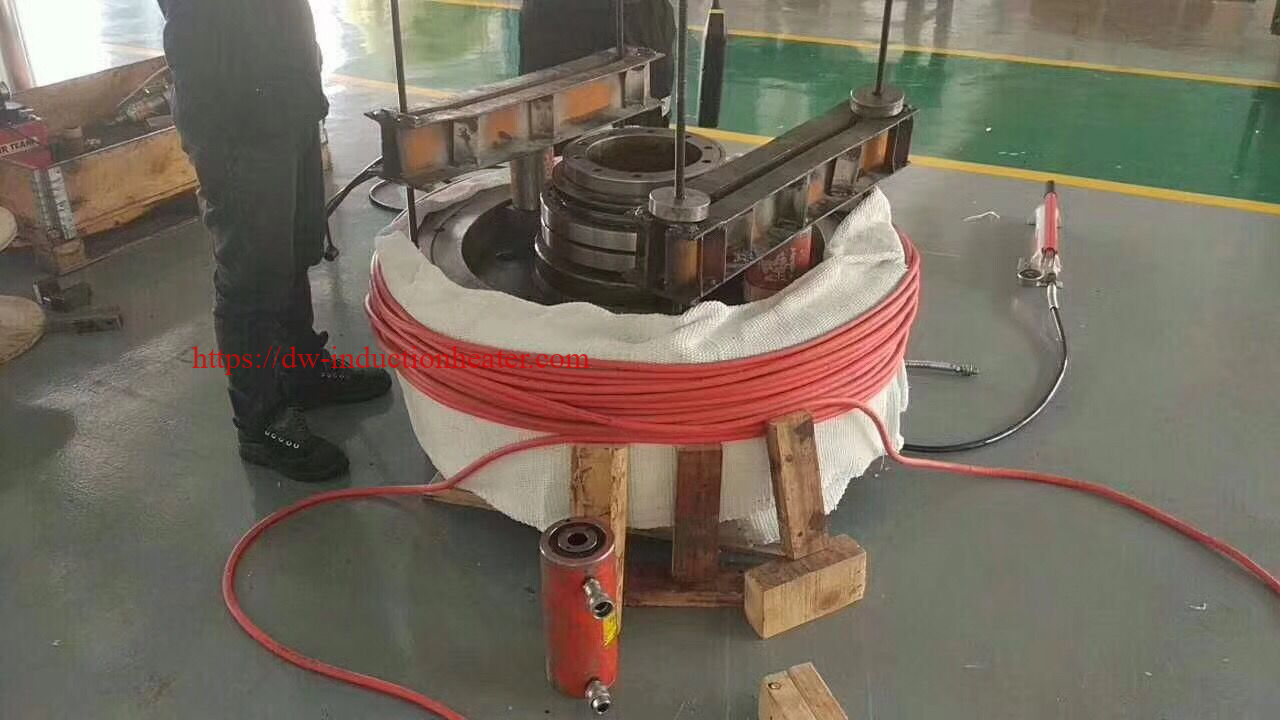


For very large bearings, couplings and propeller hubs, see induction heating for large bearings, couplings and propeller hubs.
Suitable Materials
| Bearing type or material | Max heating temperature | Notes |
|---|---|---|
| Open bearings, through-hardened bearing steel (e.g. 100Cr6 / 52100) | ≤ 120 °C (typical maker limit) | Mount at ≈ 110 °C |
| Bearings with a polyamide (PA66) cage | ≤ 120 °C | Cage limit |
| Sealed or shielded, pre-greased bearings | ≤ 80 °C | Grease and seal limit |
| Precision and super-precision bearings | Per maker (often ≤ 70 °C) | Dimensional stability |
| Case-carburised bearing steel | ≤ 120 °C | Same rule as open bearings |
| Separate rings, sleeves and labyrinth rings | Per material | Same heater, temperature mode |
Always follow the specific bearing maker’s mounting instructions.
Working Principle

- Yoke heater (50/60 Hz): Works like a transformer. The bearing hangs on the removable top yoke and acts as a one-turn short-circuited secondary winding.
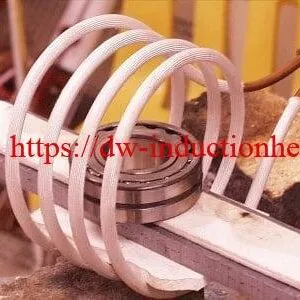
- HF helical coil: A multi-turn coil carries high-frequency current. The bearing sits inside it with its axis across the coil axis, so one coil heats a range of bearing sizes evenly.
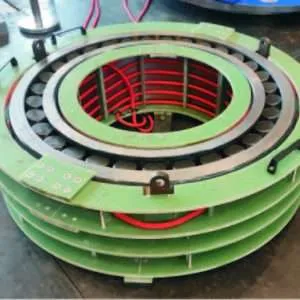
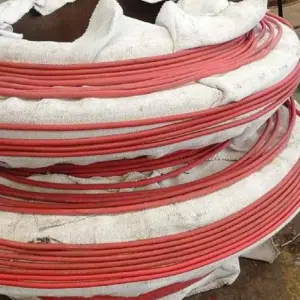
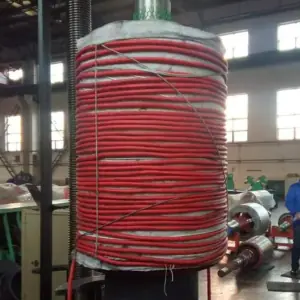
- Flexible cable coil: Medium-frequency cable is wound on large bearings and rings, in the workshop or on site.
- Expansion and mounting: The inner ring grows by ΔD = α · d · ΔT and slides onto the shaft. The heater then demagnetises the bearing.
Background: how induction heating works.
Bore growth and required temperature rise (bearing steel, α ≈ 12 × 10⁻⁶ /K)
| Bearing bore d | Bore growth at ΔT 90 K | Max interference, m6 shaft* | ΔT needed for that interference |
|---|---|---|---|
| 50 mm | 0.054 mm | 0.037 mm | ≈ 62 K |
| 100 mm | 0.108 mm | 0.055 mm | ≈ 46 K |
| 200 mm | 0.216 mm | 0.076 mm | ≈ 32 K |
| 300 mm | 0.324 mm | 0.087 mm | ≈ 24 K |
* ISO 286 m6 shaft with a normal-tolerance bearing bore. Heating 90 K above the shaft leaves a margin for an easy slide-on. Small bearings with tight fits need a relatively higher ΔT, so check it against the maker’s limit.
Technical Specifications
| Heater type | Frequency | Bearing size | Supply | Key features |
|---|---|---|---|---|
| Yoke-type induction bearing heater | 50/60 Hz | ≈ Ø20–600 mm bore, by model | Single- or three-phase, by model | Temperature mode, automatic demagnetising, swing-out yoke |
| HLQ UHF heater + helical coil (e.g. DW-UHF-6 kW) | ≈ 100–400 kHz (180 kHz in the case below) | Ø25–89 mm in one coil | Single-phase | Cart-mounted, 30–60 s per bearing |
| HLQ HF heater + custom coil (DW-HF) | 30–80 kHz | Bearings and rings in production lines | Three-phase | Fixed coil, automation I/O |
| MF flexible-cable heater | 2–36 kHz | Large bearings and rings, Ø300 mm to 3 m | Three-phase | Cable wound on the ring; site work |
Heating time by bearing mass and heater power (20 → 110 °C, η 0.6)
| Bearing mass | 2 kW | 5 kW | 10 kW | 25 kW |
|---|---|---|---|---|
| 1 kg | 34 s | 14 s | 7 s | 3 s |
| 5 kg | 173 s | 69 s | 35 s | 14 s |
| 20 kg | 690 s | 276 s | 138 s | 55 s |
| 50 kg | 1725 s | 690 s | 345 s | 138 s |
t = m · c · ΔT / (P · η), with bearing steel c ≈ 0.46 kJ/kg·K. Large bearings should be heated more slowly so that the inner and outer rings stay at a similar temperature.
Recommended Model Selection
| Requirement | Recommended | Reason |
|---|---|---|
| Small bearings in production (Ø25–90 mm) | UHF 6 kW + helical coil | One coil for all sizes, 30–60 s |
| Maintenance workshop, bearings up to ≈ 300 kg | Yoke-type bearing heater | Temperature mode and automatic demagnetising |
| Large bearings and rings, on site | MF flexible-cable heater | No size limit; portable |
| Dismounting inner rings | Cable or custom coil, high power | Heat the ring quickly, before the shaft warms |
| Mixed bearings, gears and couplings | Portable shrink fitting machine | One system for several part types |
For mixed workshop jobs, see the portable induction shrink fitting machine.
Process Workflow

| Step | Action | Check |
|---|---|---|
| 1 | Check the shaft size, interference and the bearing’s maximum temperature | Open or sealed bearing? |
| 2 | Clean the shaft and seat; apply a light oil film; set the axial stop | No burrs or dirt |
| 3 | Load the bearing on the yoke or in the coil; put the probe on the inner ring | Probe has good contact |
| 4 | Set the target to ≈ 110 °C (≤ 120 °C), or ≤ 80 °C for sealed bearings | Temperature mode, not time only |
| 5 | Heat until the set point is reached | Automatic stop |
| 6 | Demagnetise (automatic at the end of the cycle) | Cycle complete |
| 7 | Slide the bearing on at once and push it to the shoulder | Within about 30 s |
| 8 | Hold it against the shoulder until it grips, then let it cool | No gap at the shoulder |
| 9 | Inspect | Free rotation, correct axial position |
Typical mounting station layout

Common Problems and Solutions
| Problem | Likely cause | Solution |
|---|---|---|
| Bearing stops before reaching the shoulder | The ring cooled during transfer, or ΔT was too low | Mount at once; hold it against the shoulder; keep the heater close to the shaft |
| Gap at the shoulder after cooling | The bearing shrank axially and pulled away from the shoulder | Hold axial pressure until the bearing grips |
| Bearing overheated | Time mode used, or the probe was on the outer ring | Use temperature mode with the probe on the inner ring |
| Bearing attracts metal particles | Residual magnetism | Use the automatic demagnetising cycle |
| Grease leaking from a sealed bearing | Heated above ≈ 80 °C | Limit sealed bearings to ≤ 80 °C |
| Inner ring hot, outer ring cold (large bearings) | Heating too fast | Reduce the power; allow time to equalise |
| Cannot remove the bearing | The shaft heats along with the ring | Heat the inner ring fast with a puller in place; see induction thermal disassembly |
Engineering Selection Guide
| Factor | Question to answer | Guideline |
|---|---|---|
| Bearing size and mass | Bore, OD, width, weight? | Choose a yoke size or coil that fits the bore and mass |
| Bearing type | Open, sealed or precision? | Set the temperature limit: 120 / 80 / per maker |
| Volume | Bearings per day? | High volume: UHF/HF fixed coil; maintenance: yoke heater |
| Location | Workshop or on site? | On site and very large: flexible-cable heater |
| Job | Mounting, dismounting or both? | Dismounting needs fast, high-power heating of the inner ring |
| Other parts | Gears, couplings, sleeves as well? | See the induction shrink fitting machine range |
Advantages and Limitations
| Advantages | Limitations |
|---|---|
| Fast, even heating to a set temperature | The temperature must stay within the bearing maker’s limit |
| No oil, flame or press force | Bearings must be demagnetised (automatic on bearing heaters) |
| No damage to raceways or the shaft | Very small, tight-fit bearings may still need a press |
| Automatic demagnetising and temperature hold | Keep watches, tools and implants away from the yoke field |
| The same heater can be used for dismounting | Large bearings need lifting equipment |
Why Choose HLQ?
| Strength | What it means for you |
|---|---|
| Every bearing size | Yoke heaters, UHF/HF coils and MF cable heaters |
| Temperature control | Probe on the inner ring, automatic stop and hold |
| Automatic demagnetising | Clean bearings, ready to mount |
| Custom coils | Helical, split and cable coils for your parts |
| Mounting and removal | One heater for both jobs |

Application example: roller bearings Ø25–89 mm
| Item | Value |
|---|---|
| Bearings | Steel roller bearings, 25–89 mm (1–3.5 in) |
| Power supply | DW-UHF-6 kW, single-phase, remote heat station with 2 × 0.1 μF capacitors (0.2 μF) |
| Frequency | 180 kHz |
| Coil | Multi-turn helical coil; bearing axis across the coil axis (transverse heating) |
| Temperature check | Temperature-indicating paints |
| Result in test | 150–175 °C in 30–60 s; bearings slid onto the shafts without force |
| Recommended production setting | ≈ 110 °C (≤ 120 °C maker limit), which also shortens the cycle |
| Benefit | One coil for the whole size range; the single-phase supply allows a mobile cart |
10 Core FAQs
1. What temperature should a bearing be heated to for mounting?
About 110 °C, which is roughly 90 K above the shaft. Do not exceed the maker’s limit, typically 120 °C.
2. Can sealed bearings be heated by induction?
Yes, but only to about 80 °C, because of the grease and the seals.
3. Why must bearings be demagnetised?
Induction leaves some residual magnetism, which attracts wear particles. Bearing heaters demagnetise automatically at the end of the cycle.
4. Where should the temperature probe go?
On the inner ring, because the inner ring is what has to expand to fit the shaft.
5. How long does heating take?
Small bearings take 30–60 s with a 6 kW HF coil. A 20 kg bearing takes about 2–5 minutes on a 5–10 kW heater.
6. How much does the bore expand?
ΔD = α · d · ΔT. At ΔT 90 K, a 100 mm bore grows by about 0.11 mm, which is more than the maximum interference of an m6 fit.
7. Can induction be used to remove bearings?
Yes. Heat the inner ring quickly with a puller in place, so that it expands before the shaft warms, then pull it off.
8. Is an oil bath or a torch acceptable?
An oil bath is slow and dirty. An open flame causes local overheating and should never be used. Induction is faster, cleaner and temperature-controlled.
9. What frequency do bearing heaters use?
Yoke heaters run at 50/60 Hz. HF coil systems use about 100–400 kHz for small bearings (180 kHz in the case above). Flexible-cable heaters use 2–36 kHz for large rings.
10. What is the largest bearing that can be heated?
Yoke heaters cover bores up to about 600 mm, depending on the model. Flexible-cable heaters have no practical size limit and are used on rings up to several metres.
Related products
-

Induction Shrink Fitting Shaft Gears
-
Induction shrink fitting and thermal disassembly
-
Induction Heating for Disassembly and Assembly large bearings, shaft couplings, propeller hubs and Turbine Bearings in Shipbuilding Industry and Heavy Machinery Maintenance
-
Induction Disassembly Machine For Couplings, Bearings, Rotors, and Motors
-
Induction Shrink Fitting