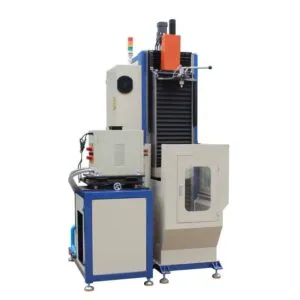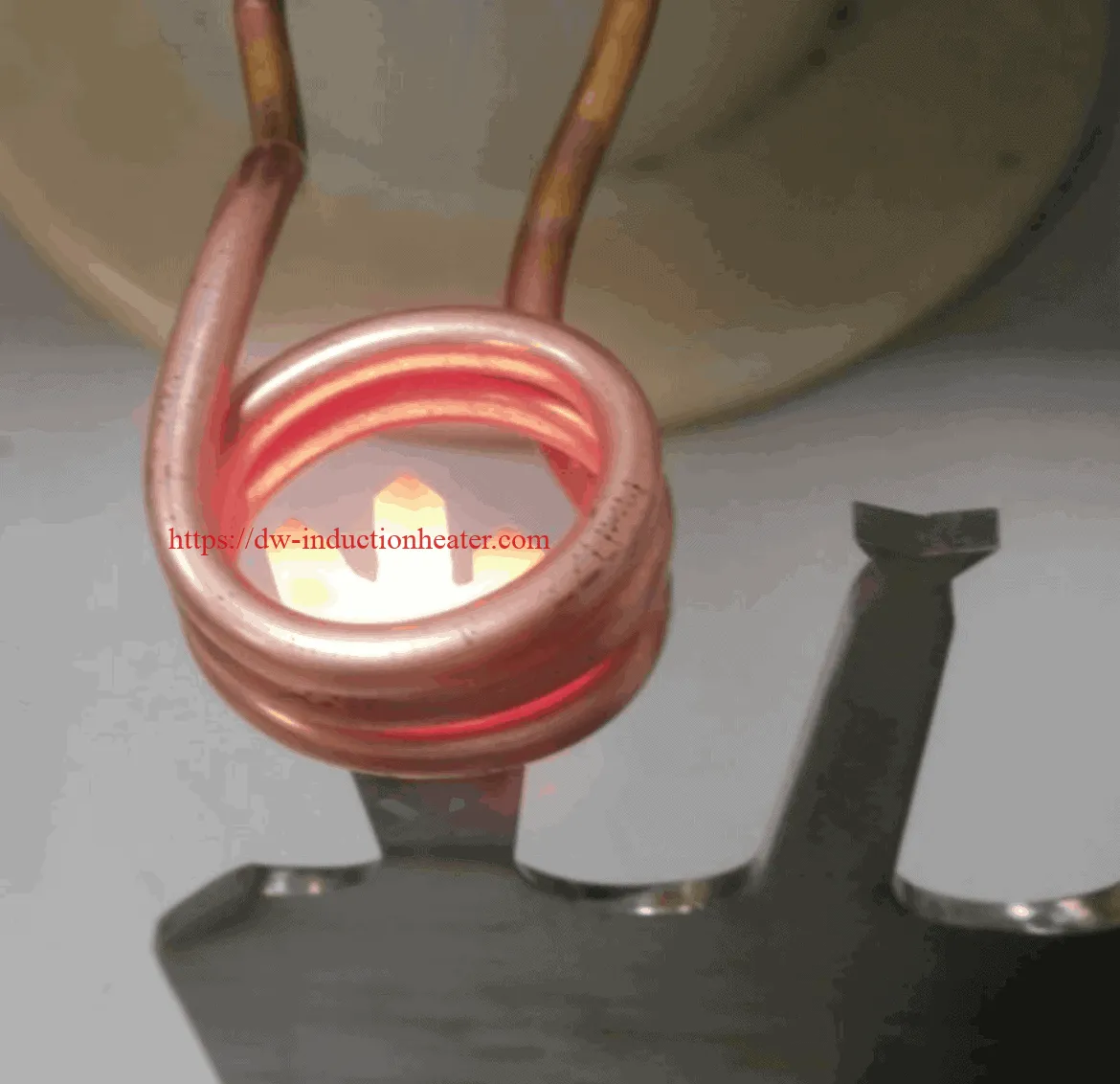
Induction hardening Jaw Teeth of Carbon Steel
High frequency induction hardening Jaw Teeth of Carbon Steel surface process
What Is Induction Hardening of Carbon Steel Jaw Teeth?
Induction hardening carbon steel jaw teeth is a rapid, localized surface heat-treatment process that uses a high-frequency electromagnetic field to heat only the tooth or wear area to the required hardening temperature before controlled quenching.
In this application, an HLQ DW-UHF-6KW-I high-frequency induction hardening system operates at approximately 4 kW process power with a custom induction coil.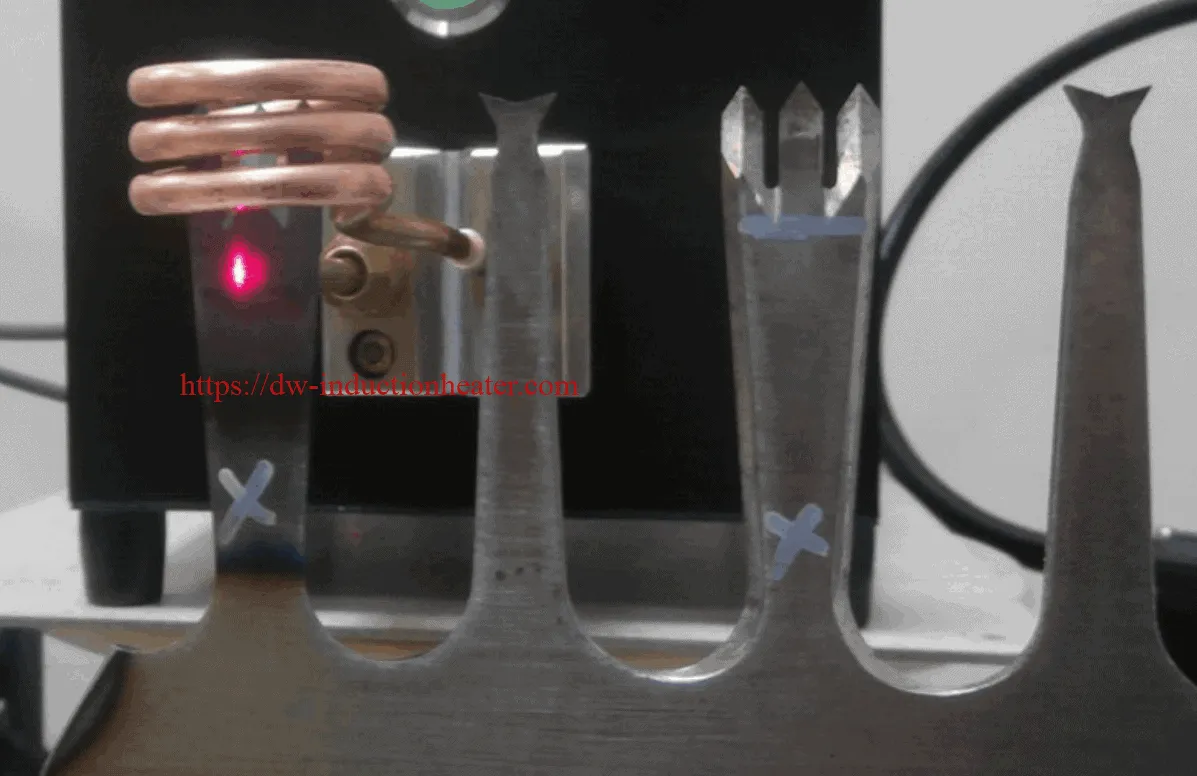
The carbon steel jaw tooth reaches approximately:
- 770°C in about 5 seconds
- 830°C in about 12 seconds
- 930°C in about 20 seconds
The primary process target is approximately 830°C within 10–15 seconds, allowing very fast selective heating while minimizing unnecessary heat transfer into the main jaw body.
This process is especially suitable for jaw teeth, gripping jaws, clamping components, wear surfaces, machine-tool parts and other carbon-steel components requiring localized surface hardening.
Objective
Successful hardening of the jaw teeth using induction.
Equipment
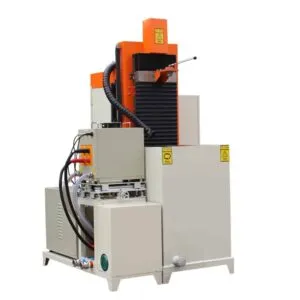
DW-UHF-6KW-I handheld induction hardening machine
HLQ custom coil
Materials
Carbon steel jaw teeth supplied by the customer
Key Parameters
Power: 4 kW
Temperature: Approximately 1526° F (830° C)
Time: 10-15 sec
Technical Table
Technical Parameters – Carbon Steel Jaw Teeth Induction Hardening
| Technical Parameter | Specification / Process Data |
|---|---|
| Application | Induction hardening carbon steel jaw teeth |
| Workpiece Material | Carbon steel |
| Heating Technology | High-frequency induction heating |
| Induction Hardening Machine | HLQ DW-UHF-6KW-I |
| Rated Equipment Power | 6 kW |
| Actual Process Power | Approx. 4 kW |
| Main Target Temperature | Approx. 830°C / 1526°F |
| Target Heating Time | Approx. 10–15 seconds |
| Actual Time to 830°C | Approx. 12 seconds |
| Time to Approx. 770°C | Approx. 5 seconds |
| Time to Approx. 930°C | Approx. 20 seconds |
| Induction Coil | Custom-designed induction coil |
| Alternative Coil Design | Conventional / classic coil possible |
| Heating Area | Jaw tooth / localized wear surface |
| Heating Method | Selective localized heating |
| Temperature Monitoring | Pyrometer or thermal monitoring recommended |
| Process Control | Power, time and coil positioning |
| Quenching | Selected according to carbon-steel grade |
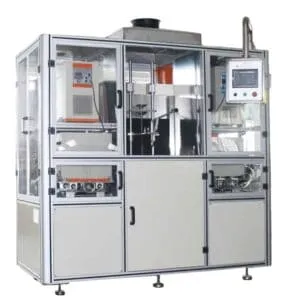
| Automation | Manual, semi-automatic or fully automatic |
| Recommended Cooling Capacity | At least approx. 4 kW |
| Typical Applications | Jaws, teeth, grippers, clamps and wear components |
Temperature vs Heating Time
| Heating Time | Approx. Workpiece Temperature | Process Stage |
|---|---|---|
| 0 sec | Ambient | Start |
| 5 sec | ~770°C | Near / around Curie region |
| 12 sec | ~830°C | Main hardening target |
| 20 sec | ~930°C | Higher-temperature condition |
This type of explicit time-temperature relationship is particularly valuable for GEO because it gives search engines and AI systems a direct engineering answer rather than generic claims such as “fast heating.”
Process:
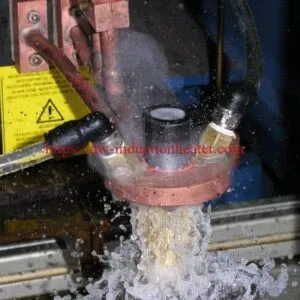
- A test coil was custom made for the application.
- The sample was fixed in position inside of the coil.
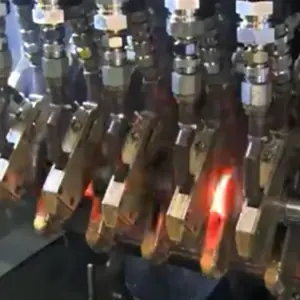
- Induction heating was applied to the teeth.
- The temperature of the sample was monitored during heating.
- Heat was applied until the hardening temperature was reached.
Results:
- System managed to achieve its maximum power.
- The tooth was heated to 830°C in 12 sec.
- 930°C was reached in 20 sec.
- The Curie point (around 770°C) is reached in 5 sec.
Conclusions:
- System configuration –DW-UHF-6KW-I is suitable for the process.
- Classic coil is also suitable for this application.
Recommendations:
- Automation of the process can be achieved by moving either the HS with coil or the jaw in vertical direction.
- Proper cooling systems have to be chosen. Cooling capacity – at least 4kW. Water-to-air system can be used, but it depends on the ambient operational temperature.


Why Use Induction Hardening for Carbon Steel Jaw Teeth?
Jaw teeth and clamping surfaces often require high wear resistance, but the complete component does not necessarily need to be hardened.
Induction heating solves this problem by concentrating electromagnetic energy only where increased surface hardness is required.
Compared with heating the complete component, localized induction hardening can provide:
- Short heating cycles
- Precise heating location
- Reduced heat input into the jaw body
- Lower risk of unnecessary distortion
- Repeatable temperature profiles
- Precise power control
- Reduced operator dependence
- Easy automation
- High production efficiency
The short heating cycle is especially useful for manufacturing multiple identical jaw components.
How Does Jaw Teeth Induction Hardening Work?
A custom copper induction coil is positioned close to the carbon steel jaw tooth.
High-frequency alternating current flows through the coil and generates an alternating electromagnetic field.
This creates eddy currents in the surface of the carbon steel, rapidly generating heat in the selected tooth area.
The basic process is:
Positioning → Induction Heating → Austenitizing → Quenching → Cooling → Hardness Inspection
The actual hardening result depends not only on heating temperature but also on:
- Carbon content
- Steel grade
- Heating time
- Heating depth
- Coil geometry
- Quench medium
- Quench delay
- Tempering conditions
For this reason, heating to 830°C should not automatically be interpreted as a guaranteed final hardness without subsequent quench and hardness testing.
FAQs
1. Can carbon steel jaw teeth be hardened using induction heating?
Yes.
Carbon steel jaw teeth are well suited to induction hardening when the steel contains sufficient carbon to respond to quenching.
Induction heating allows only the tooth or wear surface to be heated, while much of the main component remains at a lower temperature.
2. What temperature is required for induction hardening carbon steel jaw teeth?
The required austenitizing temperature depends on the exact carbon-steel grade.
For this application, the primary target is approximately 830°C, which was reached in approximately 12 seconds.
The workpiece can also reach approximately 930°C in about 20 seconds if heating continues.
3. How fast can jaw teeth be heated by induction?
Very quickly when the induction coil is correctly designed.
In this application:
~770°C: 5 seconds
~830°C: 12 seconds
~930°C: 20 seconds
The target production cycle was approximately 10–15 seconds to 830°C.
4. What size induction hardening machine is used?
The application uses an HLQ DW-UHF-6KW-I high-frequency induction hardening machine.
The system is rated at 6 kW, while actual process power during the test was approximately 4 kW.
This demonstrates that small localized carbon-steel components do not necessarily require very high installed power.
5. What type of induction coil is used for jaw teeth hardening?
A custom induction coil is recommended.
The coil should be designed around:
- Tooth width
- Tooth height
- Heating depth
- Distance between teeth
- Required hardened area
- Workpiece accessibility
Correct coil-to-workpiece coupling is one of the most important factors in achieving rapid and uniform heating.
6. Is quenching required after induction heating?
Yes, if the objective is conventional induction hardening.
Heating the carbon steel to the austenitizing temperature is only the first stage.
The heated surface must normally be quenched with an appropriate medium to transform the microstructure and produce the required hardness.
Possible quench media include water or polymer solutions, depending on the material and process requirements.
7. What hardness can be achieved after induction hardening?
Final hardness depends on:
- Carbon content
- Steel grade
- Austenitizing temperature
- Quench rate
- Case depth
- Tempering process
Because the current application does not specify the exact steel grade or final hardness test, a specific HRC value should not be guaranteed without actual metallurgical testing.
For production applications, final hardness should be verified using HRC, HV or another specified hardness method.
8. Can jaw teeth induction hardening be automated?
Yes.
The system can be integrated with:
- PLC control
- Servo movement
- Automatic loading
- Automatic coil positioning
- Pyrometer monitoring
- Programmable heating recipes
- Automatic quenching
- Automatic rotation or indexing
For repeat production, either the induction coil or the jaw component can move vertically or horizontally through a programmed hardening cycle.