

Induction Hardening Gears Teeth
Induction Hardening Gear Teeth: Seatbelt Retraction Gears in 2 Seconds
Quick Answer
Induction hardening gear teeth heats only the teeth of a gear to hardening temperature and quenches them at once, without contact.
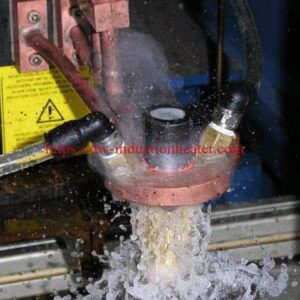
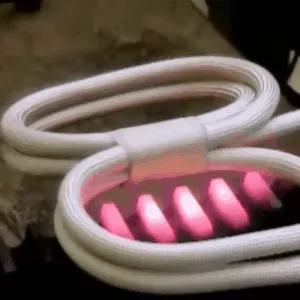
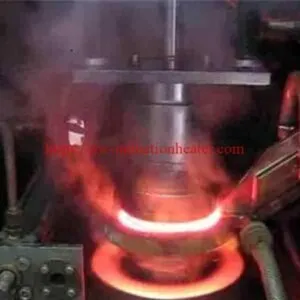
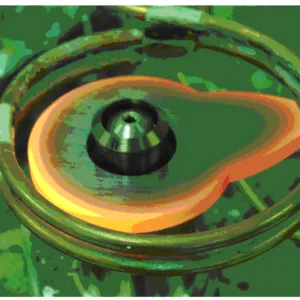
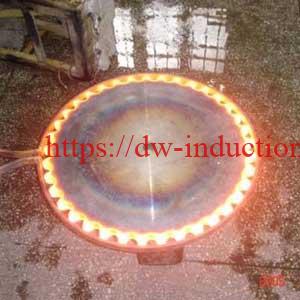
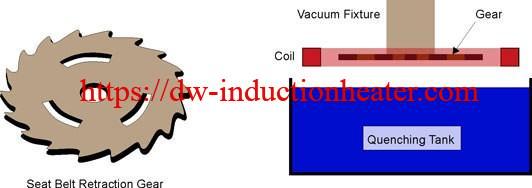
In this HLQ case, the teeth of #4130 steel seatbelt retraction gears were heated to 1700 °F (926.7 °C) in two seconds in a four-turn helical concentrating coil. The coil was powered by a DW-UHF-10kW induction heating system at 200 kHz with a 1.0 µF remote workhead. A vacuum rosette fixture held each gear in the coil above the quench tank. After heating, the gear was expelled into a water vortex quenching tank. The results were uniform and repeatable, with energy-efficient, non-contact heating.
What is Induction Hardening of Gear Teeth?
An induction coil heats the gear teeth above their transformation temperature, and a rapid quench then hardens them. The rest of the gear is not heated in the same way. For small gears, the whole toothed rim can be heated at once in a single shot, as in this case.
| Item | HLQ case data |
|---|---|
| Objective | Heat the teeth of a soft steel seatbelt retraction gear to 1700 °F (926.7 °C) within two seconds for hardening |
| Material | #4130 steel seatbelt retraction gears |
| Temperature | 1700 °F (926.7 °C) |
| Frequency | 200 kHz |
| Equipment | DW-UHF-10kW induction heating system with a remote workhead of 1.0 µF capacitance, plus a coil designed for this application |
| Coil | Four-turn helical concentrating coil, designed to deliver uniform heat to the gear |
| Fixture and controls | Vacuum rosette fixture, electronically controlled air valves, adjustable timers |
| Quench | Water vortex quenching tank |
Key Applications

| Application | Typical workpiece | Hardening method |
|---|---|---|
| Small automotive gears (this case) | Seatbelt retraction gears | Single-shot |
| Automotive transmission gears | Small spur gears, synchronizer gears, gear shafts | Single-shot, spin or scanning |
| Reducer and gearbox gears | Spur gears, helical gears, pinions | Spin or scanning |
| Large ring gears | External and internal ring gears, slewing rings | Tooth-by-tooth or scanning |
| Chain transmission | Sprockets and toothed wheels | Single-shot or spin |
| Mining machinery | Large-module gears and heavy-duty pinions | Tooth-by-tooth |
Application data from HLQ’s gear hardening machine for gear tooth and surface hardening. Large gears: tooth-by-tooth induction gear teeth hardening.

Suitable Materials
| Material type | Typical grades | Suitability |
|---|---|---|
| Steel used in this case | #4130 | Hardened at 1700 °F in 2 s |
| Medium-carbon steel | C45, 1045, 45 steel, 50 steel | Very suitable |
| Alloy structural steel | 40Cr, 42CrMo, 4140, 4340, 34CrNiMo6 | Very suitable; deeper case |
| Carburizing steel | 20CrMnTi, 8620, 18CrNiMo7-6 | Conditionally suitable |
| Ductile iron | QT500, QT600 | Possible with process testing |
| Low-carbon steel | 1018, Q235 | Not ideal directly |
More on steels and hardening: induction hardening treatment for steel surfaces.
Working Principle

- The DW-UHF-10kW drives the 1.0 µF workhead and the four-turn helical concentrating coil at 200 kHz.
- The vacuum rosette fixture holds the gear inside the coil, above the quench tank.
- Power is applied for two seconds; the teeth reach 1700 °F (926.7 °C).
- The air valve releases the gear, which drops into the water vortex quench.
| Item | Value |
|---|---|
| Skin depth in hot steel at 200 kHz (calculation) | ≈ 1.2 mm (ρ ≈ 1.2×10⁻⁶ Ω·m, µr = 1 above the Curie point) |
Technical Specifications
| Parameter | Value |
|---|---|
| Part | Seatbelt retraction gear |
| Material | #4130 steel |
| Temperature | 1700 °F (926.7 °C) |
| Heating time | 2 s |
| Frequency | 200 kHz |
| Power supply | DW-UHF-10kW |
| Workhead | Remote, 1.0 µF |
| Coil | Four-turn helical concentrating coil |
| Fixture | Vacuum rosette fixture |
| Controls | Electronically controlled air valves, adjustable timers |
| Quench | Water vortex quenching tank |
Recommended Model Selection
DW-UHF series for small gears
| Model | Power | Frequency | Supply |
|---|---|---|---|
| DW-UHF-10KW | 10 kW | 100–500 kHz | 3-phase 380 V |
| DW-UHF-20KW | 20 kW | 50–250 kHz | 3-phase 380 V |
| DW-UHF-30KW | 30 kW | 50–200 kHz | 3-phase 380 V |
| DW-UHF-40KW | 40 kW | 50–200 kHz | 3-phase 380 V |
| DW-UHF-60KW | 60 kW | 50–150 kHz | 3-phase 380 V |
DW-UHF-10KW details: 10kW induction hardening machine.
HLQ gear hardening machine range
| Parameter | Specification |
|---|---|
| Power range | 30 kW–1000 kW or customized |
| Frequency range | 1 kHz–200 kHz |
| Gear diameter | 20 mm–3000 mm or customized |
| Hardening methods | Single-shot, spin, scanning, tooth-by-tooth, contour, dual-frequency |
| Typical hardness | HRC 50–62 depending on material |
| Typical effective case depth | 0.8–8 mm or customized |
| Quenching medium | Water, polymer solution, oil or special quench liquid |
Machines: induction hardening machine for gear hardening process and automatic gears hardening machine. All models: HLQ induction heating device models.
Process Workflow

| Step | Action |
|---|---|
| 1 | Hold the gear on the vacuum rosette fixture |
| 2 | Position the gear inside the coil, above the quench tank |
| 3 | Apply power for 2 s (adjustable timer) |
| 4 | The teeth reach 1700 °F (926.7 °C) |
| 5 | The electronically controlled air valve releases the part |
| 6 | The gear is quenched in the water vortex tank |
| 7 | Unload the hardened gears |
Station layout


Common Problems and Solutions
| Problem | Cause | Solution |
|---|---|---|
| Uneven heat around the gear | Coil does not concentrate heat on the teeth | Four-turn helical concentrating coil (as in the case) |
| Results vary between parts | Manual timing and positioning | Vacuum rosette fixture, adjustable timers, controlled air valves |
| Delay between heating and quench | Manual transfer | Gear held above the tank and expelled directly into the quench |
| Uneven quench | Still quench water | Water vortex quenching tank |
Engineering Selection Guide
| Factor | What to confirm | Why it matters |
|---|---|---|
| Gear size and module | Diameter, face width, tooth size | Method: single-shot, spin, scan or tooth-by-tooth |
| Material | For example, #4130, 1045, 4140 | Achievable hardness |
| Hardened zone | Teeth only or full rim | Coil design |
| Cycle time | For example, 2 s heating | Power rating |
| Quench | Water, polymer or oil; tank or spray | Hardness and crack risk |
| Automation | Fixture, valves, timers | Repeatability |
Advantages and Limitations
| Advantages | Limitations |
|---|---|
| Uniform and repeatable results | The coil is designed for each gear |
| Energy efficient | Larger gears need more power or other methods |
| Non-contact heating | Quench must follow heating immediately |
| 2-second heating cycle | Steel grade must be hardenable |
Why Choose HLQ?
| Strength | Evidence |
|---|---|
| Fast cycles | Gear teeth to 1700 °F in 2 s |
| Automation | Vacuum fixture, air valves, timers, vortex quench |
| Concentrating coils | Uniform heat on the teeth |
| Full gear range | 20–3000 mm gears, all hardening methods |
| DW-UHF series | 10–60 kW for small and medium gears |
10 Core FAQs
1. What was hardened in this case?
The teeth of #4130 steel seatbelt retraction gears.
2. What temperature was used?
1700 °F (926.7 °C).
3. How long does heating take?
Two seconds.
4. Which equipment was used?
A DW-UHF-10kW induction heating system at 200 kHz, with a 1.0 µF remote workhead.
5. Which coil was used?
A four-turn helical concentrating coil, designed to deliver uniform heat to the gear.
6. How is the gear held?
In a vacuum rosette fixture, inside the coil and above the quench tank.
7. How is the gear quenched?
It is expelled into a water vortex quenching tank right after heating.
8. What are the benefits?
Uniform and repeatable results, energy-efficient and non-contact heating.
9. Can HLQ harden larger gears?
Yes. HLQ gear hardening machines cover gears of 20–3000 mm, using spin, scanning, tooth-by-tooth or contour hardening.
10. What is needed for a quotation?
The gear drawing (module, diameter, face width), the material, the hardened zone, the required hardness and case depth, and the parts per hour.