

Induction Forging Billets
Induction Forging Billets: Inconel Billets to 2050 °F in 12 Seconds
Quick Answer
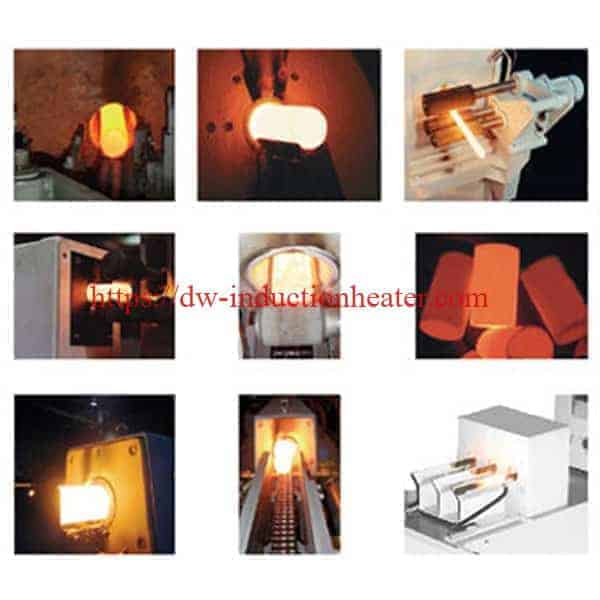
Induction forging of billets heats each billet with an induction coil to forging temperature immediately before it is forged. In this HLQ case, small Inconel billets (0.39″ × 0.7″) and large Inconel billets (0.5″ × 1.0″), each held in a ceramic crucible, were heated to 2050 °F (1121.1 °C) within 12 seconds. The heating used a four-turn helical coil designed for the application and a DW-MF-25kW medium frequency induction heating system with a remote workhead, at 15 kHz. Induction heating gave uniform and repeatable results and flameless heating.
Table of Contents
- What is Induction Forging of Billets?
- Key Applications
- Suitable Materials
- Working Principle
- Technical Specifications
- Recommended Model Selection
- Process Workflow
- Common Problems and Solutions
- Engineering Selection Guide
- Advantages and Limitations
- Why Choose HLQ?
- 10 Core FAQs
What is Induction Forging of Billets?
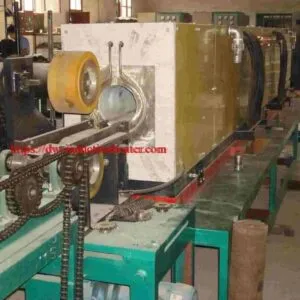
Induction forging of billets brings a metal billet to forging temperature in an induction coil. The alternating magnetic field induces eddy currents in the billet, which heats from within, without flame. In this HLQ case, small Inconel billets were placed in ceramic crucibles inside a four-turn helical coil and heated to 2050 °F (1121.1 °C) for a forging process. For the general process, see induction forging and hot forming.
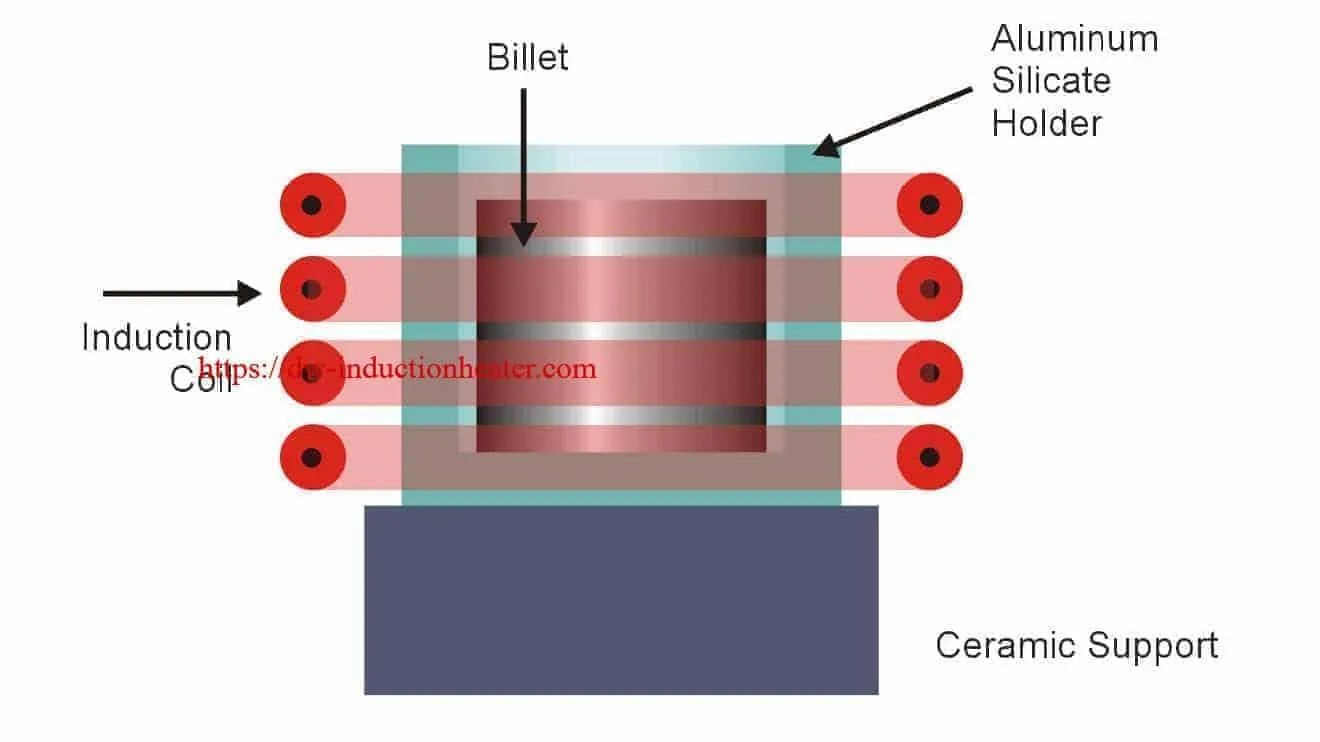
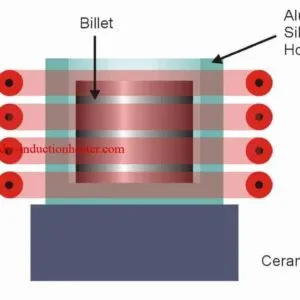
 The case drawing shows the billet in an aluminium silicate holder, inside the four-turn induction coil, standing on a ceramic support.
Key Applications

| HLQ forging case | Part | Temperature | Time | Frequency / equipment |
|---|---|---|---|---|
| Inconel billets (this page) | Ø9.9 × 17.8 mm and Ø12.7 × 25.4 mm, in crucibles | 2050 °F (1121.1 °C) | 12 s | 15 kHz, DW-MF-25kW |
| Induction forging titanium rods | Ø15 × 300 mm rod blanks | 2030 °F (1110 °C) | 25 s | 13 kHz, DW-MF-25kW |
| Steel strip for horse shoes | 1025 steel, 13″ section | 1800 °F | 10 s | 50 kHz, DW-HF-60kW |
| Induction forging steel rod end | Ø1/8″–1/2″ rods | 1800 °F | < 5 s | 50 kHz, DW-HF-45kW |
| Titanium rod for hot forming | Ø31.8 × 127 mm | 1700 °F (926.7 °C) | 60 s | 70 kHz, DW-HF-60kW |
Suitable Materials
| Material | Data | Source |
|---|---|---|
| Inconel (grade not stated) | Heated to 2050 °F (1121.1 °C) for forging | This case |
| Inconel 718 | Forging temperature 980–1,050 °C; turbine discs, aerospace | HLQ billet forging heater page |
| Steel | Typical heating range 1050–1250 °C | HLQ forging billet heating guide |
| Titanium alloy | Typical heating range 850–1100 °C | HLQ forging billet heating guide |
The forging temperature depends on the alloy grade; send the grade with your inquiry.
Working Principle

The DW-MF-25kW medium frequency system supplies 15 kHz current through the remote workhead to the four-turn helical coil. The coil surrounds the ceramic crucible (aluminium silicate holder) that holds the billet. Eddy currents heat the Inconel billet, and both billet sizes reach 2050 °F (1121.1 °C) within 12 seconds.
Heating depth follows the skin effect. Calculation (δ = 503·√(ρ/f), µr = 1 for non-magnetic nickel alloy, typical 20 °C resistivity of Inconel 600/718 ≈ 1.0–1.3 µΩ·m):
| Billet | Diameter | δ at 15 kHz | Diameter / δ |
|---|---|---|---|
| Small | 9.9 mm | ≈ 4.1–4.7 mm | ≈ 2.1–2.4 |
| Large | 12.7 mm | ≈ 4.1–4.7 mm | ≈ 2.7–3.1 |
Technical Specifications
| Parameter | Case data |
|---|---|
| Objective | Heat Inconel billets to 2050 °F (1121.1 °C) for a forging process |
| Small billets | 0.39″ (9.9 mm) OD × 0.7″ (17.8 mm) long, with ceramic crucible 1.0″ (25.4 mm) OD, 0.7″ (17.8 mm) ID, 1.4″ (35.6 mm) long |
| Large billets | 0.5″ (12.7 mm) OD × 1.0″ (25.4 mm) long, with ceramic crucible 1.25″ (31.8 mm) OD, 0.87″ (22.1 mm) ID, 1.37″ (34.8 mm) long |
| Temperature | 2050 °F (1121.1 °C) |
| Frequency | 15 kHz |
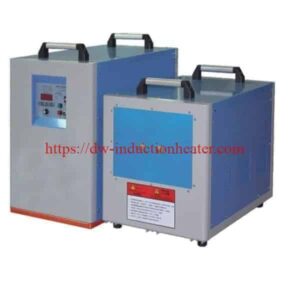
| Equipment | DW-MF-25kW induction heating system equipped with a remote workhead; induction coil designed and developed specifically for this application |
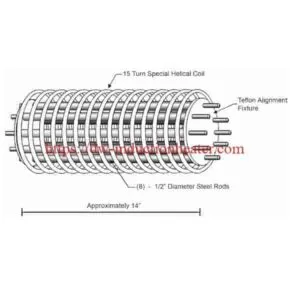
| Coil | Four-turn helical coil delivering uniform heat |
| Heating time | Both billet sizes heat to 2050 °F within 12 seconds |
| Billet mass (calculation, ≈ 8.2 g/cm³) | ≈ 11 g (small); ≈ 26 g (large) |
| Average heating rate (calculation) | (1121 − 20) °C / 12 s ≈ 92 °C/s |
| Results / benefits | Uniform and repeatable results; flameless |
Recommended Model Selection
Specifications of the DW-MF-25kW medium frequency induction heater:
| Parameter | DW-MF-25kW |
|---|---|
| Input power supply | 3 phase 380 V, 50/60 Hz |
| Oscillating power max. | 25 kW |
| Max. input current | 36 A |
| Oscillating frequency | 1–20 kHz |
| Duty cycle | 100% at 40 °C |
| Cooling water | > 0.2 MPa, 6 L/min |
| Generator / transformer size | 560 × 270 × 470 mm / 550 × 300 × 420 mm |
| Net weight / cable length | 30 kg / 35 kg; 2 m |
DW-MF series from the HLQ induction heating device model table (1–20 kHz, 3 phases 380 V ±10%, 100% duty):
| Model | Max. input power | Max. input current |
|---|---|---|
| DW-MF-15 | 15 kW | 23 A |
| DW-MF-25 (this case) | 25 kW | 36 A |
| DW-MF-35 | 35 kW | 51 A |
| DW-MF-45 | 45 kW | 68 A |
| DW-MF-70 | 70 kW | 105 A |
| DW-MF-90 | 90 kW | 135 A |
| DW-MF-110 | 110 kW | 170 A |
| DW-MF-160 | 160 kW | 240 A |
Process Workflow

- Load – place the Inconel billet in its ceramic crucible.
- Position – set the crucible on the ceramic support inside the four-turn coil.
- Heat – the DW-MF-25kW applies power at 15 kHz.
- Reach temperature – 2050 °F (1121.1 °C) within 12 seconds.
- Transfer – the heated billet goes to the forging press.
- Forge – the forging process follows.

Common Problems and Solutions
| Problem | Possible cause | Solution |
|---|---|---|
| Temperature above the alloy’s forging range | Alloy grade not matched to the set temperature | Confirm the forging temperature for the grade (HLQ data for Inconel 718: 980–1,050 °C) |
| Small billets difficult to hold in the coil | Short, small-diameter billets | Hold each billet in a ceramic crucible on a ceramic support, as in this case |
| Uneven heating | Workpiece not centred or coil field uneven | Use a coil designed for the billet; a four-turn helical coil delivered uniform heat here |
| Heating too slow | Coil gap too large, wrong coil design or insufficient power | Optimize coil shape, reduce the coil gap or choose higher power |
| Surface oxidation | Overheating or long exposure in air | Reduce heating time |
| Coil or power supply overheats | Insufficient cooling water | Supply cooling water above 0.2 MPa at 6 L/min (DW-MF-25kW requirement) |
Engineering Selection Guide
| Frequency | Calculated δ in Inconel (ρ ≈ 1.0–1.3 µΩ·m, µr = 1) |
|---|---|
| 5 kHz | ≈ 7.1–8.1 mm |
| 10 kHz | ≈ 5.0–5.7 mm |
| 15 kHz (this case) | ≈ 4.1–4.7 mm |
| 20 kHz | ≈ 3.6–4.1 mm |
- Small billets: the DW-MF-25kW at 15 kHz heated Ø9.9 mm and Ø12.7 mm Inconel billets in 12 seconds.
- Coil size: it is set by the crucible OD (25.4 mm and 31.8 mm in this case), not only by the billet.
- Larger billets and higher output: see the HLQ induction forge furnaces for hot forming steel billets (80–1000 kW systems).
- Data to send: alloy grade, billet diameter and length, forging temperature, cycle time, parts per hour, supply voltage and cooling water.
Advantages and Limitations
| Advantages | Limitations |
|---|---|
| Uniform and repeatable results | The forging temperature must be confirmed for the alloy grade |
| Flameless heating | Small billets need a holder (ceramic crucible) |
| 2050 °F reached within 12 seconds | The coil must be designed for the crucible size |
| Two billet sizes in one cycle time | Water cooling is required |
Why Choose HLQ?
- A documented Inconel billet case: 2050 °F in 12 seconds.
- Forging cases in Inconel, titanium, steel strip and steel rods.
- DW-MF medium frequency systems from 15 to 160 kW, and forge furnaces up to 1000 kW.
- Coils and fixtures designed for each billet, including crucible set-ups.
10 Core FAQs
1. What was heated in this case?
Small (0.39″ × 0.7″) and large (0.5″ × 1.0″) Inconel billets, each in a ceramic crucible.
2. What temperature was reached?
2050 °F (1121.1 °C).
3. How long did heating take?
Both billet sizes reached 2050 °F within 12 seconds.
4. Which induction machine was used?
A DW-MF-25kW medium frequency induction heating system with a remote workhead.
5. What frequency was used?
15 kHz.
6. Which coil was used?
A four-turn helical coil designed and developed specifically for the application.
7. Why are the billets placed in ceramic crucibles?
The crucible holds the small billet inside the coil; the case drawing shows an aluminium silicate holder on a ceramic support.
8. Can Inconel be heated by induction?
Yes. Inconel is an electrically conductive nickel alloy, so eddy currents heat it directly.
9. What are the benefits?
Uniform and repeatable results with flameless heating.
10. What information is needed for a quotation?
The alloy grade, billet diameter and length, forging temperature, cycle time, output, and available power supply and cooling water.