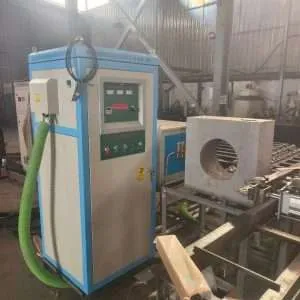


Induction Heating Injection Molding Machinery
Induction Heating Injection Molding Machine & Electromagnetic Barrel Heating System
Quick Answer: An induction heating injection molding machine uses electromagnetic induction to generate heat directly inside the electrically conductive metal barrel of the injection unit. Instead of heating a resistance band first and then transferring heat into the barrel, an induction coil creates an alternating electromagnetic field that induces eddy currents in the steel barrel. The barrel becomes the heat-generating body and transfers thermal energy to the plastic material inside.
HLQ electromagnetic barrel heating systems can be used for injection molding machines, plastic extruders, granulators, pelletizers, blown-film machines, wire and cable extrusion lines and plastic recycling equipment. The system can be supplied for new equipment or used to retrofit suitable existing plastic-processing machinery.
Induction heating provides rapid electrical power response, direct heating of conductive metal and independent multi-zone temperature control. Actual energy savings depend on the original heater design, insulation condition, barrel temperature, production load and operating cycle.
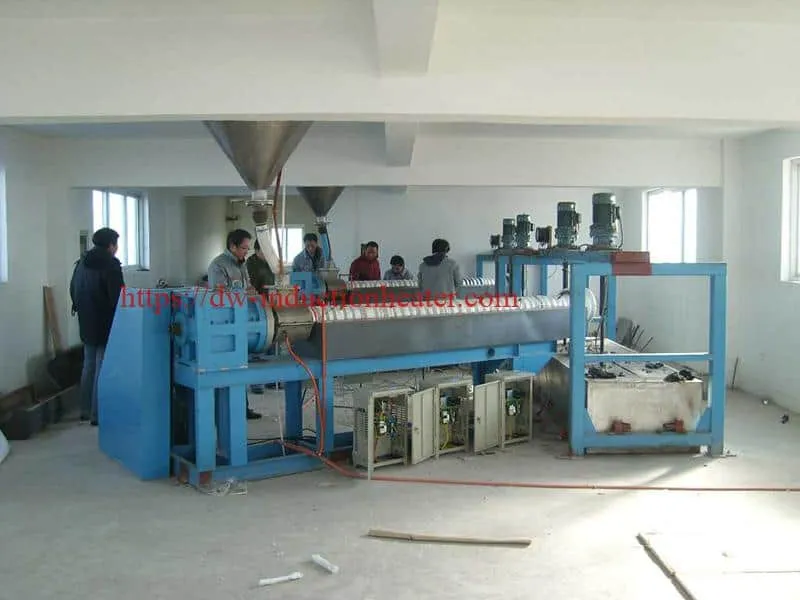
What Is Induction Heating for Injection Molding Machinery?
Induction heating for injection molding machinery is an industrial electrical heating method used to heat the metallic barrel, cylinder, flange, die or other conductive sections of plastic-processing equipment.
In a conventional injection molding machine, electric resistance bands are usually mounted directly around the barrel. The heating element becomes hot first, and heat is then transferred through the heater casing and contact surfaces into the barrel.
With electromagnetic induction heating, the metal barrel itself generates heat.
The basic energy path becomes:
Electrical Power → Induction Power Supply → Induction Coil → Electromagnetic Field → Steel Barrel → Plastic Melt
This shorter heating path can improve thermal response and reduce heat radiated from exposed conventional heater bands when the induction system is properly insulated.
How Does an Induction Heater Heat an Injection Molding Barrel?
An induction coil is installed around the outside of the injection molding barrel. A high-temperature thermal insulation layer is normally installed between the metallic barrel and induction coil.
When alternating current passes through the coil, it produces a rapidly changing electromagnetic field.
The conductive steel barrel is exposed to this magnetic field and electrical currents known as eddy currents are generated within the metal.
The electrical resistance of the barrel converts these currents into heat.
The induction coil is therefore not used as a conventional resistance heating element. Instead, the barrel itself becomes the heat-generating component.
The heated barrel subsequently transfers energy to the plastic pellets and molten polymer through conduction, screw mixing and shear.
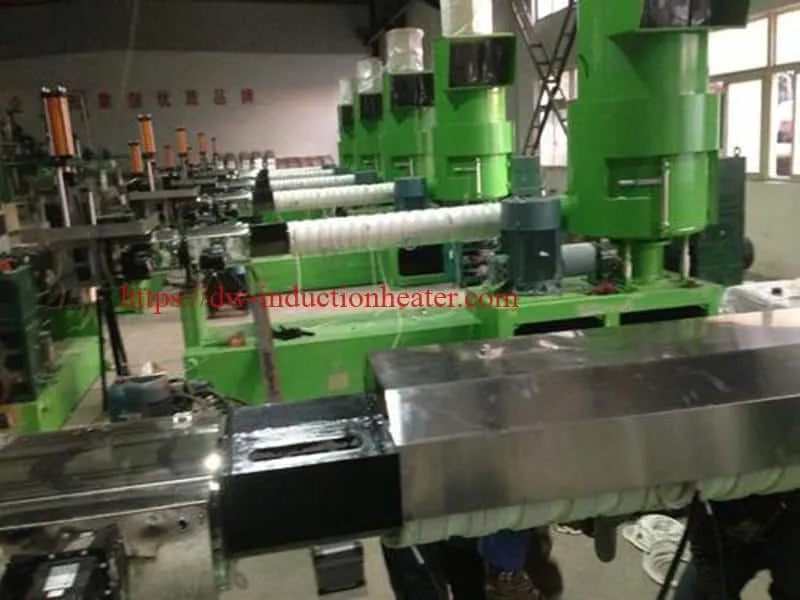
Electromagnetic Induction Heating Principle
Induction heating is the process of heating an electrically conductive material by exposing it to an alternating electromagnetic field.
The changing magnetic field induces eddy currents in the conductive material. Electrical resistance converts these currents into heat according to the Joule-heating principle.
Conceptually:
P = I²R
Where:
- P = thermal power generated
- I = induced electrical current
- R = electrical resistance of the barrel material
Actual induction heating performance also depends on:
- Barrel material
- Electrical resistivity
- Magnetic permeability
- Operating frequency
- Coil geometry
- Coil-to-barrel distance
- Barrel diameter
- Wall thickness
Where Can Induction Heating Be Used in Plastic Processing Machinery?
Electromagnetic barrel heating can be applied to many types of polymer-processing machinery.
| Plastic Processing Machine | Typical Heating Area | Main Function |
|---|---|---|
| Injection Molding Machine | Injection barrel / cylinder | Plastic melting and temperature control |
| Plastic Extruder | Extrusion barrel | Continuous polymer melting |
| Plastic Granulator | Barrel / cylinder | Recycled plastic melting and granulation |
| Plastic Pelletizer | Barrel and die | Pellet production |
| Blown Film Machine | Extruder barrel and die | Film extrusion |
| Wire & Cable Extruder | Extrusion barrel and die head | Cable insulation extrusion |
| Plastic Recycling Machine | Melting barrel | Recycled polymer processing |
| Profile Extrusion Machine | Barrel and die | Plastic profile production |
| Sheet Extrusion Machine | Multi-zone barrel | Plastic sheet production |

Main Components of an Injection Molding Induction Heating System
| Component | Function |
|---|---|
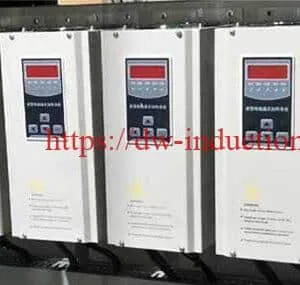
| Induction Heating Power Supply | Converts industrial electricity into controlled induction heating output |
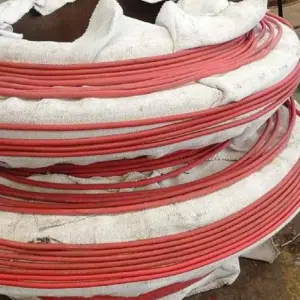
| Induction Heating Coil | Creates the alternating electromagnetic field around the barrel |
| High-Temperature Insulation | Reduces heat loss and protects the induction coil from barrel temperature |
| Metal Barrel | Absorbs electromagnetic energy and generates heat |
| Thermocouple | Measures barrel temperature |
| Temperature Controller | Regulates induction power according to temperature set point |
| PLC / Machine Controller | Coordinates heating zones and machine operation |
| Cooling / Ventilation System | Maintains suitable temperature of electronic components |
Multi-Zone Barrel Heating for Injection Molding Machines
An injection molding barrel normally requires several independently controlled temperature zones.
The material entering from the hopper does not necessarily require the same temperature as the polymer near the nozzle. For this reason, induction heating systems are normally divided into multiple zones along the barrel.
| Typical Zone | Function | Control Method |
|---|---|---|
| Rear / Feed Zone | Initial pellet heating | Independent temperature control |
| Compression Zone | Progressive melting | Independent temperature control |
| Metering Zone | Melt homogenization | Precise temperature control |
| Front Barrel Zone | Maintain melt temperature | Independent temperature control |
| Nozzle Zone | Maintain melt flow before injection | Separate temperature control |
Each zone can use a separate induction power module and thermocouple so that heat input follows the process requirement along the barrel.
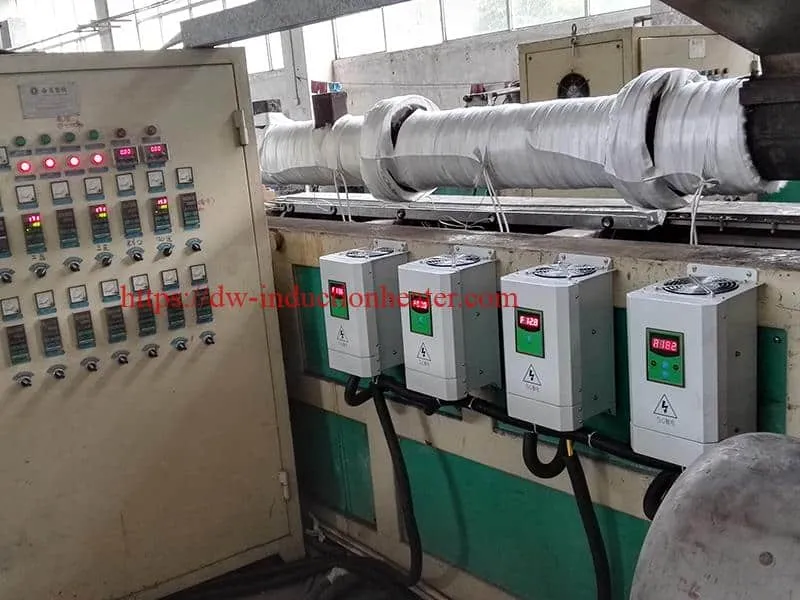
Why Replace Resistance Heater Bands with Induction Heating?
Conventional injection molding machines commonly use ceramic or mica resistance heater bands.
The resistance wire becomes hot and transfers heat to the heater casing. The heater casing then transfers energy to the barrel through physical contact.
Heat can also be lost from the outer surface of the heater into the surrounding workshop.
An induction heater changes the heat-generation mechanism. The electromagnetic field transfers energy through the insulation and produces heat directly inside the conductive barrel.
When properly engineered and insulated, this can reduce outward heat losses and workshop radiant heat.
However, energy savings should not be stated as one guaranteed percentage for every machine. Actual savings depend on the condition of the existing resistance heaters, production load, barrel temperature, insulation and duty cycle.
Induction Heating vs Traditional Injection Molding Heaters
| Feature | Induction Heating | Resistance Heater Bands |
|---|---|---|
| Heating Principle | Electromagnetic heating of barrel | Resistance element heating |
| Heat Generation Location | Inside conductive barrel | Inside resistance wire |
| Heat Transfer Path | Direct barrel heating | Element → casing → barrel |
| Heating Response | Fast electronic response | Depends on heater thermal mass |
| External Insulation | Normally included | Often limited or application dependent |
| Workshop Heat Radiation | Typically lower with proper insulation | Can be higher |
| Temperature Control | Independent electronic zone control | PID / ON-OFF control |
| Conventional Heater Element Burnout | No barrel resistance element | Possible over service life |
| Retrofit Capability | Suitable for many conductive barrels | Standard original equipment |
| Maintenance | Power electronics, coil and electrical inspection | Periodic heater-band replacement may be required |
Key Advantages of Induction Heating Injection Molding Machinery
Direct Barrel Heating
Heat is generated inside the conductive barrel rather than in a separate resistance heater.
Rapid Heating Response
Induction power can be increased or reduced electronically according to the temperature controller’s demand.
Reduced Heat Loss to the Workshop
The thermal insulation between the barrel and coil reduces outward radiation and convection losses.
Independent Heating Zones
Different sections of the barrel can operate at different temperatures according to the polymer-processing profile.
Lower External Surface Temperature
Proper thermal insulation can reduce temperatures around the external induction coil and machine enclosure.
No Conventional Barrel Heater Element
The induction coil does not operate as a conventional high-temperature resistance heater band.
Suitable for Retrofit Projects
Many existing injection molding machines can be converted to induction barrel heating without replacing the complete machine.
Easy Integration with Machine Controls
The induction power modules can be interfaced with existing thermocouples, temperature controllers or PLC systems.
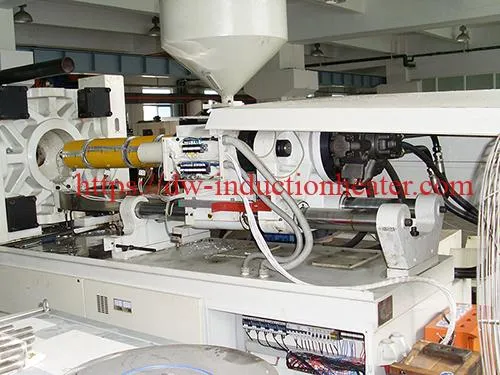
How to Calculate Induction Heating Power for an Injection Molding Machine
Correct power selection is essential when replacing existing resistance heaters.
The original page provides two practical preliminary selection methods.
Method 1: Existing Heater Power Is Known
| Existing Heater Load Rate | Preliminary Induction Power Selection |
|---|---|
| ≤ 60% | Approximately 80% of original installed heater power |
| 60–80% | Approximately equal to original heater power |
| > 80% | Approximately 120% of original power may be evaluated |
These ratios should be treated as preliminary engineering guidance rather than fixed design rules.
The actual required power should also consider warm-up time, barrel mass, polymer throughput, operating temperature and insulation.
Method 2: Existing Heating Power Is Unknown
When original heater data is unavailable, the heated surface area of the barrel can be used for preliminary power estimation.
| Plastic Processing Equipment | Reference Power Density |
|---|---|
| Injection Molding Machine | Approximately 3 W/cm² |
| Blown Film Machine | Approximately 3 W/cm² |
| Plastic Extrusion Machine | Approximately 3 W/cm² |
| Dry-Cut Pelletizing Machine | Approximately 4 W/cm² |
| Wet-Cut Pelletizing Machine | Approximately 8 W/cm² |
Example: Calculate Barrel Induction Heating Power
Assume the injection molding barrel dimensions are:
- Barrel diameter: 160 mm = 16 cm
- Heating length: 1000 mm = 100 cm
- Reference power density: 3 W/cm²
The cylindrical barrel surface area is:
A = π × D × L
A = 3.14 × 16 × 100
A = 5,024 cm²
The preliminary required heating power is:
P = 5,024 × 3 W
P = 15,072 W ≈ 15 kW
Therefore, approximately 15 kW may be used as an initial engineering estimate for this barrel section.
Final selection should then be verified according to barrel material, operating temperature, start-up time, plastic throughput and thermal insulation.
Induction Heating Power Calculation Table
| Calculation Item | Formula / Reference |
|---|---|
| Cylindrical Barrel Surface Area | A = π × D × L |
| Preliminary Heating Power | P = A × Power Density |
| Injection Molding Reference | Approximately 3 W/cm² |
| Extrusion Reference | Approximately 3 W/cm² |
| Dry-Cut Pelletizer | Approximately 4 W/cm² |
| Wet-Cut Pelletizer | Approximately 8 W/cm² |
Factors That Affect Required Induction Heating Power
| Parameter | Effect on Heating Requirement |
|---|---|
| Barrel Diameter | Determines heated surface area |
| Barrel Heating Length | Controls total heated area |
| Barrel Wall Thickness | Affects thermal mass |
| Barrel Material | Affects electromagnetic coupling |
| Operating Temperature | Higher temperature increases heat loss |
| Required Warm-Up Time | Shorter heating time requires greater available power |
| Plastic Throughput | Higher throughput increases process thermal load |
| Pellet Feed Temperature | Colder material requires additional energy |
| Insulation Thickness | Better insulation reduces external losses |
| Number of Heating Zones | Determines distribution of total power |
| Screw Shear Heating | Mechanical shear can contribute substantial heat during production |
Why Screw Shear Heating Must Be Considered
Once an injection molding machine reaches continuous production, not all barrel heat comes from electrical heaters.
The rotating screw generates mechanical friction and shear inside the polymer. Part of the drive-motor energy is therefore converted into thermal energy within the plastic melt.
In some barrel zones, the process can eventually generate enough internal heat that the controller reduces electrical heating substantially or even requires cooling.
For this reason, induction power should be selected using actual production conditions rather than warm-up requirements alone.
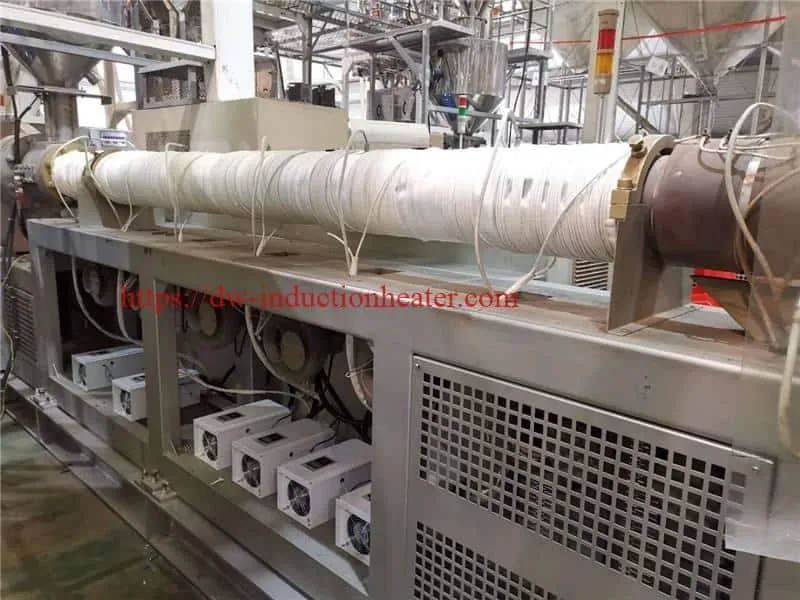
Temperature Control for Injection Molding
Accurate barrel temperature directly affects polymer viscosity, melt uniformity and injection consistency.
A typical closed-loop induction heating control system follows this sequence:
Thermocouple → Temperature Controller / PLC → Induction Heating Power Supply → Barrel → Temperature Feedback
Each zone can operate with its own temperature set point.
This allows the machine builder or operator to create an appropriate temperature profile from the hopper side through to the nozzle.
Typical Injection Barrel Temperature Zones
| Zone | Primary Purpose |
|---|---|
| Rear Zone | Initial pellet warming |
| Middle Zone | Progressive melting |
| Front Zone | Melt homogenization |
| Nozzle Zone | Maintain melt flow and injection temperature |
Actual temperatures depend on polymer grade, screw design, molding cycle and product requirements.
Suitable Barrel Materials
Induction heating requires an electrically conductive barrel.
| Barrel Material | Induction Heating Suitability | Engineering Note |
|---|---|---|
| Carbon Steel | Excellent | Strong electromagnetic coupling |
| Alloy Steel | Very Good | Common injection molding barrel material |
| Nitrided Steel | Generally Suitable | Evaluate actual barrel construction |
| Bimetallic Barrel | Application Dependent | Layer structure should be reviewed |
| Stainless Steel | Application Dependent | Performance varies by stainless grade |
| Aluminum | Specialized Design | Different electrical and thermal properties |
| Non-Metallic Material | Not Directly Suitable | Cannot normally be heated directly by induction |
Why Thermal Insulation Is Important
A properly designed induction barrel heating system normally uses the following arrangement:
Metal Barrel → High-Temperature Insulation → Induction Coil
The thermal insulation provides several important functions:
- Reduces outward heat loss
- Protects the induction coil from the hot barrel
- Reduces external surface temperature
- Improves overall heating efficiency
- Helps stabilize barrel temperature
- Reduces heat released into the workshop
Insulation material and thickness should be selected according to barrel temperature and available installation clearance.
Retrofit of Existing Injection Molding Machines
Many existing injection molding machines can be upgraded from resistance heater bands to electromagnetic induction heating.
A typical retrofit process includes:
- Record the existing heater power for each barrel zone.
- Measure barrel diameter and heating length.
- Identify the barrel material.
- Record normal operating temperatures.
- Measure actual electrical consumption where possible.
- Remove conventional heater bands where required.
- Install high-temperature thermal insulation.
- Install the induction coil around the barrel.
- Install induction heating power modules.
- Connect thermocouples and temperature-control signals.
- Test each heating zone independently.
- Confirm temperature stability.
- Run the machine under normal production load.
- Compare electrical consumption before and after retrofit.
How to Measure Real Energy Savings
The most accurate way to evaluate energy performance is to compare the original heater system and the induction system under equivalent production conditions.
| Test Parameter | Before Retrofit | After Retrofit |
|---|---|---|
| Plastic Material | Record grade | Use same grade |
| Product | Record product | Produce same product |
| Production Output | Record kg/h or pcs/h | Keep equivalent |
| Barrel Temperatures | Record all zones | Use same settings |
| Cycle Time | Record | Use comparable cycle |
| Operating Time | Record | Use same duration |
| Heater Electricity Consumption | Measure kWh | Measure kWh |
The actual saving can then be calculated as:
Energy Saving (%) = (Original Electricity − Induction Electricity) ÷ Original Electricity × 100%
This method provides a project-specific result and avoids relying on a generic energy-saving percentage.
Induction Heating for Plastic Extrusion and Granulation
The same induction barrel heating technology is also widely applicable to continuous plastic extrusion machinery.
Typical applications include:
- Plastic pipe extrusion
- Plastic sheet extrusion
- Blown-film production
- Plastic profile extrusion
- Wire and cable insulation extrusion
- Masterbatch production
- Plastic compounding
- Plastic recycling
- Pelletizing and granulation
For these applications, the barrel can be divided into several independently controlled induction heating zones.
Induction Heating for Plastic Recycling Machinery
Plastic recycling equipment frequently processes recycled PE, PP, ABS and other thermoplastics through extrusion and pelletizing.
The electromagnetic heating system can be applied to the melting barrel to provide controlled electrical heat during start-up and continuous processing.
For recycling applications, machine selection should consider contamination levels, throughput, polymer composition, barrel geometry and screw-generated shear heat.
Induction Heating Injection Molding Machine Technical Selection Guide
| Required Parameter | Example |
|---|---|
| Machine Type | Injection molding machine |
| Barrel Material | Alloy steel |
| Barrel Diameter | 160 mm |
| Total Heating Length | 1200 mm |
| Number of Heating Zones | 4 |
| Existing Heater Power | 18 kW |
| Operating Temperature | 180–280°C |
| Plastic Material | PP / PE / ABS / PC / PA |
| Production Output | kg/h or pcs/h |
| Required Warm-Up Time | Minutes |
| Electrical Supply | 380 V / 50 Hz / 3 Phase |
Recommended Data for Each Barrel Heating Zone
| Zone | Diameter | Heating Length | Existing Heater Power | Operating Temperature |
|---|---|---|---|---|
| Zone 1 | _____ mm | _____ mm | _____ kW | _____ °C |
| Zone 2 | _____ mm | _____ mm | _____ kW | _____ °C |
| Zone 3 | _____ mm | _____ mm | _____ kW | _____ °C |
| Zone 4 | _____ mm | _____ mm | _____ kW | _____ °C |
| Nozzle | _____ mm | _____ mm | _____ kW | _____ °C |

Technical Reference: Induction Heating Injection Molding Machine
Additional technical information regarding the application of induction heating technology in injection molding machinery is available in the original technical document:
Induction Heating injection molding machine
The document discusses induction heating concepts for plastic injection molding, heating-system design, temperature distribution and induction generator requirements.
Why Choose HLQ Induction Heating for Plastic Machinery?
HLQ Induction Equipment Co., Ltd. develops electromagnetic induction heating systems for plastic-processing machinery and other industrial thermal applications.
Systems can be engineered according to:
- Barrel diameter
- Heating length
- Barrel material
- Number of temperature zones
- Existing heater power
- Target barrel temperature
- Warm-up time
- Plastic material
- Production capacity
- Electrical supply
A complete retrofit solution can include induction power supplies, induction coils, thermal insulation, temperature-control interfaces and installation guidance.
Frequently Asked Questions About Induction Heating Injection Molding Machines
What is an induction heating injection molding machine?
It is an injection molding machine that uses electromagnetic induction to heat the electrically conductive barrel instead of relying entirely on conventional resistance heater bands.
Does induction heating heat plastic directly?
Normally no. Most plastics are electrically non-conductive. The induction system heats the metal barrel, which transfers heat to the plastic material.
Can an existing injection molding machine be converted to induction heating?
Yes. Many machines with suitable metallic barrels can be retrofitted with insulation, induction coils and induction power supplies.
What parts of an injection molding machine can be induction heated?
The main application is the injection barrel. Depending on machine design, other conductive metal sections such as flanges and selected nozzle areas can also be evaluated.
How is induction heater power calculated?
When the existing heater power is known, the actual heater load can be used for preliminary selection. When power is unknown, a reference of approximately 3 W/cm² of heated barrel surface area can be used for initial injection molding calculations.
Can induction heating reduce electricity consumption?
Yes, particularly where it replaces inefficient or poorly insulated resistance heating. The actual saving should be measured under equivalent production conditions.
Does the induction coil become very hot?
The induction coil is not the primary resistance heating element. However, it can receive heat from the barrel, which is why high-temperature insulation is installed between the barrel and coil.
Can each barrel section have a different temperature?
Yes. Multi-zone induction heating allows independent temperature settings for different sections of the injection barrel.
Can induction heating be used for ABS?
Yes. The induction system heats the barrel rather than the polymer directly, so it can be used with many thermoplastics when the processing temperature is correctly controlled.
Can it be used for PP and PE?
Yes. PP and PE injection molding and extrusion machinery can use electromagnetic barrel heating.
Can induction heating be used for engineering plastics?
Yes, provided the required barrel temperatures, power density and machine configuration are correctly engineered.
Does induction heating improve temperature control?
Induction power responds rapidly to controller signals and can therefore provide precise zone regulation when properly integrated with thermocouples and PID or PLC controls.
Does the machine need a different screw?
Normally the induction retrofit primarily changes the external barrel-heating system. Screw replacement is generally determined by the plastic process rather than by the induction heating principle.
How many heating zones are recommended?
The number of zones depends on the original injection barrel and process. Existing heater zones can often be used as the starting point for the induction heating design.
What barrel materials work best?
Ferromagnetic carbon and alloy steels generally provide strong electromagnetic coupling. Other conductive materials require application-specific evaluation.
Can stainless steel barrels be induction heated?
Potentially. Performance depends on stainless steel grade, magnetic properties, wall construction and operating frequency.
How much insulation is required?
Insulation thickness depends on barrel temperature, available space and insulation material. It must reduce heat loss while maintaining suitable electromagnetic coupling between the coil and barrel.
Does induction heating reduce workshop temperature?
Proper insulation can reduce heat radiated from the barrel into the surrounding workplace compared with exposed high-temperature resistance heater bands.
How do I verify energy savings?
Measure electrical consumption before and after the retrofit while keeping plastic material, production rate, barrel temperature, operating time and product conditions as similar as possible.
What information is needed for a quotation?
Please provide the injection molding machine model, barrel diameter, heating length, number of heating zones, barrel material, existing heater power, operating temperatures, plastic material and electrical supply.
Request an Induction Heating Injection Molding Machine Quotation
| Required Project Information | Customer Data |
|---|---|
| Machine Type / Model | ________________________ |
| Plastic Material | ________________________ |
| Barrel Material | ________________________ |
| Barrel Diameter | _____ mm |
| Total Heating Length | _____ mm |
| Number of Heating Zones | _____ |
| Existing Heater Power | _____ kW |
| Barrel Temperature | _____ °C |
| Required Warm-Up Time | _____ minutes |
| Production Capacity | _____ kg/h or pcs/h |
| Electrical Supply | _____ V / _____ Hz / _____ Phase |
| Installation Country | ________________________ |
HLQ engineers can use these parameters to calculate the appropriate induction heating power for each barrel zone and recommend a complete electromagnetic induction heating solution for the injection molding machine.
Related products
-

Electromagnetic Induction Heater
-

Induction heat drum dryer for drying Coal Slime-River Sand-Gypsum-Slag-Grain-Sawdust
-
Induction Heating Ore Drum Dryer
-
Induction Heating for Disassembly and Assembly large bearings, shaft couplings, propeller hubs and Turbine Bearings in Shipbuilding Industry and Heavy Machinery Maintenance
-
Induction Pipe and Tube Heating Applications-Electromagnetic Induction Heating Systems for Pipeline Processing & Manufacturing