



Induction Billet Forge – High‑Efficiency Heating Solution for Metals Forging
Table Of Contents
Skin Effect & Frequency Relationship
Non-Ferrous & Special Alloy Billets
Comprehensive Advantage Comparison
7.1 Open Die Induction Forging
7.2 Closed Die Induction Forging
7.3 Ring Rolling with Induction Heating
7.5 Hot Extrusion with Induction Heating
7.6 Continuous Induction Forge Heating
8.1 Power Supply Technical Parameters
8.2 Induction Coil Specifications
8.3 Production Rate vs Billet Size
8.4 Temperature Monitoring Equipment
1. Introduction
In the modern manufacturing landscape, the demand for high-strength, precision-engineered metal components has never been higher. Induction Billet Forging stands at the forefront of this evolution. Unlike traditional gas or oil-fired furnaces that rely on radiant heat, induction forging uses electromagnetic energy to generate heat directly within the metal billet.
This method has revolutionized sectors from automotive to aerospace, providing a clean, fast, and highly controllable alternative to legacy heating technologies. As industries push toward “Industry 4.0” and carbon neutrality, induction forging’s efficiency and automation compatibility make it an indispensable tool.
2. What is Induction Billet Forge?
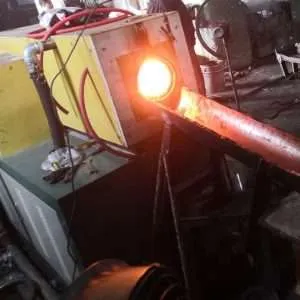
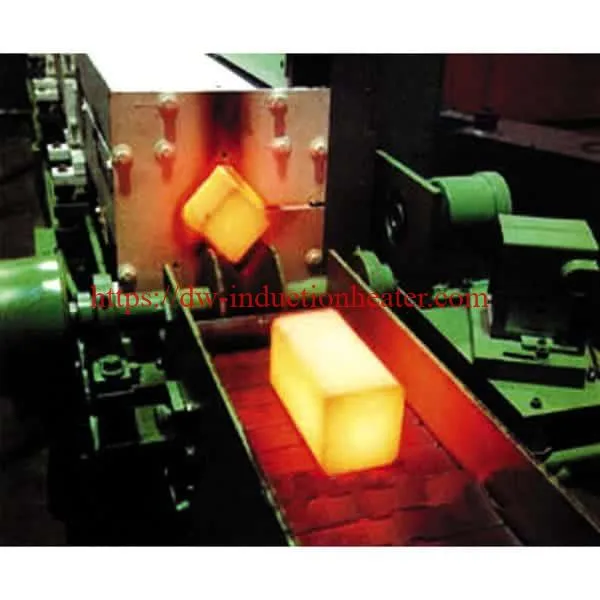
Induction billet forge is a metal forming technology that uses electromagnetic induction heating to bring metal billets — cylindrical or rectangular bars of steel, aluminum, titanium, or other conductive metals — to their required forging temperature before shaping operations using forging presses, hammers, or rolling mills.
Unlike traditional gas or oil furnaces that heat billets from the outside through convection and radiation, induction billet forge technology generates heat directly inside the metal billet through induced eddy currents. This internal heating mechanism produces faster, more uniform, and more energy-efficient heating results that directly translate into higher quality forgings and lower production costs.
| Feature | Specification |
| Heating Method | Electromagnetic Induction |
| Heating Speed | 30 seconds ~ 5 minutes per billet |
| Temperature Range | Up to 1,300°C (steel) |
| Temperature Accuracy | ±5 ~ ±10°C |
| Energy Efficiency | 85 ~ 95% |
| Frequency Range | 50 Hz ~ 10,000 Hz |
| Power Range | 50 kW ~ 10,000+ kW |
| Emissions | Zero direct combustion |
3. Working Principle of Induction Billet Forge
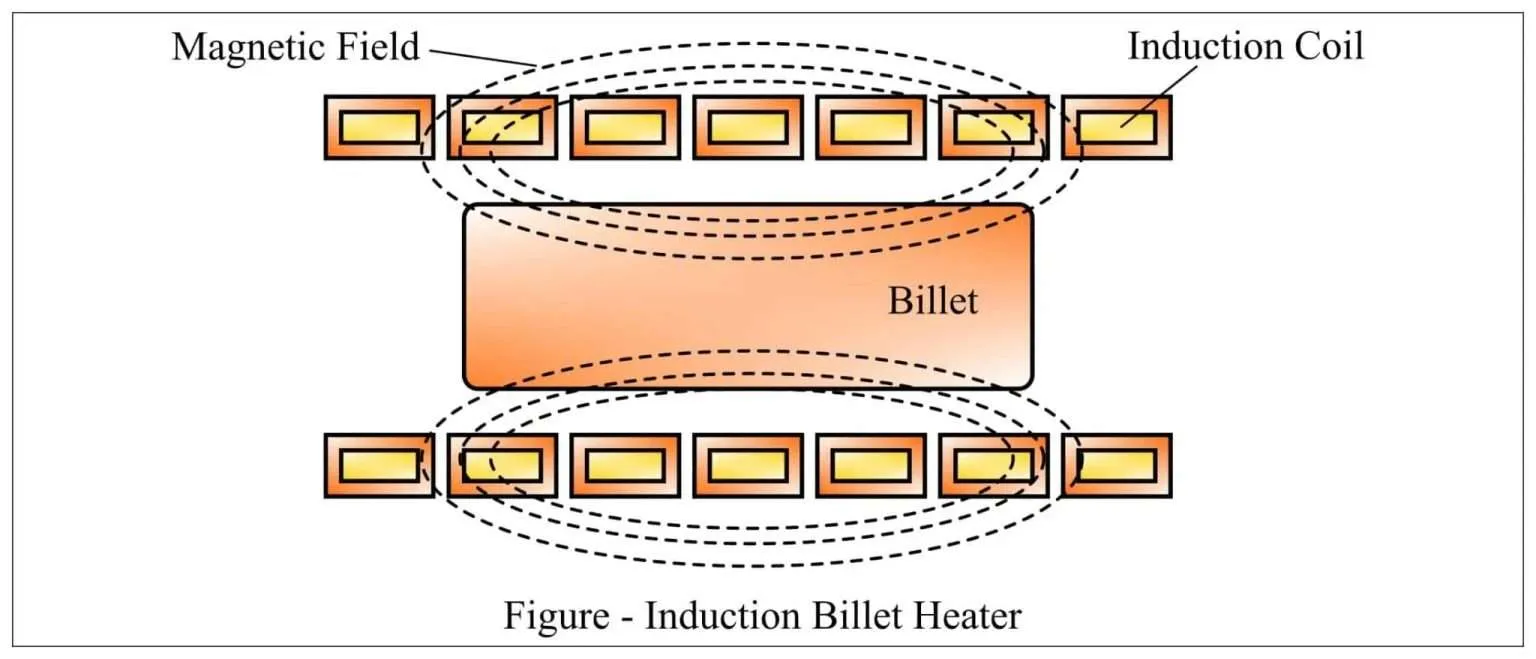
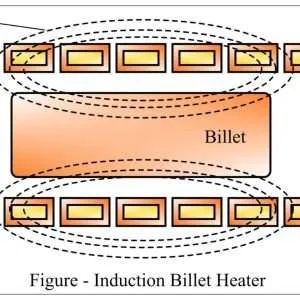
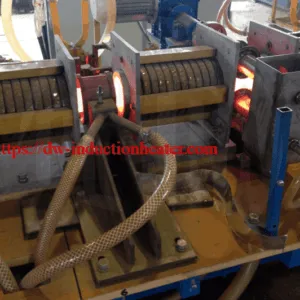
The induction billet forge process operates on Faraday’s Law of Electromagnetic Induction. When alternating current passes through the water-cooled copper induction coil surrounding the metal billet, it generates a rapidly alternating magnetic field. This alternating magnetic field induces electrical eddy currents directly within the billet material. The resistance of the metal to these eddy currents causes the billet to heat rapidly from within — a process known as Joule heating.
AC Power Supply
↓
Water-Cooled Copper Induction Coil
↓
Alternating Magnetic Field Generated
↓
Eddy Currents Induced in Metal Billet
↓
Joule Heating Effect (I²R)
↓
Billet Heats Rapidly from Inside Out
↓
Target Forging Temperature Achieved
Skin Effect & Frequency Relationship
A critical principle governing induction billet forge heating is the skin effect — the tendency of induced currents to concentrate near the billet surface. The depth of current penetration (skin depth) is directly controlled by the operating frequency:
| Billet Diameter | Optimal Frequency | Penetration Depth |
| < 25 mm | 3,000 ~ 10,000 Hz | 2 ~ 5 mm |
| 25 ~ 75 mm | 1,000 ~ 3,000 Hz | 5 ~ 12 mm |
| 75 ~ 150 mm | 250 ~ 1,000 Hz | 10 ~ 22 mm |
| 150 ~ 300 mm | 100 ~ 250 Hz | 18 ~ 35 mm |
| > 300 mm | 50 ~ 100 Hz | 30 ~ 55 mm |
Higher frequencies concentrate heating near the surface (suitable for small billets), while lower frequencies allow deeper current penetration for uniform heating of large diameter billets.
4. Which Materials Are Suitable for Induction Billet Forging?
Induction billet forge technology is compatible with virtually all electrically conductive metals. Ferromagnetic materials (iron and steel) are particularly well-suited due to their high magnetic permeability, which significantly enhances heating efficiency below the Curie temperature (approximately 768°C for steel).
| Grade | Carbon Content | Forging Temperature | Main Application |
| AISI 1020/1025 | 0.18~0.28% | 1,200~1,250°C | General forgings, pins |
| AISI 1040/1045 | 0.38~0.48% | 1,150~1,200°C | Gears, shafts, automotive |
| AISI 1060/1080 | 0.55~0.83% | 1,050~1,150°C | Springs, tools |
| A516 Gr.70 | ≤ 0.28% | 1,100~1,200°C | Pressure vessel parts |
| A36 | ≤ 0.26% | 1,100~1,250°C | Structural components |
| Grade | Key Alloys | Forging Temperature | Application |
| 4130/4140 | Cr-Mo | 1,100~1,200°C | Gears, shafts, oil & gas |
| 4340 | Ni-Cr-Mo | 1,100~1,200°C | Landing gear, heavy shafts |
| 8620/8640 | Ni-Cr-Mo | 1,100~1,200°C | Carburized gears |
| P22/F22 | 2.25Cr-1Mo | 1,100~1,200°C | High temp flanges & piping |
| P91/F91 | 9Cr-1Mo-V | 1,050~1,150°C | Ultra high temp power plant |
| 52100 | Cr | 1,050~1,100°C | Bearing races & elements |
| 4145H | Cr-Mo | 1,100~1,200°C | Drill collars, oil tools |
Non-Ferrous & Special Alloy Billets
| Material | Forging Temperature | Key Application |
| Aluminum 6061/7075 | 400 ~ 480°C | Aerospace, automotive |
| Titanium Ti-6Al-4V | 900 ~ 1,000°C | Aerospace, medical |
| Copper/Brass | 750 ~ 900°C | Electrical, plumbing |
| Inconel 718 | 980 ~ 1,050°C | Turbine discs, aerospace |
| Stainless 316/316L | 1,100 ~ 1,200°C | Oil & gas, food industry |
| Duplex SS 2205 | 1,050 ~ 1,150°C | Offshore, chemical plant |
5. Advantages of Induction Billet Forge
Comprehensive Advantage Comparison
| Advantage | Induction Billet Forge | Gas Furnace | Flame Heating |
| Energy Efficiency | ✅ 85~95% | ❌ 40~60% | ❌ 30~50% |
| Heating Speed | ✅ Minutes | ❌ Hours | ⚠️ Variable |
| Temperature Accuracy | ✅ ±5~10°C | ❌ ±20~50°C | ❌ Poor |
| Scale Formation | ✅ Minimal | ❌ Heavy | ❌ Heavy |
| CO₂ Emissions | ✅ Zero | ❌ High | ❌ Very High |
| Startup Time | ✅ Instant | ❌ 30~60 min | ⚠️ Variable |
| Automation | ✅ Easy | ❌ Difficult | ❌ Very Difficult |
| Floor Space | ✅ Compact | ❌ Large | ⚠️ Variable |
| Safety | ✅ No open flame | ⚠️ Fire risk | ❌ High risk |
| Temperature Uniformity | ✅ Excellent | ⚠️ Variable | ❌ Poor |
| Operating Cost | ✅ Low | ❌ High | ❌ High |
| Maintenance | ✅ Low | ❌ High | ❌ High |
- ⚡ Energy Savings — 30~50% reduction in energy costs versus gas furnaces
- 🎯 Precision Heating — ±5~10°C accuracy ensures consistent forging quality
- 🌱 Environmental Compliance — Zero direct emissions support green manufacturing goals
- 🤖 Automation Ready — Seamless integration with robots, conveyors, and Industry 4.0 systems
- 📉 Reduced Scale Loss — Minimal oxidation improves material yield and die life
- 🔄 Instant Startup — No warmup time maximizes production availability
- 🏭 Compact Footprint — Smaller equipment footprint versus equivalent gas furnace systems
6. Induction Billet Forge Applications by Industry
| Industry | Components | Material | Volume |
| Automotive | Crankshaft, connecting rod, gear, hub | 4140/4340/1045 | 🔴 Very High |
| Oil & Gas | Flanges, valves, drill collars, fittings | F22/F11/4145H | 🟠 High |
| Aerospace | Landing gear, discs, airframe parts | 4340/Ti-6Al-4V/Inconel | 🟡 Medium |
| Power Generation | Turbine discs, rotor, boiler parts | P22/P91/CrMoV | 🟡 Medium |
| Fasteners | Bolts, studs, nuts, anchors | Carbon/Alloy steel | 🔴 Very High |
| Mining | Drill bits, wear parts, crusher parts | 4340/Hadfield | 🟠 High |
| Marine/Offshore | Propeller shafts, anchors, connectors | Carbon/Duplex SS | 🟡 Medium |
| Wind Energy | Main shaft, bearing rings, flanges | Alloy steel | 🟠 High |
| Hand Tools | Wrenches, hammers, agricultural tools | Carbon steel | 🔴 Very High |
| Railway | Wheels, axles, couplings | Carbon/Alloy steel | 🟡 Medium |

7. Types of Induction Billet Forge Processes
7.1 Open Die Induction Forging
Used for large custom forgings including shafts, discs, cylinders, and rings. Billets are heated by induction and shaped between flat or simple-profile dies using hydraulic presses up to 80,000 tons.
7.2 Closed Die Induction Forging
The most common induction billet forge process for high-volume production. Heated billets are pressed into precision die cavities to produce near-net-shape components. Widely used in automotive and oil & gas industries.
7.3 Ring Rolling with Induction Heating
Heated Billet → Upsetting → Piercing → Ring Rolling Mill
→ Seamless Rolled Ring (Flanges, Bearing Races, Gear Rings)
End-heating of bars using induction to enlarge specific sections. Common for bolt heads, drill pipe tool joints, valve stems, and engine valves.
7.5 Hot Extrusion with Induction Heating
Induction-heated billets pushed through dies to produce profiles, tubes, and complex cross-sections in steel, aluminum, copper, and titanium.
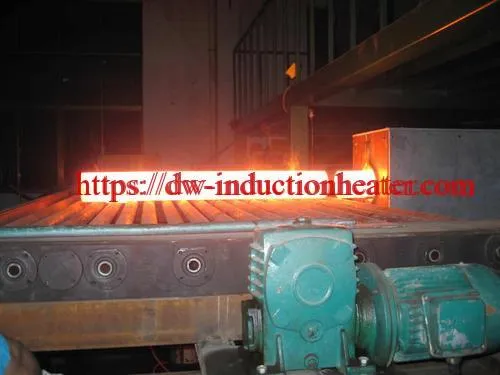
7.6 Continuous Induction Forge Heating
Bar Stock → Auto Cut → Roller Feed → Induction Coil
→ Pyrometer Check → Auto Transfer → Forge Press
→ High Volume Production (500~2,000+ pcs/hour)
| Process Type | Best For | Production Volume | Billet Size |
| Open Die | Large custom parts | Low~Medium | Large |
| Closed Die | Complex high-volume parts | Very High | Small~Medium |
| Ring Rolling | Rings, flanges, races | Medium~High | Medium~Large |
| Upset Forging | End enlargement | High | Small~Medium |
| Hot Extrusion | Profiles, tubes | High | Small~Medium |
| Continuous | Mass production | Very High | Small |
8. Equipment & Technical Parameters
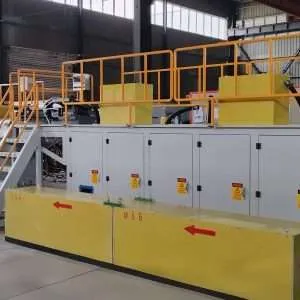
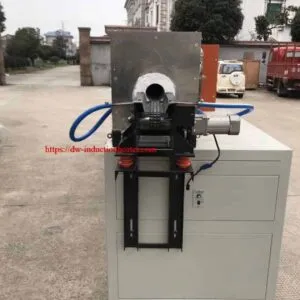
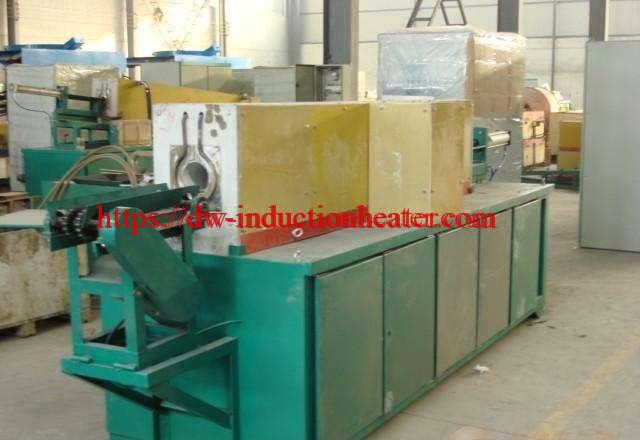
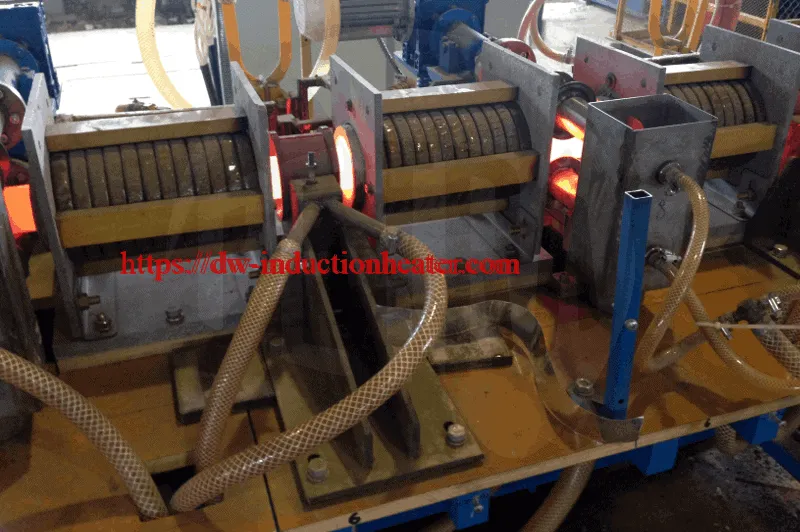
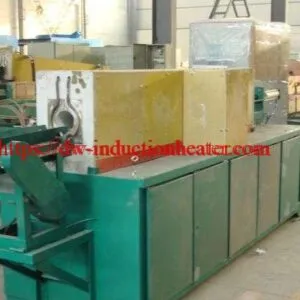
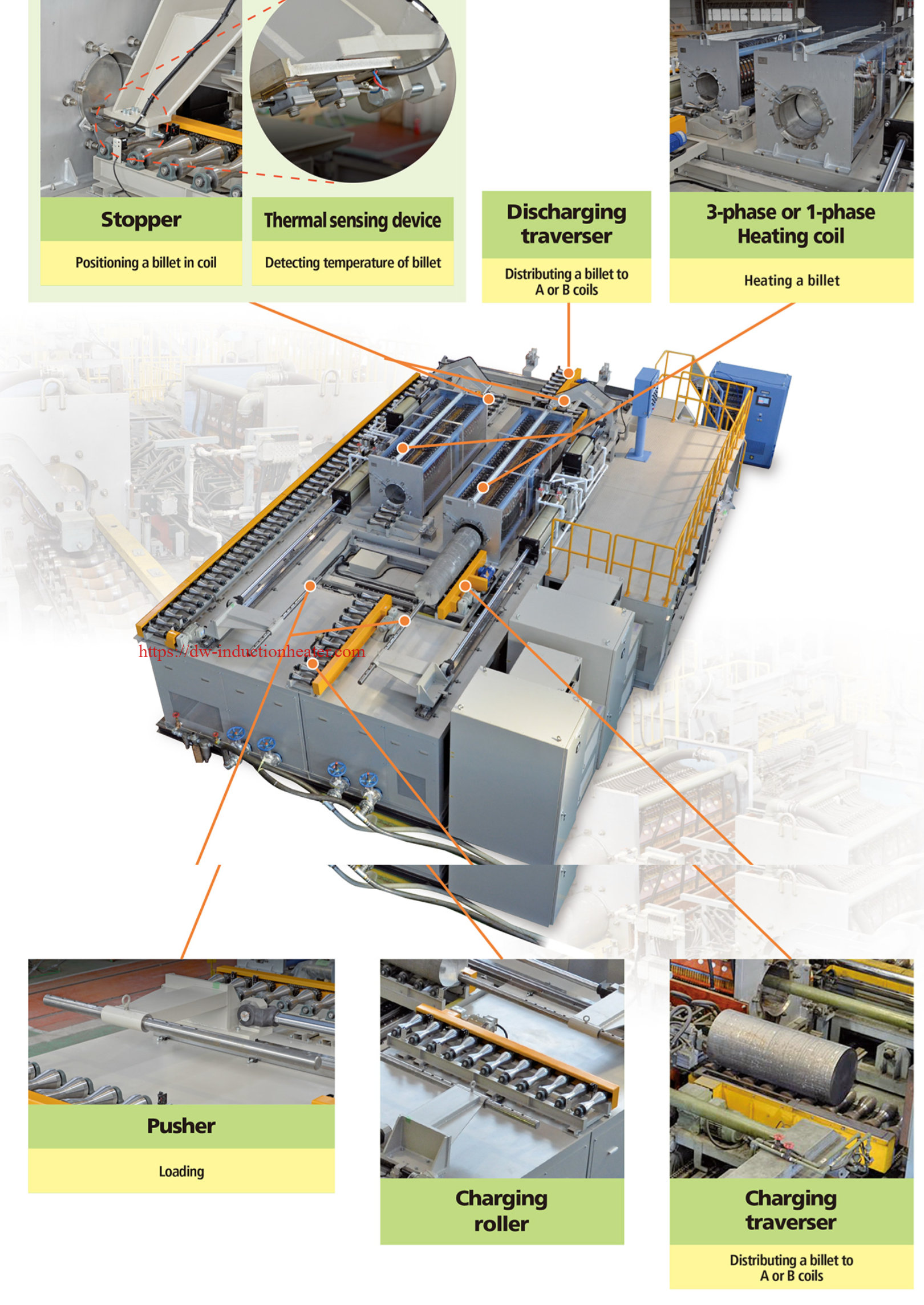
An induction forging system typically consists of a power supply, a heating station (coil), and a material handling system (vibratory feeders or robotic arms).
8.1 Power Supply Technical Parameters
| Parameter | Small System | Medium System | Large System | Heavy System |
| Power Output | 50~200 kW | 200~1,000 kW | 1,000~3,000 kW | 3,000~10,000 kW |
| Frequency | 1,000~10,000 Hz | 250~3,000 Hz | 100~1,000 Hz | 50~250 Hz |
| Input Voltage | 380V 3-phase | 380~660V 3-phase | 660~3,300V | 3,300~10,000V |
| Power Factor | > 0.95 | > 0.95 | > 0.95 | > 0.95 |
| Efficiency | 90~95% | 88~93% | 85~92% | 85~90% |
| Cooling | Water cooled | Water cooled | Water cooled | Water cooled |
| Control | PLC + HMI | PLC + HMI | PLC + HMI | PLC + SCADA |
8.2 Induction Coil Specifications
| Parameter | Specification |
| Coil Material | High conductivity copper tube |
| Cooling Method | Internal water circulation |
| Cooling Water Flow | 10 ~ 100 L/min |
| Operating Temperature | < 60°C (coil surface) |
| Insulation Class | H class (180°C) |
| Coil Inner Diameter | Match billet OD + 10~30mm gap |
| Coil Life | 2,000 ~ 10,000 operating hours |
| Refractory Lining | Ceramic / Refractory cement |
8.3 Production Rate vs Billet Size
| Billet Diameter | Power Required | Production Rate | Heating Time |
| Ø20 ~ 40 mm | 100 ~ 200 kW | 800 ~ 2,000 kg/hr | 30 ~ 60 sec |
| Ø40 ~ 80 mm | 200 ~ 500 kW | 500 ~ 1,500 kg/hr | 60 ~ 120 sec |
| Ø80 ~ 150 mm | 500 ~ 1,200 kW | 300 ~ 1,000 kg/hr | 90 ~ 180 sec |
| Ø150 ~ 250 mm | 1,200 ~ 2,500 kW | 200 ~ 600 kg/hr | 120 ~ 300 sec |
| Ø250 ~ 400 mm | 2,500 ~ 5,000 kW | 100 ~ 400 kg/hr | 180 ~ 480 sec |
| > Ø400 mm | 5,000 ~ 10,000 kW | 50 ~ 200 kg/hr | 300 ~ 900 sec |
8.4 Temperature Monitoring Equipment
| Equipment | Type | Measurement Range | Accuracy | Application |
| Infrared Pyrometer | Single point | 600 ~ 1,800°C | ±5°C | Standard billet check |
| Two-Color Pyrometer | Ratio type | 700 ~ 1,800°C | ±3°C | Scale-resistant measurement |
| Thermal Camera | Area imaging | 500 ~ 1,500°C | ±10°C | Full billet surface map |
| Fiber Optic Sensor | Contact-free | 400 ~ 2,000°C | ±5°C | High EMI environments |
| Thermocouple | Contact type | 0 ~ 1,600°C | ±2°C | Calibration reference |
9. How to Choose the Right Induction Billet Forge System
Selecting a system is not just about power; it’s about the physics of your specific part.
- Material Mass & Production Rate: Calculate the total kilograms per hour required. (Rule of thumb: 1kW can heat roughly 3kg of steel to 1200°C in one hour).
- Frequency Selection: Larger billets require lower frequencies for deep heat penetration. Small billets require higher frequencies to prevent “Skin Effect” where only the surface heats up.
- Coil Design: The coil should be custom-shaped to your billet geometry for maximum electromagnetic coupling.
- Cooling Requirements: Ensure your facility has adequate water cooling for the power supply and the induction coils.
10. Conclusion
The Induction Billet Forge is a cornerstone of sustainable, high-precision manufacturing. By significantly reducing material waste, energy consumption, and cycle times, it provides a clear competitive edge. Whether you are forging small automotive fasteners or massive aerospace shafts, the transition to induction heating is a strategic investment in quality and efficiency.
11. Frequently Asked Questions (FAQ)
Q1: Can induction heating be used for non-magnetic materials like Aluminum?
A: Absolutely. While aluminum is non-magnetic, it is highly conductive. Induction creates eddy currents in aluminum just as it does in steel, though it requires different frequency settings due to aluminum’s high thermal conductivity.
Q2: What is “Skin Effect” in induction forging?
A: At higher frequencies, the induced current tends to flow on the surface of the billet. For forging, we choose a frequency that allows the heat to penetrate deep enough to reach the core without overheating the surface.
Q3: How long does an induction coil last?
A: With proper water cooling and refractory lining (thermal cement), a coil can last for thousands of production hours. Regular maintenance of the insulation is key.
Q4: Is induction forging more expensive than gas heating?
A: The initial equipment cost is higher. However, the Total Cost of Ownership (TCO) is usually lower due to reduced material scale loss, lower energy bills, and increased die life.
Q5: Can I integrate a robot with an induction forge?
A: Yes. Induction forging systems are digital and provide “Ready to Heat” signals, making them perfect for synchronization with robotic arms and automatic forging presses.
Q6: Does the billet need to be clean before heating?
A: While induction can heat through light oil or rust, excessive debris can contaminate the induction coil’s refractory lining. Pre-cleaning or shot blasting is recommended for high-quality precision forging.
Related products
-

Metals Billet Hot Forging Furnace
-
Continuous Steel Billet Heater with Induction Heating For Forging Steel Copper Aluminum Metals
-
Induction Forge Furnace
-
Steel Bar Induction Forging, Aluminum Billet Induction Heating, Titanium Rod Forging Heater, Brass Extrusion Die Induction Heater, Copper Billet Induction Heating-Ferrous Billet Induction Forging
-
Induction Bar Heating Systems for Metal Forging Rolling and Extrusion Applications