
Induction Heating vs Gas Furnace for Billet Forging: Engineering Comparison Guide
This engineering guide compares induction heating and gas furnace heating for billet forging applications, including steel, aluminum, copper, brass, titanium, and alloy billets. It explains how each heating method works, where each method is suitable, and how engineers should evaluate power demand, temperature uniformity, scale loss, production rate, safety, emissions, maintenance, and total operating cost. The article is written for plant engineers, forging line designers, purchasing managers, and production teams who need a practical, honest comparison before selecting a billet heating system.
Table of Contents
- Quick Answer
- What Is Billet Heating for Forging?
- Working Principle of Induction Heating and Gas Furnace Heating
- Key Technical Parameters
- Temperature Control and Heating Uniformity
- Energy Efficiency and Operating Cost
- Scale Loss, Oxidation, and Material Yield
- Engineering Selection Guide
- Real Project Case Study
- Common Engineering Errors and How to Avoid Them
- Common Problems and Solutions
- Recommended Induction Billet Heating System Design
- Honest Limitations of Induction Heating
- Related Technical Articles
- FAQ
Quick Answer
For most high-throughput billet forging lines, induction heating is usually better than a gas furnace when the priorities are fast heating, precise temperature control, lower scale loss, cleaner working conditions, compact layout, and automatic production. A gas furnace may still be suitable for very large billets, low electricity availability, low fuel price regions, or applications where long soaking time is required. In practical forging plants, induction heating is strongest for repeatable billet sizes, continuous production, and automated forging presses, while gas furnaces remain useful for flexible batch heating and extremely large workpieces.
What Is Billet Heating for Forging?
Billet heating is the process of raising a metal billet from ambient temperature to its forging temperature before deformation by a press, hammer, rolling mill, or extrusion machine. The target temperature depends on the material. Carbon steel forging commonly requires approximately 1050°C to 1250°C. Stainless steel is often heated in the range of 1050°C to 1180°C. Aluminum alloys may be forged or extruded at approximately 420°C to 520°C. Copper and brass billets are often heated between 600°C and 850°C depending on alloy and process. Titanium alloys may require carefully controlled heating, often around 850°C to 980°C depending on grade and forging schedule.
In billet forging, heating quality directly affects deformation resistance, die life, surface oxidation, metallurgical consistency, dimensional accuracy, and production cost. A billet that is too cold may crack, overload the press, or damage dies. A billet that is overheated may suffer excessive scale, grain growth, decarburization, melting at edges, or poor mechanical properties. This is why billet heating equipment should not be selected only by price or nominal power. The correct selection must consider material grade, billet diameter, billet length, required production rate, final temperature, allowable temperature difference, available power or fuel, plant layout, and automation level.
In our engineering experience, many forging line problems are not caused by the forging press itself, but by unstable billet temperature before forging. When the billet temperature varies by more than ±30°C between pieces, operators often compensate by increasing furnace temperature, slowing the line, or adjusting press force. These actions may keep production moving, but they reduce material yield, increase die wear, and hide the real root cause.
Working Principle of Induction Heating and Gas Furnace Heating
How Induction Billet Heating Works
Induction heating uses electromagnetic induction to generate heat directly inside the billet. An alternating current flows through an induction coil, creating a changing magnetic field. When a conductive billet passes through or stays inside the coil, eddy currents are induced in the metal. These currents generate heat due to the electrical resistance of the billet. For magnetic steels below Curie temperature, magnetic hysteresis can also contribute to heating, although eddy current heating is the dominant mechanism at forging temperatures.
The induction power supply usually operates in medium frequency or high frequency ranges. For billet induction forging, common frequencies may range from 500 Hz to 10 kHz, depending on billet diameter, material, and required heating depth. Larger steel billets usually need lower frequency to improve penetration. Smaller billets or shallow heating applications may use higher frequency. Typical billet heating systems may use 100 kW, 250 kW, 500 kW, 1000 kW, or even several megawatts for continuous production lines.
How a Gas Furnace Works
A gas furnace heats billets by combustion. Natural gas, LPG, or other fuel is burned in burners, and heat is transferred to billets mainly by radiation, convection, and some conduction through contact surfaces. Gas furnaces may be box furnaces, rotary hearth furnaces, walking beam furnaces, pusher furnaces, or continuous reheating furnaces. For billet forging, gas furnaces are often used when many billet sizes are processed, when long soaking is required, or where fuel cost is significantly lower than electricity cost.
Gas furnace design must address combustion air, burner control, exhaust gas handling, refractory lining, furnace pressure, safety interlocks, flame detection, ventilation, and emissions. In many industrial contexts, furnace safety design needs to consider standards such as NFPA 86 for ovens and furnaces, while refinery fired heater applications may involve API 560. Process piping around gas systems may also need engineering review consistent with applicable piping codes such as ASME B31.3.
Key Technical Parameters
| Parameter | Induction Billet Heating | Gas Furnace Heating | Engineering Notes |
|---|---|---|---|
| Typical steel forging temperature | 1050°C–1250°C | 1050°C–1250°C | Both systems can reach forging temperature, but control response is faster with induction. |
| Typical aluminum billet temperature | 420°C–520°C | 420°C–520°C | Induction requires correct frequency and coil design because aluminum is non-magnetic and highly conductive. |
| Heating time | Usually 30 seconds to 10 minutes depending on billet size | Often 20 minutes to several hours depending on furnace type and billet mass | Induction is normally much faster for repeated billet sizes. |
| Power range | 100 kW–3000 kW+ per line | Fuel input varies widely, often hundreds of kW to several MW thermal | Selection should be based on kg/h throughput and required temperature rise. |
| Temperature control accuracy | Commonly ±5°C to ±20°C with pyrometer and closed-loop control | Often ±20°C to ±50°C depending on furnace design and soaking time | Actual accuracy depends on measurement location, emissivity settings, and control logic. |
| Scale loss for steel billets | Often lower due to shorter heating time | Usually higher due to longer exposure to oxygen and hot combustion gases | Scale loss directly affects material yield and die contamination. |
| Start-up time | Fast, often minutes | Longer, especially for large refractory furnaces | Induction is better for intermittent production. |
| Floor space | Compact | Usually larger | Induction systems integrate well with automatic feeding and presses. |
| Major safety risks | High voltage, high current, cooling failure, electromagnetic field, hot billet handling | Flame failure, gas leakage, explosion risk, CO exposure, refractory failure, hot exhaust | Both require engineered safety systems, not only operator training. |
| Relevant standards and references | IEC 60519-1, IEC 60519 series, local electrical codes | NFPA 86, API 560 for fired heater contexts, ASME B31.3 for process piping | Final compliance depends on country, industry, and plant requirements. |
Temperature Control and Heating Uniformity
Temperature control is one of the most important differences between induction heating and gas furnace heating. In induction heating, power can be adjusted almost instantly. A closed-loop control system can use an infrared pyrometer at the coil exit, PLC logic, and variable power output to stabilize billet exit temperature. In a continuous billet heater, each billet can be heated under a repeatable cycle with controlled line speed, coil current, and power distribution.
In a gas furnace, temperature control is slower because the furnace chamber, refractory lining, flame pattern, and exhaust flow have thermal inertia. A gas furnace can provide good soaking uniformity if the billet remains inside long enough. However, when production rate changes or billet sizes vary, the furnace takes longer to stabilize. For forging plants running mixed products, this may require operator experience and conservative setpoints.
[INSERT_EXPERIENCE] In our engineering experience, induction heating is especially effective when the forging plant runs one billet diameter for several hours or one product family for a full shift. Gas furnaces become more attractive when operators need to heat many billet sizes in small batches and can accept longer soaking times.
Typical Temperature Uniformity Targets
| Application | Typical Target Temperature | Acceptable Billet Temperature Difference | Preferred Heating Method |
|---|---|---|---|
| Carbon steel closed-die forging | 1100°C–1250°C | ±15°C to ±30°C | Induction heating for automated lines |
| Aluminum extrusion billet heating | 450°C–520°C | ±5°C to ±15°C | Induction or resistance/gas depending on alloy and line design |
| Copper billet forging | 650°C–850°C | ±10°C to ±25°C | Induction heating with careful coil design |
| Titanium alloy forging | 850°C–980°C | Often requires tight metallurgical control | Depends on alloy, atmosphere, and quality requirements |
| Very large alloy steel billets | 1050°C–1200°C | Core-surface uniformity is critical | Gas furnace or combined preheat + induction final heating |
Energy Efficiency and Operating Cost
The operating cost comparison between induction heating and gas furnace heating cannot be answered by one simple statement. It depends on electricity price, gas price, billet material, line utilization, furnace loading rate, exhaust heat recovery, scale loss, labor cost, maintenance, and production losses. A gas furnace may appear cheaper if only fuel price is compared with electricity price. However, when material yield, start-up loss, idle loss, environmental control, and production flexibility are included, induction heating often becomes more competitive.
Induction heating transfers energy directly into the billet. There is no need to heat a large furnace chamber before heating the metal. This is a major advantage in intermittent production. A gas furnace must heat the furnace atmosphere, refractory lining, furnace structure, and exhaust gas path. For continuous, fully loaded, well-designed gas furnaces, thermal efficiency can be acceptable, especially with recuperative burners or waste heat recovery. But for small batch production or frequent start-stop operation, gas furnace energy loss can be high.
Simple Engineering Power Estimation
A basic heat duty calculation for billet heating is:
Required thermal power = mass flow rate × specific heat × temperature rise ÷ heating time efficiency factor
For example, if a forging line heats 800 kg/h of carbon steel from 25°C to 1150°C, using an average specific heat estimate of 0.65 kJ/kg·K over the heating range:
Thermal energy required per hour = 800 × 0.65 × (1150 – 25) = 585,000 kJ/h, approximately 162.5 kW thermal. After considering system losses, coil losses, inverter efficiency, radiation loss, and production margin, the selected induction power may be around 220 kW to 300 kW depending on billet size, cycle time, and temperature uniformity requirement.
For a gas furnace, the same theoretical heat demand exists, but additional energy is consumed by exhaust gas, refractory heat storage, incomplete loading, and chamber losses. Therefore, fuel input may be significantly higher than the theoretical metal heating requirement.
Scale Loss, Oxidation, and Material Yield
For steel billet forging, oxidation scale loss is a major hidden cost. Scale forms when hot steel reacts with oxygen at elevated temperature. The longer the billet remains at high temperature, the more scale can form. Because induction heating is fast, the billet has less time exposed to air at high temperature, so scale loss is usually lower than in gas furnace heating. In gas furnaces, combustion products and furnace atmosphere can further increase oxidation if the atmosphere is not well controlled.
Lower scale loss provides several engineering benefits:
- Higher material yield per ton of billet
- Less scale entering forging dies
- Lower die wear and lower cleaning frequency
- Improved surface quality
- Reduced descaling requirement before forging
However, induction heating does not eliminate oxidation. If billet temperature is too high, transfer time to press is long, or the billet is held after heating, scale still forms. For high-grade alloy steel, stainless steel, titanium, or aerospace applications, atmosphere control, protective coating, vacuum, or inert gas may still be required.
Engineering Selection Guide
| Engineering Condition | Better Choice | Reason | Design Recommendation |
|---|---|---|---|
| Continuous forging line with fixed billet diameter | Induction heating | Fast, repeatable, easy to automate | Use automatic feeding, multi-zone coils, pyrometer feedback, and PLC recipe control. |
| Mixed billet sizes in small batches | Gas furnace or hybrid system | Gas furnace offers flexible chamber loading | Consider gas preheating plus induction final temperature equalization. |
| High electricity cost and low gas cost | Case-dependent | Fuel price may favor gas, but yield and labor must be included | Calculate total cost per ton, not only energy price. |
| Strict temperature accuracy requirement | Induction heating | Fast response and closed-loop control | Install calibrated infrared pyrometer and correct emissivity setting. |
| Very large billets requiring long soaking | Gas furnace or combined system | Core temperature uniformity may require long heat soak | Use furnace soak, then induction final heating if fast surface recovery is needed. |
| Urban plant with emissions restrictions | Induction heating | No on-site combustion during heating | Check electrical infrastructure and cooling system capacity. |
| Frequent start-stop production | Induction heating | Low idle loss and fast start-up | Use recipe-based start sequence and standby power logic. |
| Lowest initial equipment cost | Often gas furnace | Basic gas furnace may have lower upfront cost | Do not ignore burner safety, exhaust, refractory, foundation, and environmental cost. |
| Clean workshop and automated handling | Induction heating | Compact equipment and cleaner environment | Integrate with billet feeder, conveyor, press robot, and safety guarding. |
| High-alloy or titanium billet heating | Case-dependent | Metallurgical limits and atmosphere may dominate the choice | Validate with trial heating, metallurgical testing, and process qualification. |
Real Project Case Study: Replacing a Gas Furnace with a 600 kW Induction Billet Heating Line
The following case is based on a typical industrial forging project configuration. The plant produced medium carbon steel forged parts for mechanical transmission components. Before the upgrade, the line used a gas-fired batch furnace to heat cut billets before a 1000-ton forging press. The customer wanted shorter heating time, lower scale loss, better temperature repeatability, and improved workshop conditions.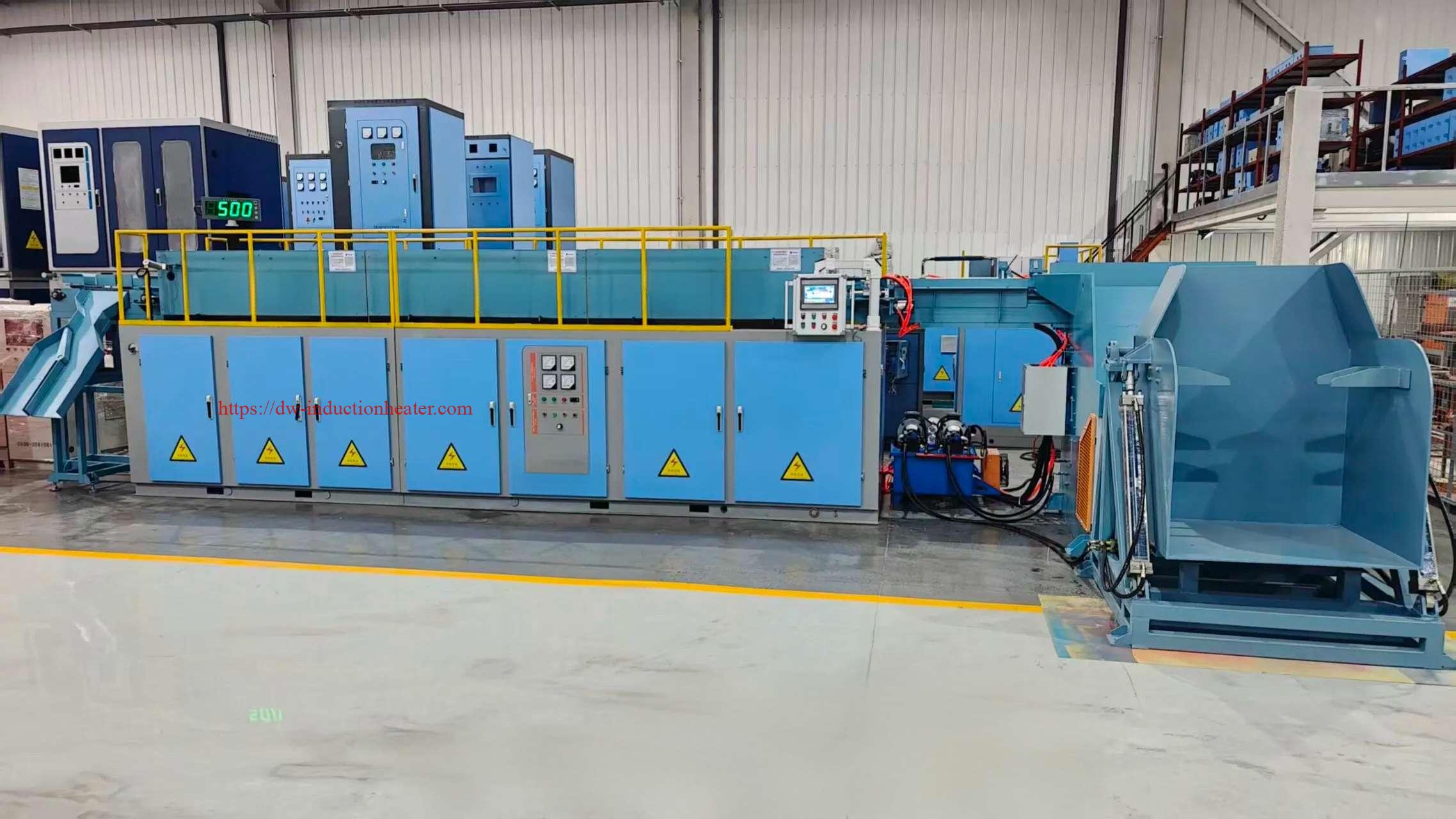
Project Conditions
| Item | Project Data |
|---|---|
| Material | Medium carbon steel billets |
| Billet size | Diameter 60 mm × length 180 mm |
| Billet weight | Approximately 4.0 kg per billet |
| Target forging temperature | 1180°C |
| Original heating method | Gas-fired batch furnace |
| New heating system | 600 kW medium frequency induction billet heater |
| Production rate | Approximately 900–1100 kg/h depending on press rhythm |
| Frequency range | Approximately 1–3 kHz, selected according to billet size and heating depth |
| Temperature feedback | Infrared pyrometer at coil exit with PLC closed-loop correction |
Observed Engineering Results
| Performance Item | Gas Furnace Before Upgrade | Induction Heating After Upgrade | Result |
|---|---|---|---|
| Heating time per billet batch/cycle | Long batch heating with preheat and soaking | Continuous heating matched to press rhythm | Line response improved significantly |
| Exit billet temperature variation | Often ±35°C to ±50°C depending on load | Usually controlled within approximately ±15°C after tuning | More stable forging quality |
| Scale formation | Visible heavy scale after long furnace exposure | Reduced scale due to shorter heating time | Cleaner dies and less surface loss |
| Workshop environment | High radiant heat and combustion exhaust | Lower ambient heat around heating station | Better operator conditions |
| Start-up loss | Furnace warm-up required | Short start-up time | Better for two-shift intermittent production |
[INSERT_EXPERIENCE] In our engineering experience, the biggest improvement in this type of project is not only energy saving. The more important value is process stability. When every billet reaches the press at a similar temperature, forging load becomes more predictable, die life improves, and operators no longer need to compensate for unstable furnace output.
Common Engineering Errors and How to Avoid Them
Error 1: Selecting Induction Power Only by Billet Diameter
A common mistake is to select induction heater power only from billet diameter. Billet diameter is important, but it is not enough. Engineers must also consider billet length, material grade, target temperature, production rate, cycle time, required core temperature, coil efficiency, line loss, cooling loss, and safety margin.
Avoidance method: calculate thermal load from kg/h throughput, temperature rise, specific heat, and expected efficiency. Then add a practical engineering margin, commonly 10% to 20%, depending on line stability requirements.
Error 2: Ignoring Core-Surface Temperature Difference
Induction heating can heat very fast, but fast heating may create a temperature difference between the billet surface and core. If the frequency is too high, power density is concentrated near the surface. The surface may appear hot while the core is still below forging temperature.
Avoidance method: choose proper frequency, coil length, heating time, billet rotation if needed, multi-zone heating, and equalization zone design. For large billets, a hybrid process may be better: gas furnace preheat followed by induction final heating.
Error 3: Poor Pyrometer Setup
Infrared pyrometers are useful, but incorrect emissivity settings, scale interference, steam, dust, wrong measurement angle, or looking at the wrong billet location can lead to false temperature readings. A PLC cannot control correctly if the input temperature signal is wrong.
Avoidance method: use proper pyrometer wavelength, calibrate with contact measurement or reference methods during commissioning, set emissivity according to material and surface condition, and protect the optical path from dust and scale.
Error 4: Underestimating Cooling Water Requirements
Induction coils, power cabinets, busbars, capacitors, and transformers need reliable cooling. A 600 kW induction system may require a significant water flow rate, stable pressure, and controlled inlet temperature. Cooling failure can damage coils or power electronics quickly.
Avoidance method: specify water pressure, flow rate, conductivity, filtration, inlet temperature, outlet temperature rise, alarms, and interlocks. Cooling design should be treated as part of the heating system, not as an accessory.
Error 5: Comparing Equipment Price Instead of Cost per Forged Ton
A basic gas furnace may look cheaper than an induction heater at the purchasing stage. But a proper comparison must include fuel or electricity cost, material scale loss, labor, maintenance, downtime, refractory replacement, exhaust treatment, start-up loss, and production consistency.
Avoidance method: compare cost per forged ton over at least 3 to 5 years, not only initial CAPEX.
Common Problems and Solutions
| Problem | Likely Cause | Engineering Solution | Preventive Measure |
|---|---|---|---|
| Billet surface is hot but core is cold | Frequency too high, heating time too short, insufficient soaking | Lower frequency, extend coil length, reduce line speed, add equalization zone | Verify core temperature during commissioning by cutting test billets. |
| Billet exit temperature fluctuates | Unstable feeding interval, pyrometer error, power control not tuned | Use automatic feeder, tune PID control, stabilize billet spacing | Use recipe control for each billet size. |
| Excessive scale on steel billets | Overheating, long holding time, slow transfer to press | Reduce target temperature, shorten transfer time, improve press synchronization | Use pyrometer and alarm limits for overheating. |
| Induction coil overheats | Insufficient cooling water, scale blockage, poor coil design | Increase flow, clean water channels, redesign coil section | Install flow switch, pressure alarm, and water temperature monitoring. |
| Gas furnace temperature is uneven | Poor burner distribution, wrong loading pattern, damaged refractory | Adjust burners, improve circulation, repair refractory lining | Perform regular thermal mapping and furnace inspection. |
| High induction power consumption | Incorrect coil-billet coupling, oversized gap, poor power factor, low utilization | Optimize coil ID, match power supply, reduce idle time | Record kWh per ton and compare by product recipe. |
| Cracking during forging | Billet too cold, uneven temperature, unsuitable forging temperature window | Raise target temperature, improve uniformity, verify material grade | Use metallurgical process validation before mass production. |
| Gas furnace safety trips | Flame instability, poor gas pressure, combustion air issue | Check burner system, gas train, pressure regulator, flame detector | Maintain burner safety system according to applicable furnace safety requirements. |
Recommended Induction Billet Heating System Design
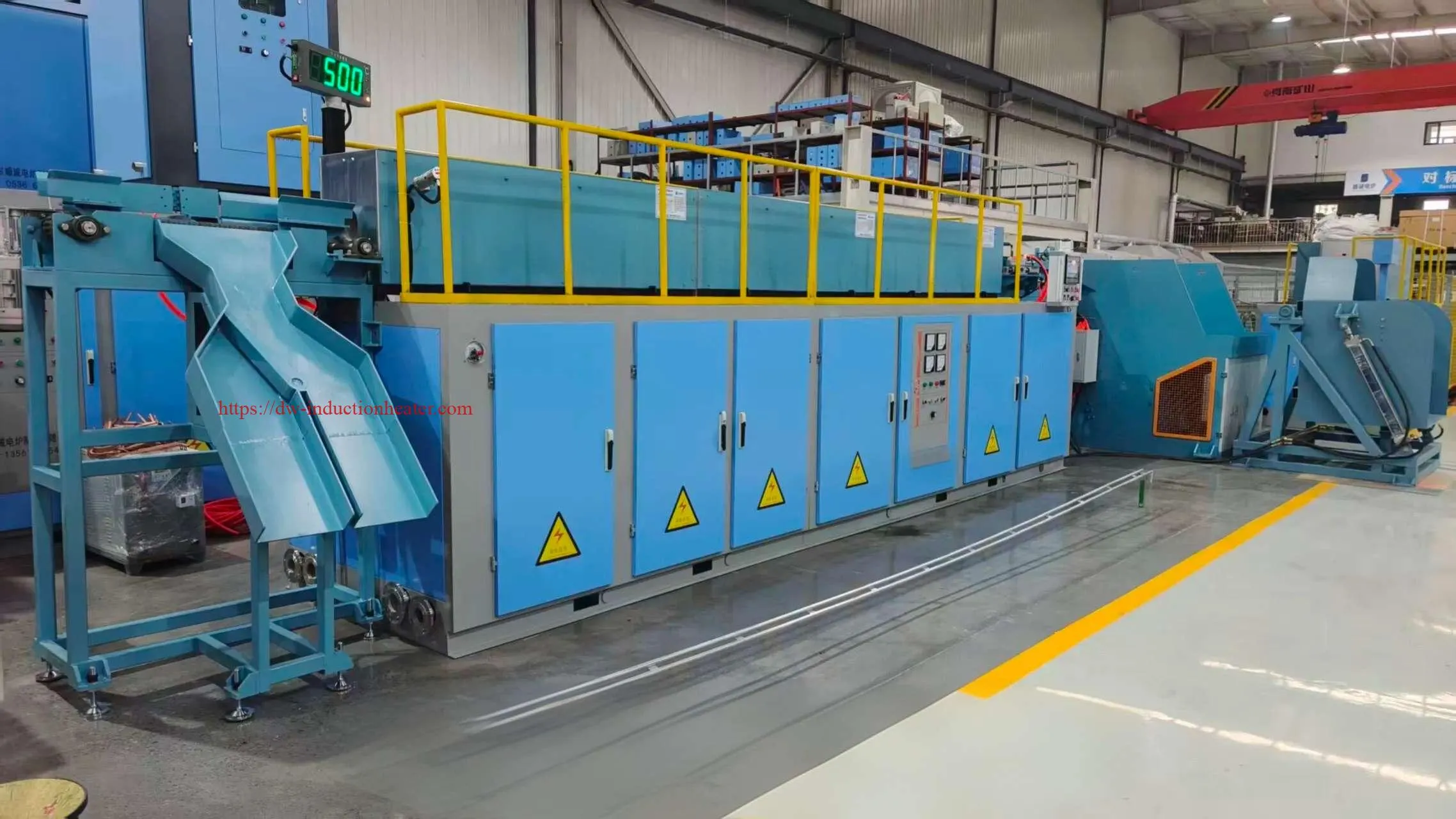
A complete induction billet heating line is not only a power supply and a coil. For industrial forging, the system should be designed as an integrated production station. A typical system may include:
- Medium frequency induction power supply
- Water-cooled induction coil or multi-zone coil set
- Compensation capacitor bank
- Automatic billet feeder
- Push rod or roller conveyor
- Infrared pyrometer at coil exit
- PLC control cabinet with HMI recipes
- Cooling water system or industrial chiller
- Safety guarding and interlock system
- Reject mechanism for underheated or overheated billets
- Interface with forging press or robot handling system

Example Configuration for Steel Billet Forging
| Component | Recommended Specification | Engineering Reason |
|---|---|---|
| Power supply | 300 kW–1000 kW medium frequency inverter | Suitable for many medium-size steel billet forging lines. |
| Frequency | Approx. 500 Hz–5 kHz | Selected based on billet diameter and required penetration depth. |
| Coil type | Water-cooled copper coil, single-zone or multi-zone | Controls heating profile and maintains coil reliability. |
| Temperature measurement | Infrared pyrometer, commonly 600°C–1600°C range for steel | Enables closed-loop control and over-temperature alarm. |
| Cooling system | Closed-loop cooling water with flow, pressure, and temperature interlocks | Protects coil, power electronics, capacitors, and transformer. |
| Control system | PLC + HMI recipe management | Stores billet size, material, temperature, speed, and power settings. |
| Safety design | Door interlocks, emergency stop, water failure alarm, overcurrent, overvoltage protection | Industrial electroheat systems should be designed with electrical and thermal safety controls. |
Standards and Compliance Considerations
Billet heating equipment is part of an industrial thermal process, so engineering design should consider applicable local codes, plant standards, and industry-specific requirements. The following references are commonly relevant:
- IEC 60519-1: General safety requirements for industrial electroheating and electromagnetic processing equipment.
- NFPA 86: Safety requirements for ovens and furnaces, especially for fire and explosion hazard control in gas-fired systems.
- API 560: Fired heater requirements and recommendations for refinery service contexts.
- ASME B31.3: Process piping requirements, relevant when gas piping, cooling piping, or plant process piping is involved.
- NACE MR0175 / ISO 15156: Material selection guidance for H2S-containing oil and gas production environments when the heating system is used in sour service-related facilities.
These standards do not replace project-specific engineering review. They should be applied according to the plant location, industry, hazard classification, voltage level, fuel system design, and customer quality requirements.
Honest Limitations of Induction Heating
Induction heating is powerful, but it is not the best answer for every billet heating problem. Engineers should understand its limitations before selecting equipment.
1. High Initial Electrical Infrastructure Requirement
A 1000 kW induction heating line requires serious electrical infrastructure. The plant may need transformer capacity, switchgear upgrades, harmonic control, cooling water systems, and electrical safety design. If the workshop has limited power capacity, a gas furnace may be easier to install.
2. Less Flexible for Random Batch Sizes
Induction coils are normally optimized for a certain billet diameter range. If the plant frequently changes from small billets to very large billets, multiple coils or adjustable systems may be required. A gas furnace chamber can accept mixed shapes more easily, although with less precise control.
3. Core Temperature Control Requires Correct Frequency
If the frequency is too high or the cycle time is too short, the billet surface may reach target temperature before the core. This is especially important for large-diameter billets and alloy steels. Engineers should not assume that a higher power rating automatically solves core heating.
4. Non-Magnetic and High-Conductivity Materials Need Careful Design
Aluminum, copper, and brass can be heated by induction, but the design is different from steel heating. Their electrical and thermal properties require suitable frequency, coil geometry, and power control. Poor design can result in low efficiency or uneven heating.
5. Not a Substitute for Metallurgical Process Qualification
For critical forgings, induction heating equipment must be validated with material testing. Grain size, hardness, microstructure, decarburization, oxidation, and mechanical properties may need to be checked. Heating equipment can provide temperature control, but metallurgical acceptance belongs to the complete forging process.
Induction Heating vs Gas Furnace: Practical Summary

| Comparison Item | Induction Heating | Gas Furnace |
|---|---|---|
| Best for | Automated, repeated billet production | Batch heating, large parts, flexible loading |
| Heating speed | Fast | Slower, especially with soaking |
| Temperature response | Very fast | Slow due to furnace thermal mass |
| Scale loss | Usually lower | Usually higher |
| Workshop environment | Cleaner, less combustion heat | Hotter, exhaust and flame systems required |
| Initial cost | Often higher | Often lower for simple systems |
| Automation | Excellent | Possible but slower response |
| Maintenance | Power electronics, coil, cooling water | Burners, refractory, gas train, exhaust |
| Energy source | Electricity | Natural gas, LPG, or other fuel |
| Main engineering risk | Wrong frequency, poor coil design, cooling failure | Combustion safety, uneven temperature, refractory loss |
Engineering Notes from HLQ Induction Equipment
HLQ Induction Equipment designs induction heating systems for billet forging, melting, brazing, hardening, annealing, pipeline heating, and industrial thermal processing. For billet forging projects, we normally start with the material, billet size, production rate, and final forging temperature, then calculate the required thermal load and select the power supply, frequency, coil geometry, feeding method, temperature control method, and cooling system.
In our engineering experience, the best induction billet heating project is not the one with the largest power rating. It is the one where the coil, power supply, feeding speed, billet spacing, temperature feedback, and forging press rhythm are designed as one process. When these elements are matched correctly, the system becomes stable, efficient, and easy for operators to run.
Related Technical Articles
- Billet Forge Induction Heater Engineering Guide
- Continuous Steel Billet Heater with Induction Heating
- Aluminium Billet Induction Heater for Extrusion
- Medium Frequency Induction Power Supply Selection Guide
- Industrial Induction Heating Machine Applications
FAQ: Induction Heating vs Gas Furnace for Billet Forging
1. Is induction heating always better than a gas furnace for billet forging?
No. Induction heating is usually better for fast, repeatable, automated billet heating, but gas furnaces may be better for very large billets, flexible batch heating, or plants with low-cost fuel and limited electrical capacity.
2. What billet materials can be heated by induction?
Induction heating can be used for carbon steel, alloy steel, stainless steel, aluminum, copper, brass, titanium, and many conductive metals. However, frequency, coil design, and power density must be selected according to material properties.
3. What is the typical forging temperature for steel billets?
Many carbon steel billets are heated to approximately 1050°C to 1250°C before forging. The exact temperature depends on steel grade, forging reduction, die design, and metallurgical requirements.
4. Does induction heating reduce scale loss?
Usually yes. Induction heating can reduce scale loss because heating time is shorter and the billet has less exposure to oxygen at high temperature. However, oxidation still occurs if the billet is overheated or held too long after heating.
5. How do engineers select the correct induction power?
Power should be calculated from billet mass flow rate, material specific heat, target temperature rise, heating time, system efficiency, and engineering margin. Billet diameter alone is not enough for power selection.
6. What frequency is used for billet induction heating?
Many billet forging induction heating systems use medium frequency, commonly from several hundred Hz to several kHz. Larger billets generally require lower frequency for better penetration, while smaller billets may use higher frequency.
7. Can induction heating provide uniform core temperature?
Yes, if frequency, coil length, heating time, and process control are correctly designed. For large billets, engineers may need lower frequency, longer heating time, multi-zone coils, or a preheat and equalization strategy.
8. Is a gas furnace cheaper than an induction heater?
A simple gas furnace may have lower initial cost, but total cost must include fuel, scale loss, labor, maintenance, downtime, exhaust treatment, safety systems, and product consistency. Induction can be more economical over time in high-throughput lines.
9. What are the main maintenance issues of induction billet heaters?
The main maintenance areas are induction coils, cooling water circuits, power electronics, capacitors, busbars, sensors, and feeding mechanisms. Clean cooling water and reliable interlocks are essential.
10. Can induction heating and gas furnace heating be combined?
Yes. A hybrid process can use a gas furnace for preheating or soaking and induction heating for final temperature control before forging. This is useful for large billets or applications requiring both core uniformity and precise final temperature.