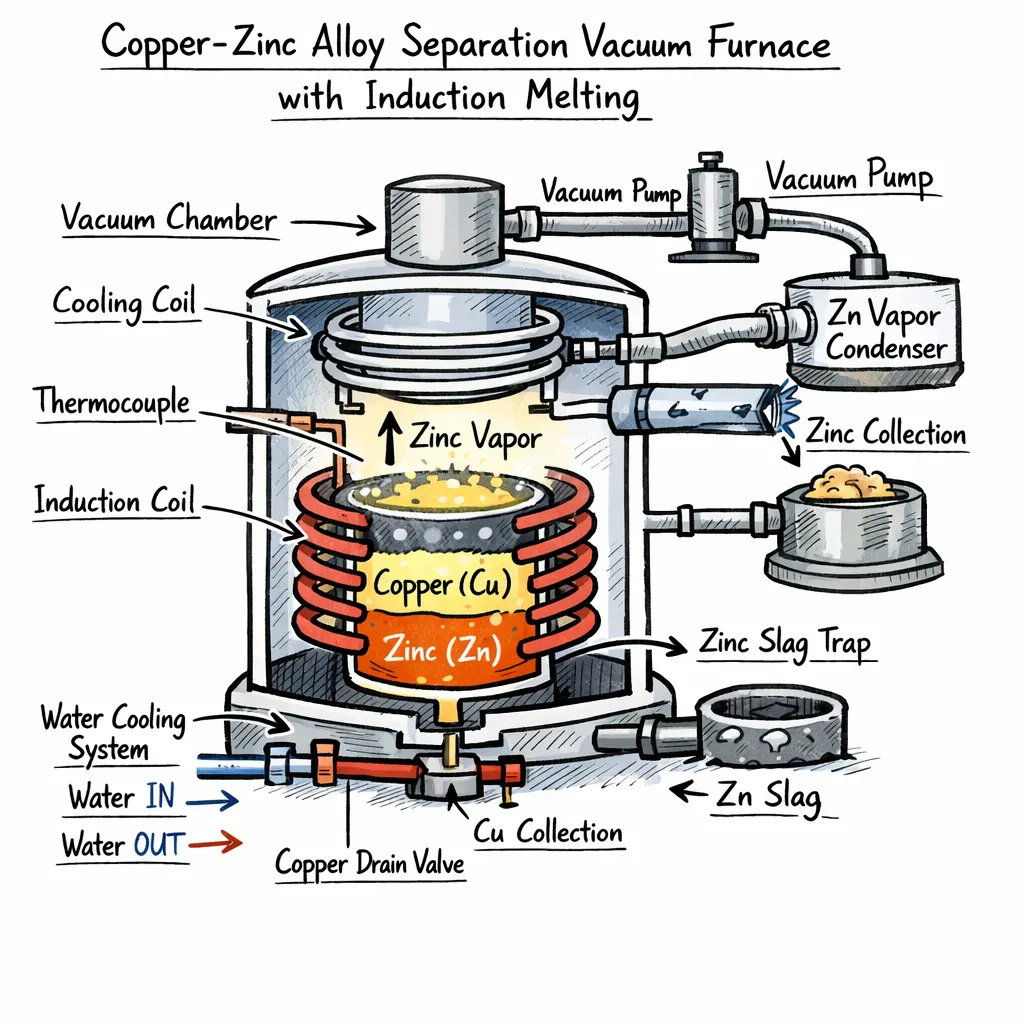
How to Separate Copper and Zinc Alloy (Brass)?-Vacuum Distillation Furnace
How to Separate Copper and Zinc Alloy (Brass)? A Technical Guide to Brass Recycling
If you are a metal recycler, brass mill operator, or sustainability engineer wondering how to separate copper and zinc alloy, you are tackling one of the most economically valuable challenges in modern non-ferrous metallurgy. Brass — a homogeneous alloy of roughly 60–70% copper and 30–40% zinc — cannot be split with magnets, screens, or mechanical sorting. Because the two metals are fully miscible in the solid state, separating them requires exploiting their dramatic differences in vapor pressure or chemical behavior. This guide explains every viable separation method, compares them on recovery, purity, energy, and cost, and shows why the induction-based copper zinc separation furnace from HLQ Induction Equipment Co.,Ltd at https://dw-inductionheater.com has become the industry standard for high-recovery, low-emission brass recycling.
Brass is not a mixture — it is a true alloy. Copper and zinc atoms occupy the same crystal lattice, forming either α-brass (face-centered cubic, up to ~37% Zn) or β-brass (body-centered cubic, 37–46% Zn). Because there is no physical phase boundary between the two metals, no amount of crushing, screening, magnetic separation, eddy-current sorting, or density sorting can isolate the copper from the zinc. To separate copper from brass, you must change the metal’s physical state — either by melting it and exploiting the enormous difference between zinc’s and copper’s boiling points, or by dissolving it and recovering each element through chemistry or electrochemistry.
Property
Copper (Cu)
Zinc (Zn)
Implication for Separation
Melting point
1,085 °C
419 °C
Both melt easily in induction furnace
Boiling point
2,562 °C
907 °C
Huge gap → distillation works
Vapor pressure at 1,100 °C
1.4 × 10⁻⁵ kPa
22.5 kPa
~10⁶ ratio — clean separation
Density
8.96 g/cm³
7.14 g/cm³
Density sorting impossible (alloy)
Standard electrode potential
+0.34 V
−0.76 V
Electrolytic separation possible
Solubility in H₂SO₄
Slow
Fast
Selective leaching possible
2. The Four Main Methods to Separate Copper and Zinc Alloy
Industry has developed four practical routes to separate copper and zinc alloy. Each route exploits a different physical or chemical property, and each has distinct advantages depending on feedstock, scale, and target purity.
The most widely deployed answer to “how to separate copper and zinc” is pyrometallurgical distillation inside an induction melting furnace. The brass scrap is loaded into a sealed crucible and heated to 1,000–1,150 °C by a medium-frequency induction coil. At this temperature zinc — with a boiling point of only 907 °C — vaporizes rapidly, while copper (boiling point 2,562 °C) stays a quiet liquid. An inert sweep gas (N₂ or Ar) carries the zinc vapor into a water-cooled condenser where it solidifies into metallic zinc ingots. The remaining refined copper is tapped directly from the crucible.
Recovery: ≥99% for both Cu and Zn
Purity: Cu ≥99.9% (cathode grade), Zn ≥99.95% (SHG grade)
Energy: 450–550 kWh per tonne — about half of fuel-fired methods
Cycle time: 60–180 minutes per heat
Emissions: Particulate matter <5 mg/Nm³ with bag-house filtration
CO₂ footprint: 40–60% lower than reverberatory furnaces
HLQ Induction Equipment Co.,Ltd manufactures the full range of induction-based copper zinc separation furnaces — from 250 kg pilot units to 5,000 kg fully automated production lines — at dw-inductionheater.com. Every system includes the medium-frequency power supply, induction coil, crucible, condenser, off-gas filtration, and PLC automation as a single integrated package.
4. Method 2: Vacuum Distillation
Vacuum distillation is a high-purity refinement of Method 1. By operating the induction furnace at 1–100 mbar, the effective boiling point of zinc drops, allowing it to evaporate even faster and at lower bath temperatures. The resulting zinc condenses with very few volatile contaminants (Pb, Cd) and routinely reaches 99.99% purity, equivalent to Z1/SHG grade used in batteries, pharmaceuticals, and specialty alloys.
Parameter
Atmospheric Distillation
Vacuum Distillation
Operating pressure
~1 atm (101 kPa)
1–100 mbar
Bath temperature
1,050–1,150 °C
900–1,050 °C
Zn purity
99.95%
99.99%
Cu purity
99.9%
99.95%
Capex
Medium
Medium-High
Best for
Standard recyclers
Premium-grade producers
5. Method 3: Hydrometallurgical Leaching
Hydrometallurgy dissolves the brass into solution using either acidic (H₂SO₄ + H₂O₂) or ammoniacal (NH₃/(NH₄)₂CO₃) chemistry, then recovers each metal in separate downstream steps. Copper is typically recovered by solvent extraction followed by electrowinning, while zinc is precipitated as carbonate or recovered by separate electrowinning. The route is well-suited for very low-grade, oxidized, or contaminated feedstocks where pyrometallurgy is uneconomic.
Pros: Handles dirty / low-grade scrap, lower temperatures, no smoke
Best for: Slag, dust, oxidized residues, heavily contaminated brass
6. Method 4: Electrolytic Refining
In electrolytic refining, brass is cast into anodes and immersed in an acidic copper-sulfate bath. When DC current is applied, copper preferentially deposits on the cathode (because of its higher standard electrode potential), while zinc remains in solution and is later recovered by zinc electrowinning. The method delivers ultra-high purity copper (99.99%+) but is slow and energy-intensive, so it is normally used as a polishing step downstream of pyrometallurgical separation rather than as a primary route for raw brass scrap.
7. Side-by-Side Method Comparison
Method
Cu Recovery
Zn Recovery
Cu Purity
Zn Purity
Energy (kWh/t)
CO₂ (kg/t)
Best For
Induction melting + Zn distillation
99.9%
99.5%
99.9%
99.95%
450–550
180–220
Standard brass scrap
Vacuum distillation
99.95%
99.9%
99.95%
99.99%
500–650
200–250
Premium-purity Zn
Hydrometallurgical leaching
~92%
~90%
99.9%
99.5%
700–900
400–500
Low-grade / dusts
Electrolytic refining
99.99%
(secondary)
99.99%
99.5%
800–1,200
300–400
Cu polishing step
Reverberatory furnace (legacy)
97%
70%
99.5%
97%
1,000–1,200
500–600
Outdated, high-emission
8. Step-by-Step: How an HLQ Cu-Zn Separation Furnace Works
The HLQ copper zinc separation furnace turns the science above into a fully automated production line. Here is exactly what happens during a typical heat:
Step
Stage
Time
Temperature
What Happens
1
Charging
5–10 min
Ambient
Brass scrap loaded into the induction crucible
2
Pre-heat / dry
10–15 min
up to 600 °C
Moisture, oils, plastics burn off under N₂ purge
3
Melting
15–25 min
600–950 °C
Entire charge becomes liquid brass
4
Holding / homogenize
10–15 min
950–1,000 °C
Electromagnetic stirring, slag removal
5
Zinc distillation
30–90 min
1,000–1,150 °C
Zn vaporizes, swept into condenser
6
Zn condensation
Continuous
200–450 °C (condenser)
Vapor solidifies into Zn ingots
7
Cu tapping
5–10 min
1,100–1,150 °C
Refined copper is cast into ingots / billets
8
QC + batch close
10–20 min
Cooling
Sample assay, traceability data logged
9. Economic and Environmental Considerations
Choosing how to separate copper and zinc alloy is not only a metallurgical question — it is a financial and ESG decision. The table below summarizes the key economic and environmental indicators that recyclers evaluate when sizing a new separation line.
Indicator
Induction Cu-Zn Furnace
Reverberatory Furnace
Hydrometallurgy
Direct production cost (USD/t)
$73–$100
$142–$208
$160–$240
Cu price capture
≥99%
97%
92%
Zn price capture
≥99%
70%
90%
Energy use (kWh/t)
450–550
1,000–1,200
700–900
CO₂ emissions (kg/t)
180–220
500–600
400–500
Wastewater
None
None
High
Particulate emissions
<5 mg/Nm³
30–80 mg/Nm³
n/a
Payback (typical)
8–18 months
3–5 years
3–6 years
10. How to Choose the Right Method for Your Operation
Use the decision matrix below to identify the most appropriate brass separation method for your business. In the vast majority of cases — particularly for recyclers, brass mills, plumbing/faucet manufacturers, and automotive component recyclers — the induction-melting + zinc-distillation route delivers the optimal balance of recovery, purity, energy efficiency, emissions, and payback.
Your Situation
Recommended Method
Recommended HLQ Model
Standard brass scrap, 1,000–10,000 t/yr
Induction melting + Zn distillation
HLQ-CZ-1000 / 1500 / 2500
High-throughput recycler, >10,000 t/yr
Induction melting + Zn distillation
HLQ-CZ-3500 / 5000
Premium Zn customers (battery, pharma)
Vacuum induction distillation
HLQ-CZ-V1000
R&D / pilot scale
Induction melting + Zn distillation
HLQ-CZ-250 / 500
Very low-grade dusts, oxide residues
Hydrometallurgy (often + induction polishing)
Hybrid line, custom
Cu cathode polishing
Electrolytic refining
Downstream of induction Cu
11. Why Choose HLQ
HLQ Induction Equipment Co.,Ltd is a vertically integrated manufacturer with more than 20 years of experience designing and exporting induction melting equipment and complete copper zinc recovery systems. The company controls every step from R&D and coil engineering to power-supply assembly, mechanical fabrication, factory acceptance testing, installation, and lifetime service support. Customers in over 60 countries rely on HLQ for turnkey, single-vendor solutions.
Custom engineering: Each system tailored to scrap mix, throughput, and target purity
End-to-end integration: Power supply, coil, crucible, condenser, off-gas, automation
Global service: Installation, commissioning, training, remote IoT diagnostics
Quality certifications: CE, ISO 9001, full FAT documentation
Direct-from-manufacturer pricing with no intermediaries
Comprehensive product line: 250 kg pilot units to 5+ tonne automated lines
Browse the full product portfolio, application videos, case studies, and contact form at https://dw-inductionheater.com.
12. Conclusion
You cannot separate copper and zinc alloy by mechanical means — but you can achieve near-perfect separation by exploiting the enormous difference in vapor pressure between zinc (boiling point 907 °C) and copper (boiling point 2,562 °C). The clear winner across recovery, purity, energy, emissions, and payback is the induction melting + zinc distillation route, with vacuum distillation, hydrometallurgy, and electrolytic refining serving specific niches. For virtually every brass recycler, mill, faucet maker, automotive remelter, and copper smelter handling zinc-bearing materials, an induction-based copper zinc separation furnace from HLQ Induction Equipment Co.,Ltd is the most economically and environmentally compelling choice in 2026.
To request a quotation, view live process videos, or speak with an HLQ application engineer about your specific scrap mix and throughput targets, visit https://dw-inductionheater.com. HLQ will respond with a tailored proposal — including process flow, equipment list, energy and emissions estimates, and pricing — within 24 to 48 hours.
13. Frequently Asked Questions
Q1. Can you separate copper and zinc with magnets or eddy-current sorters?
No. Brass is a single-phase alloy in which copper and zinc atoms share the same crystal lattice. There is no physical phase boundary, so mechanical, magnetic, and eddy-current sorting cannot separate the two metals. Thermal or chemical treatment is required.
Q2. What is the best method to separate copper and zinc alloy?
For nearly all industrial recyclers, induction melting plus zinc vacuum distillation is the best method. It delivers ≥99% recovery of both metals, cathode-grade copper, SHG-grade zinc, ~50% lower energy use than gas furnaces, and payback in under two years.
Q3. What temperature is required to separate copper from zinc?
The brass bath is typically held at 1,000–1,150 °C inside a sealed induction crucible. At this temperature zinc rapidly vaporizes (its boiling point is 907 °C) while copper (boiling point 2,562 °C) remains a quiet liquid.
Q4. Where does the zinc go after it evaporates?
The zinc vapor is swept by inert gas (N₂ or Ar) — or pulled by partial vacuum — into a water-cooled condenser, where it cools and solidifies into metallic zinc ingots or powder. Capture efficiency exceeds 99.5%.
Q5. How pure are the recovered copper and zinc?
HLQ atmospheric induction systems routinely deliver ≥99.9% Cu (cathode equivalent) and ≥99.95% Zn (SHG equivalent). Vacuum-distillation furnace versions can reach 99.99% Zn for premium markets.
Manage Consent
To provide the best experiences, we use technologies like cookies to store and/or access device information. Consenting to these technologies will allow us to process data such as browsing behavior or unique IDs on this site. Not consenting or withdrawing consent, may adversely affect certain features and functions.
Functional
Always active
The technical storage or access is strictly necessary for the legitimate purpose of enabling the use of a specific service explicitly requested by the subscriber or user, or for the sole purpose of carrying out the transmission of a communication over an electronic communications network.
Preferences
The technical storage or access is necessary for the legitimate purpose of storing preferences that are not requested by the subscriber or user.
Statistics
The technical storage or access that is used exclusively for statistical purposes.The technical storage or access that is used exclusively for anonymous statistical purposes. Without a subpoena, voluntary compliance on the part of your Internet Service Provider, or additional records from a third party, information stored or retrieved for this purpose alone cannot usually be used to identify you.
Marketing
The technical storage or access is required to create user profiles to send advertising, or to track the user on a website or across several websites for similar marketing purposes.